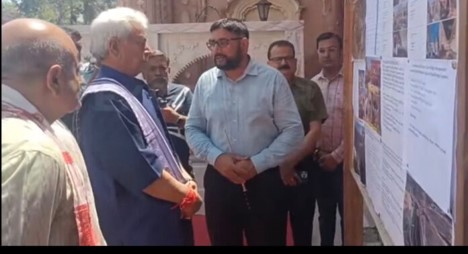
JAMMU, June 8: Lieutenant Governor Manoj Sinha on Monday visited the historic Mubarak Mandi heritage complex and inspected the damage caused to the nearby Gadadhar Temple, where a portion of the boundary wall collapsed following recent rainfall.
Accompanied by Chief Secretary Atal Dulloo, the Lt Governor reviewed the ongoing restoration and conservation works at the heritage complex and assessed the repair work underway at the nearly 200-year-old temple.
A section of the wall of the Gadadhar Temple, located adjacent to the Mubarak Mandi complex, collapsed on June 4 after heavy rain, sparking concerns among local residents who alleged that ongoing excavation and restoration activities near the shrine contributed to the damage.
Addressing reporters, Dulloo said restoration and renovation work is currently underway on 11 buildings within the heritage complex, with nine to 10 projects nearing 80 to 90 per cent completion and expected to be finished by March 2027.
He said a parking facility capable of accommodating around 200 vehicles is being developed by Smart City Limited to address parking shortages in the area. During the construction work, a slab adjoining the temple collapsed, but repair work has already begun and is likely to be completed within a few days.
Dulloo said additional projects, including a laser show, light-and-sound show and other visitor amenities, are also planned as part of the heritage development initiative.
Located in the heart of Jammu’s old city overlooking the Tawi River, Mubarak Mandi served as the royal residence of the Dogra rulers until 1925, when the last Maharaja shifted to Hari Niwas Palace. The complex was declared a protected monument in 2005, and the Mubarak Mandi Jammu Heritage Society was formed the following year to oversee its preservation and restoration.
The conservation project is being implemented under a comprehensive master plan approved in 2019, with an estimated expenditure of Rs 144.15 crore on various sub-projects. The complex has been divided into multiple zones, including public spaces, knowledge centres, galleries, experiential areas and a crafts bazaar.
The Chief Secretary attributed delays in some works to inadequate funding in earlier years but said the pace of execution had accelerated over the past four to five years. He noted that facilities such as a restaurant, café and library have already been developed as part of the restoration programme and assured that additional conservation work would be undertaken wherever required. (Agencies)