By Rahul Singh
In an era when regional identities across India are being rediscovered and celebrated, Dogri theatre stands as both a remarkable cultural achievement and a troubling example of neglect. Rich in folklore, music, performance traditions, and social resistance, Dogri theatre has travelled a long journey from obscurity to national recognition. Yet, despite its artistic depth and historical relevance, it continues to struggle for institutional support, wider audiences, and sustained cultural preservation.
The story of Dogri theatre is not merely about stage performances. It is the story of a people reclaiming their language, dignity, and cultural memory after decades of marginalisation. At the heart of this cultural awakening was the formation of the Dogri Sanstha in 1944 under the leadership of Prof. Ram Nath Shastri. At a time when Dogri-speaking people were made to feel culturally inferior and their language had been pushed aside by official preference for Urdu and Persian, the Sanstha emerged as a revolutionary movement. It sought not only to revive Dogri literature but also to restore pride among Dogras.
The conditions before Independence were bleak. Dogri literature was almost non-existent in written form, and educated Dogras often hesitated to speak their mother tongue publicly. Folk traditions survived in villages, but they remained ignored by mainstream cultural institutions. Against this backdrop, the pioneers of Dogri literature and theatre performed a historic task. They transformed a neglected language into a powerful medium of artistic and social expression.
The evolution of Dogri theatre after Independence mirrors the cultural journey of Jammu and the larger Duggar region. Writers and theatre practitioners realised early that literature alone could not fully capture the emotional and social realities of Dogra life. Theatre became the living bridge between language and people. Through plays, folk forms, songs, and storytelling traditions, Dogri theatre carried the voices of farmers, labourers, women, and ordinary citizens onto the stage.
Yet Dogri theatre developed under difficult circumstances. Unlike many established theatrical traditions of India, Dogri theatre lacked a continuous institutional structure. Political turmoil, repeated wars, displacement, and the partition of the region disrupted cultural continuity. Many traditional forms either weakened or disappeared entirely. The region that once nurtured vibrant folk traditions became divided geographically and psychologically after Independence.
Despite these challenges, Dogri theatre retained its creative spirit through folk forms such as Geetru, Kud, Karak, Bhakh, and Tudd. These traditions may not fit neatly into classical definitions of theatre, but they contain powerful dramatic elements. The solo narrative strength of Tudd, the musical storytelling of Geetru, and the emotionally charged ballads of Karak demonstrate that Dogri performance culture possessed remarkable theatrical potential. The problem was never artistic weakness; it was the absence of sustained patronage and cultural stability.
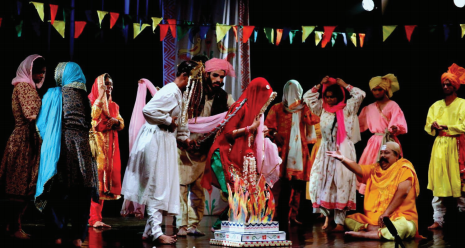
Perhaps no production symbolises the strength of Dogri theatre more than the legendary play Bawa Jitto. Written by Prof. Ram Nath Shastri and later transformed into a landmark production by Balwant Thakur and the theatre group Natrang, Bawa Jitto gave Dogri theatre national and international visibility. Based on the story of a peasant saint who sacrificed his life against feudal oppression, the play resonated deeply with audiences because it connected folklore with contemporary concerns of justice and dignity.
More importantly, Bawa Jitto revived several fading folk traditions by integrating them into modern theatre. Art forms such as Jatar, Karak, Geetru, Kud, and Bhakh found new life on stage. What was once dismissed as rural performance suddenly became a source of cultural pride. Through more than 150 performances across India, the production demonstrated that regional theatre could speak a universal language without losing its roots.
The success of Bawa Jitto also challenged a long-standing misconception that regional theatre cannot travel beyond its linguistic boundaries. In truth, audiences respond to emotional honesty and artistic authenticity far more than to language barriers. Dogri theatre succeeded whenever it remained rooted in local realities while addressing universal human concerns.
Another important pillar in the development of Dogri theatre has been the Jammu and Kashmir Academy of Art, Culture and Languages. Since its establishment in 1958, the Academy has played a crucial role in promoting local theatre through financial assistance, drama festivals, and institutional support. Its annual drama festivals introduced audiences to a wide range of Dogri plays and adaptations, helping local artists sustain theatrical activity in difficult times.
Over the decades, Dogri theatre has produced an astonishing body of work. From Vishwanath Khajuria and Dinu Bhai Pant to Narsingh Dev Jamwal, Mohan Singh, Kumar A. Bharti, Rattan Doshi, and Balwant Thakur, generations of playwrights enriched the language with social dramas, historical narratives, political satire, and experimental productions. Adaptations of Shakespeare, Tagore, Girish Karnad, Vijay Tendulkar, and Sophocles into Dogri further proved the creative flexibility of the language.
Yet despite this rich heritage, Dogri theatre remains under-recognised nationally. Regional theatre groups continue to face financial insecurity, shrinking audiences, and inadequate infrastructure. Young artists often migrate towards cinema, television, or digital platforms because theatre offers little economic stability. Cultural policies frequently celebrate diversity in speeches while failing to invest seriously in regional arts.
This neglect would be a tragic mistake. Dogri theatre is not merely entertainment; it is a living archive of history, memory, resistance, and collective identity. At a time when cultural homogenisation threatens India’s linguistic diversity, preserving regional theatre traditions becomes essential for the country’s democratic and cultural health.
The future of Dogri theatre depends on more than nostalgia. It requires active intervention. Educational institutions must include Dogri dramatic literature in curricula. Government bodies should establish dedicated repertory companies, grants, and touring circuits for regional theatre. Digital archiving of scripts and performances is urgently needed before valuable material disappears. Most importantly, younger generations must be encouraged to engage with their language not as a relic of the past but as a creative force for the future.
Dogri theatre has survived invasions, partition, political instability, and cultural neglect. Its resilience itself is extraordinary. The question now is whether India is willing to recognise and nurture this cultural inheritance before another generation of artistic memory fades into silence.