
By Girdhari Lal Raina, Ex-MLC
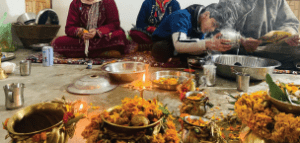
In Kashmir, Mahashivratri—known to Kashmiri Pandits as Herath—is far more than a date on the religious calendar. It is a civilisational marker, a reminder that faith can endure even when history turns hostile. Every ritual associated with Herath carries layers of memory, but few are as symbolically charged as the tradition of salaam.
To many observers today, the practice is framed as a sign of syncretic culture. Harmony is a noble aspiration, and shared cultural spaces deserve appreciation. Yet, to fully understand the salaam, one must look beyond contemporary interpretations and engage with the deeper historical memory preserved within the community itself. For Kashmiri Pandits, the ritual is not merely etiquette—it is remembrance, shaped by a time when survival demanded both courage and quiet assertion of identity.
Community memory traces the origins of this practice to the brief but turbulent rule of Jabbar Khan, the last Afghan governor of Kashmir under the Durrani Empire. The late Afghan period (1752–1819) witnessed sustained instability and widespread hardship. Resistance took many forms. Political leadership among Kashmiris sought structural change, while ordinary communities relied on cultural continuity to preserve identity.
One of the most significant political initiatives of the time involved Birbal Dhar, who undertook a mission to Lahore in 1819 to appeal to Maharaja Ranjit Singh for intervention. His effort reflected a broader sentiment within sections of Kashmiri society that Afghan rule had become untenable. While diplomacy and strategy unfolded at the elite level, the social fabric of the community responded in quieter but equally meaningful ways—through rituals that sustained morale and identity.
Jabbar Khan’s tenure occupies a particularly dark place in the Valley’s historical consciousness. Accounts from chronicles and community histories describe an atmosphere of repression marked by heavy taxation, administrative excesses, and restrictions that weighed heavily on the Hindu population, especially the Pandits. Whether every detail is preserved in documentary precision or carried through oral memory, the emotional truth of the period remains powerful: a society under pressure yet unwilling to surrender its spiritual core.
It is within this context that the salaam acquires its real significance. Rather than a gesture of submission, it evolved into a subtle assertion of continuity—a way of navigating authority without relinquishing identity. Rituals often emerge from necessity, but over generations they become repositories of collective memory. The salaam at Herath thus stands as a reminder that dignity can survive even under constraint.
Herath itself reinforces this message each year. The festival commemorates the cosmic union of Shiva and Shakti, but for Kashmiri Pandits it has also historically symbolised endurance. Celebrating Herath meant reaffirming belonging—to faith, to land, and to a lineage that refused erasure. The rhythms of worship, family gatherings, and inherited customs became acts of cultural persistence, quietly defying the uncertainties of their time.
The political turning point came in 1819, when the forces of Maharaja Ranjit Singh, led by General Misr Diwan Chand, defeated the Afghan army near Shopian. The collapse of Afghan rule ended decades of external domination and ushered in a new administrative phase. Yet history does not end with regime change. The memories of hardship, and the resilience forged through it, remained embedded in the community’s cultural consciousness.
Among the most evocative memories is the folklore linked to Herath. Oral tradition recounts that to mock the Pandit belief that snow invariably falls on Shivratri, Jabbar Khan ordered the festival to be observed in peak summer. The community, according to the story, responded with prayers and a prolonged yagna near Sharika Peeth, after which an unseasonal snowfall was said to have occurred, giving rise to the well-known satirical saying:
“Wuchhton yih Jabbar, Jandah, Haaras tih karun wandah”
(Look at Jabbar, the wretch — even spring turned into winter.)
Whether interpreted as literal history or symbolic narrative, the episode illustrates the central theme of Herath’s memory: faith as a source of moral strength. Folklore, after all, often preserves emotional truths even when empirical details remain debated.
Understanding these layers is essential because traditions stripped of context risk being reduced to decorative symbols. When the salaam is presented solely as a gesture of cultural fusion, a crucial dimension of its meaning disappears. It is not only about coexistence; it is about endurance. It reflects how a community negotiated difficult circumstances while safeguarding its inner core.
This distinction carries relevance for contemporary discourse. Kashmir’s past is often framed through political binaries, yet the lived experiences of its communities reveal more nuanced realities. For Kashmiri Pandits, identity has frequently been preserved through continuity rather than confrontation—through rituals practiced in homes, prayers carried across generations, and customs that encode collective memory.
Herath therefore stands at the intersection of remembrance and renewal. It reminds us that cultural survival is neither accidental nor automatic; it requires conscious transmission. Each generation inherits not just rituals but the responsibility to understand their meaning and sustain their spirit.
The story of the salaam ultimately invites a broader reflection on how societies remember. Genuine harmony does not require forgetting; it rests on acknowledging history in its fullness—its pain, perseverance, and lessons. Recognising the resilience embedded in such traditions does not weaken the idea of coexistence; it strengthens it by grounding it in truth rather than abstraction.
Each year, when the chants of Har Har Mahadev echo during Herath, they carry more than devotional fervour. They echo centuries of continuity, reminding us that faith is preserved as much in memory as in ritual. The salaam becomes, in this sense, a bridge between past and present—a quiet salute not just to a festival, but to the enduring spirit of a people.
In an age that often prizes immediacy over memory, Herath offers a simple yet profound lesson: cultures endure because communities choose to remember. And in that act of remembrance lies dignity, continuity, and strength—steady, composed, and undefeated.
(Girdhari Lal Raina is a former MLC and spokesperson of BJP JK-UT)