Puran Chand Sharma
Recently in January 2026, University Grants Commission,(UGC), India’s statutory Regulator for higher education has notified the promotion of Equity in Higher education Institutions Regulations, 2026, replacing the earlier 2012 anti – discrimination framework with rules that are legally binding and enforceable across all universities and colleges.
Key Provisions:-
– Establishment of Equal Opportunity Centers and Equity committees at every institution to address caste related discrimination.
– Mandatory help-lines, grievance redressal, reporting and monitoring systems.
– Designated equity Squads to oversee compliance and prevent discriminatory conduct.
The regulations explicitly define caste based discrimination in campuses and place institutional responsibility on colleges to act swiftly on complaints.
The UGC and Government justify these rules by pointing to a rising trend of caste related complaints in academic institutions; official data shows a more than 100% increase in reported cases over five years.
WHY it triggered severe controversy:
The backlash is widespread from students, political figures, faculty associations and even government bureaucrats, and has several reported components:
A PERCEIVED bias against General Category Students:
Let us explore and find out the truth. Critics at this point of time argue as under:-
– Lopsided focus on protection to Scheduled castes (SC), Scheduled Tribes (ST) and other Backward Classes (OBC) alone.
– Authorities do not extend equivalent protection or grievance structures to general category students.
– There is lack of clear safeguards against false or malicious complaints.
These factors have alarmed many general category students who feel vulnerable under the new system.
VAGUE DEFINITIONS AND ENFORCEMENT MECHANISMS:
Opposition groups point out that terms like ‘implicit discrimination” are open to interpretation, which could lead to misuse or arbitrary application. Quick timelines for action (e.g. 24 hours to act on a complaint) without due process clarity raises fears of unfair treatment.
POLITICAL AND SOCIAL MOBILIZATION:
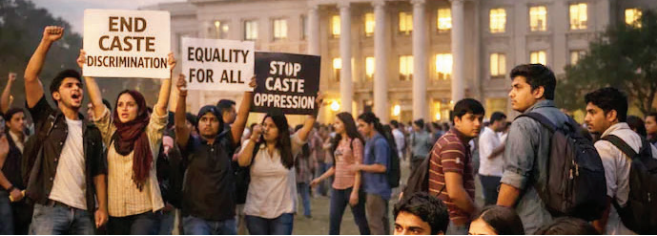
Protest have erupted across campuses and cities (e.g. Lucknow University demonstrations) and even led to politically symbolic resignations, including a Bareilly city magistrate calling the regulations a “BLACK LAW”.
LEGAL CHALLENGES:
PILS have been filed in the Supreme Court contesting provisions that define discrimination too narrowly and alleging constitutional violations for denying equal protection to general category students. In essence, many feel that in trying to fix a long-standing problem, the new regulations have created an atmosphere of distrust, fear and perceived reverse discrimination on campuses.
WHY DID THE GOVERNMENT AND UGC LET THE CONTROVERSY HAPPEN?
The Government and UGC ‘let it happen’, not due to malice and or deliberate exclusion, but due to convergence of haste, centralized thinking, weak consultation and political miscalculation. The question as to why did the Government and the UGC let it happen- demands an examination of Institutional behaviour, governance culture and reform agency rather than attributing it to a single lapse.
REFORM URGENCY DRIVEN BY NATIONAL EDUCATION POLICY – 2020
The Government being under pressure to rapidly implement the National Education Policy 2020, which envisions:
– Standardization and quality enhancement
– Centralized benchmarks for appointments and governance.
– Outcome based accountability.
In this urgency, procedural caution must have been sacrificed to demonstrate reform momentum. The UGC acting as an implementing arm, prioritized speed over consensus, assuming that resistance would fade once guidelines were notified.
TECHNOCRATIC APPROACH OVER DEMOCRATIC PROCESS
Both the Government and the UGC adopted a top-down, technocratic mindset:
– Policy drafting was driven by experts and committees.
– Ground realities of State Universities were underestimated.
– Social implications, especially regarding reservation against, were treated as secondary.
This approach ignored the fact that education in India is not merely administrative, it is deeply political and social.
SUPREME COURT STAY, WHY IT MATTERS
The Supreme Court intervened and granted the stay on the implementation of UGC Guidelines, indicating prima facie concerns.
SIGNIFICANCE OF THE STAY:
The Stay prevents irreversible administrative changes,
– Upholds the principle that executive guidelines cannot override the constitutional mandates.
– Reinforces judicial scrutiny over policy actions affecting fundamental rights.
– The stay is not rejection of reform but a reminder that process and constitutionality matter as much as intent.
THE WORKABLE AND SUSTAINABLE SOLUTION
A balanced path forward:
- PAUSE AND REVIEW MECHANISM:
In this case we need to set up an expert committee consisting of Constitutional scholars, educationists, state representatives and social stakeholders.
- Stakeholders-driven Consultation:
Adopt a bottom-up approach, respecting diversity among central, state and regional universities.
- Constitutional compliance audit:
Ensure every guideline explicitly aligns with constitutional provisions and Supreme court jurisprudence.
- PHASED AND OPTIONAL ADOPTION
Allow universities flexibility with graded implementation instead of rigid timelines.
- Parliament Oversight
Sensitive reforms should be debated in Parliament to enhance legitimacy and trust.
CONCLUSION
Now when the matter pertaining to new UGC guidelines has been stayed by the Honourable Court and is under their active consideration for final verdict, one and all across the National horizon must stay cool and wait for the Hon’ble court’s decision. We are passing through the critical times in this significant twilight hour replete with severe challenges. It shall be, therefore, prudent not to get embroiled in petty politics and squander away the valuable national time in wasteful protests and undesirable bickering.
As the country is well poised to achieve the coveted top spot amongst the comity of nations we, as responsible citizens must be aware and cautious of our filial obligations and duties.
The UGC guidelines controversy is not merely administrative dispute, it is, in fact a test of India’s commitment to constitutional values, social harmony and cooperative federalism. Reform is essential but reform divorced from dialogue and constitutional wisdom risks instability. The Supreme Court stay provides an opportunity to reset, recalibrate and reform responsibly, ensuring that higher education remains a vehicle for both excellence and equity.
We need to handle such sensitive matters with great responsibility and accountability, No room should be left open for exploitation and misuse from any quarters, observing very strictly the related rules and other significant do’s and don’ts.
The Hon’ble Minister concerned must be extraordinarily vigilant and proactive in such significant issues which if not tackled with proper care and due caution can explode and stir the hornet’s nest endangering the communal harmony, mutual understanding and long lasting peace for ultimate Developed India.
Hope, we sooner come out of the Caste Web for the ultimate and holistic national upliftment. Jai Bharat.
– (Author is President, Ved Mandir, Amphala, Jammu)