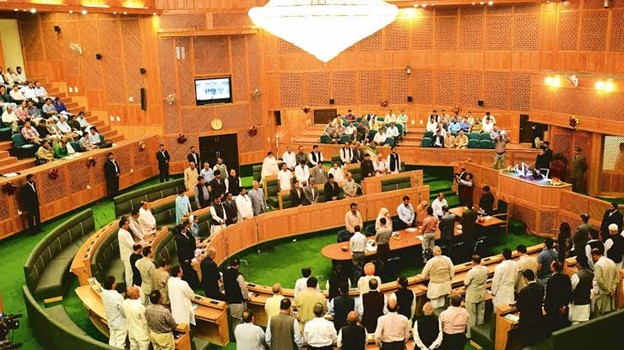
JAMMU, Feb 13: The Jammu and Kashmir Legislative Assembly on Friday witnessed heated exchanges over the sale of rotten and unsafe meat, with members across party lines demanding stringent action, stronger enforcement and even attachment of properties of those involved, while the Government admitted staff shortages and clarified that arrests are not within the powers of Food Safety Officers.
The issue was raised through Assembly Question Nos. 10, 94, 569 and 757 by MLAs Mubarak Gul, Mir Saifullah, Pirzada Farooq Ahmad Shah and Hasnain Masoodi on “Food Adulteration and Sale of Rotten Meat.” Members voiced concern over public health risks, alleging that consumption of contaminated food could be contributing to rising cancer cases and frequent disease outbreaks.
Replying to the debate, Health Minister Sakina Itoo acknowledged manpower shortages in the department, stating there was “no denial” about the deficiency and informing the House that the recruitment process has been initiated. She clarified that under the Food Safety and Standards Act, 2006, Food Safety Officers are empowered to inspect premises, lift samples, suspend or cancel licences and launch prosecutions, but arrests can only be made by police under the Criminal Procedure Code.
Speaker Abdul Rahim Rather asked why the Government does not consider bringing an amendment to the Act if stronger provisions are required. National Conference MLA Tanvir Sadiq suggested constituting a separate task force and exploring amendments, noting that police is not under the control of the House.
Earlier, in a written reply, the Government informed the House that 12,183.5 kg of rotten or unsafe meat and chicken worth ₹29,19,060 were seized and destroyed during the current financial year 2025-26 (up to December 2025) across the Union Territory. A total of 1,676 inspections were conducted and 144 meat samples lifted, of which 18 were found Not of Standard Quality (NSQ). Additionally, 2,139 kg of meat worth ₹3,90,137 was seized.
District-wise destruction included 700 kg in Anantnag, 234 kg in Budgam, 162 kg in Bandipora, 125 kg in Baramulla, 770 kg in Ganderbal, 1,520.5 kg in Kupwara, 450 kg in Pulwama, 121 kg in Shopian, 4,220 kg in Srinagar and 3,881 kg in Jammu.
The Government further disclosed that 173 paneer samples were lifted, of which 157 reports were received; 47 were found sub-standard and one unsafe. A total of 7,665 kg of paneer worth ₹16,32,150 was seized or destroyed, including 6,465 kg in Jammu and 1,200 kg in Samba. Samples were tested in accredited laboratories within and outside J&K, including facilities in Kashmir, Ghaziabad, New Delhi and Hyderabad.
Two NABL-accredited Food Testing Laboratories are functional in Jammu and Srinagar, along with 12 Mobile Food Testing Laboratories. However, out of 19 sanctioned posts each in the Jammu and Srinagar labs, 11 posts remain vacant in both. The vacant posts will be referred to the J&K Services Selection Board after finalisation of recruitment rules with concurrence of the Finance Department, while outsourced staff are being engaged through funds provided by FSSAI under the Annual Work Plan.
The Government reiterated that enforcement under the Food Safety and Standards Act is a statutory mechanism involving inspection, sampling, adjudication and prosecution and does not provide for routine registration of FIRs for every violation. The issue remained a focal point in the House, with legislators demanding tougher measures to safeguard public health. (KNC)