42 out of 50 seats in first MBBS batch from Muslim community allocated by the JK BOPEE to shrine-funded institute
Jammu Tawi, Nov 5: The release of the maiden MBBS admission list for the newly established Sri Mata Vaishno Devi Institute of Medical Excellence (SMVDIME) in Katra has sparked an intense public debate across Jammu and Kashmir. Questions are being raised over the selection process, the role of the J&K Board of Professional Entrance Examinations (JK BOPEE), and the religious composition of the inaugural batch at an institution funded entirely by the Shri Mata Vaishno Devi Shrine Board (SMVDSB) — a statutory Hindu religious body.
According to the J&K NEET-UG 2025 admission list issued by BOPEE, out of the 50 students selected for the first MBBS batch at SMVDIME, 42 belong to the Muslim community while only eight are from the Hindu community. The data has triggered a wave of reactions — ranging from concern among sections of devotees and social organizations to calls for structural review of the admission process.
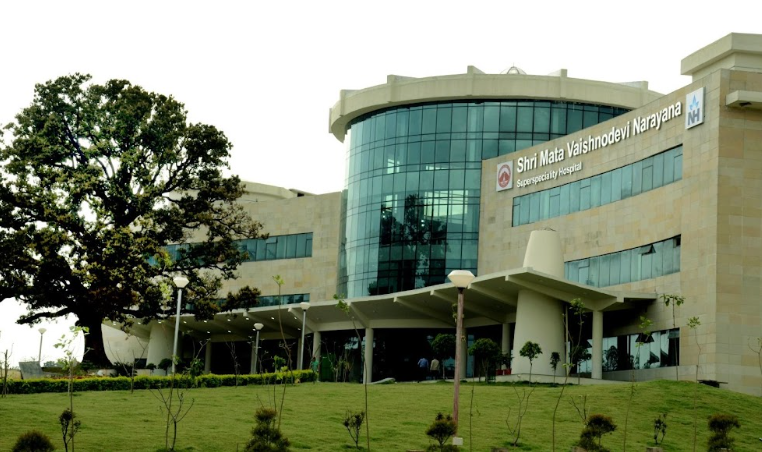
The SMVD Shrine Board, constituted in 1986 to manage the revered Mata Vaishno Devi temple, had envisioned SMVDIME as a state-of-the-art medical institution to promote healthcare and medical education in the region. The project, completed at a cost of ₹500 crore, was financed entirely through donations made by Hindu pilgrims visiting the shrine. The Board already operates the Shri Mata Vaishno Devi College of Nursing and the SMVD Super Speciality Hospital as part of its expanding social welfare initiatives.
However, the current controversy appears to have caught the Shrine Board off guard. Sources within the Board admitted that while the admissions were conducted under BOPEE’s jurisdiction, the implications of demographic imbalance were “unforeseen.” This conflation of disproportionate ratio in allocation of Muslim-Hindu students may throw a serious challenge in days to come for both the management and the students from the J&K’s majority community for their different and sometimes conflicting religious sensitivities, values, beliefs, conduct, food habits while at the campus and hostels.
Questions Over BOPEE’s Role and Admission Process
Observers have pointed out that the BOPEE’s Information Brochure 2025 did not list SMVDIME among the affiliated MBBS/BDS colleges under its purview. This omission has led to confusion about how the entrance and counselling process was extended to the Shrine Board-run medical college.
An official in the know described the situation as “procedurally ambiguous,” adding that “any institution outside the BOPEE brochure should ideally have had a formal affiliation notification before admissions were made.”
BOPEE officials, however, maintain that the process followed the NEET-based national merit system, which allows centralized counselling for all recognized colleges once approval is granted by the National Medical Commission (NMC).
Affidavit and Code of Conduct Clause Raises New Concerns
Adding another layer to the debate is a clause in the SMVDIME’s Annexure-I Affidavit that requires all students to pledge adherence to institutional values. The affidavit, attested by a First-Class Magistrate, states:
“I will ensure that non-vegetarian food in any form is not consumed, cooked, or served in the University/College/Hospital premises of SMVDIME.”
The clause aligns with the religious ethos of the Shrine Board and the vegetarian traditions of the Mata Vaishno Devi temple complex. However, there is no explicit mention of any stringent disciplinary measures or penalties for violations like termination or expulsion, but only a general statement that the student “shall be personally responsible for consequences arising thereupon.”
Critics argue that such soft provisions could lead to conflicts if students belonging to other faiths express dietary or religious preferences inconsistent with the institution’s norms.
Public Reaction and Political Overtones
The demographic composition of the first batch has drawn criticism from certain right-wing groups, including the Bajrang Dal, which staged a demonstration in Jammu, alleging that the admissions reflected “disregard for the sentiments of devotees whose donations built the institution.”
Bajrang Dal leader Rakesh Kumar Bajrangi claimed that the “disproportionate selection” could lead to “future communal tension” if students begin demanding space for religious practices or non-vegetarian meals. He urged the Shrine Board to ensure that the institution’s spiritual identity and code of conduct are preserved.
At the same time, moderate voices within civil society have cautioned against turning the issue communal. Social analyst and education expert Prof. Ramesh Zutshi said, “The NEET system is merit-based and secular by design. It would be unconstitutional to introduce religious criteria in admissions. However, the Shrine Board could coordinate with authorities to ensure that institutional values are respected by all students, irrespective of faith.”
Balancing Faith, Law, and Institutional Autonomy
In the context of the prevailing national scenario, where minority-managed educational and professional institutions exclusively confine admissions to students of their own faith, the episode has raised a complex question: Should a religiously managed Hindu charitable institution not be allowed to maintain its faith-based traditions while reasonably adapting to the secular, merit-driven framework of higher education in India?
Legal experts suggest that the SMVD Shrine Board, being a statutory body under the Jammu & Kashmir legislature, functions under public accountability and cannot prescribe religion based admissions. However, it may frame internal conduct codes within constitutional limits.
Former Advocate General S.C. Sharma noted, “The Shrine Board cannot violate Article 15, which prohibits discrimination in educational access on religious grounds. But as the funding body, it can ensure that certain ethical and cultural standards are not challenged but followed within the campus environment.”
Looking Ahead: Need for a Regulatory Framework
Analysts believe the current controversy underscores the urgent need for a regulatory framework to manage faith-based educational institutions established through religious endowments but functioning under public educational systems.
Education policy researcher Dr. Samina Altaf said, “Faith-funded institutions often enter grey zones when national merit systems intersect with cultural identity. There must be clear guidelines balancing inclusivity with institutional integrity.”
As of now, the Shrine Board has not issued an official statement addressing the concerns over admissions or the demographic composition of the first batch. BOPEE officials, too, have refrained from making public comments beyond affirming that “the process was transparent and merit-based.”
However, within sections of the public and social media, the issue continues to generate intense debate — not just about representation, but also about the broader questions of coexistence, secularism, and respect for institutional ethos in a multi-religious society.
A Test Case for the Future
The SMVDIME episode is emerging as a test case for how faith-based public institutions can navigate the balance between devotion and diversity. While the establishment of the medical college marks a significant milestone in Jammu’s healthcare infrastructure, it also presents a challenge for policymakers and administrators — to ensure that inclusivity coexists with respect for tradition.
As the first batch of students prepares to begin their medical journey, all eyes are now on how the institution manages this delicate equilibrium in the years ahead and how far the Muslim student avoid any regimentation keeping their faith above their academic pursuit and respect the religious sensitivities of the Institution fully funded by a Hindu shrine.