By Puran Chand Sharma
On Oct. 2 this year, India celebrated Vijaydashmi. The day also coincided with birth anniversaries of two great leaders of India. One was Mahatma Gandhi and the other was the former Prime Minister Lal Bahadur Shastri. The day was an occasion to reflect upon the evolution and significance of the festival in the modern context.
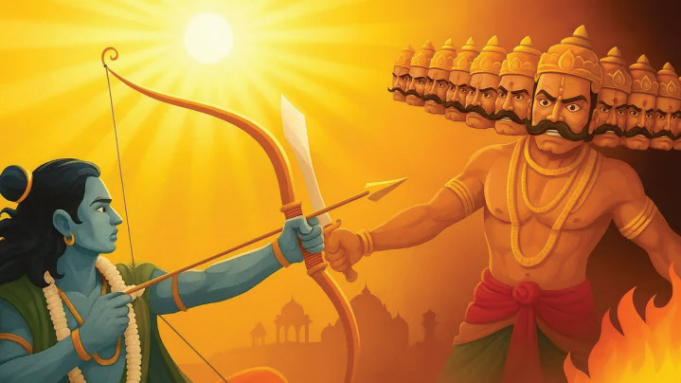
Our beloved country Bharat is prominently a sacred haven for innumerable festivals being celebrated across the national horizon from time to time with great fervor and tremendous ecstasy, recharging the whole society with enthusiasm and positive energy. Festivals in India are not merely seasonal markers or cultural festivities, but they are deeply embedded in the country’s philosophical and ethical consciousness. Amongst these, Vijaydashmi, popularly known as Dussehra, stands as one of the most significant festive event. Traditionally celebrated on the tenth day of the bright fortnight (Shukla Paksha) of the Hindu lunar month of Ashwin, the festival symbolizes the eternal victory of good over evil, truth over falsehood and righteousness over arrogance. While its religious foundation is drawn from the Ramayana (Lord Rama’s conquest over Ravana) and the Devi Mahamaya (Durga’s victory over Mahishasura), the festival has grown into something larger: a force that triggers social, national and spiritual rejuvenation. In a rapidly changing world, where modern challenges often blur moral boundaries. Vijay Dashmi continues to remind individuals and communities of their responsibilities to uphold Dharma, justice and unity. In Bhagavada Gita, Shree Krishana declares, “Whenever there is decline of righteousness and rise of unrighteousness, I manifest myself to protect the good, to destroy the wicked and to establish Dharama.” This captures the essence of Vijayadashmi — Good ultimately prevails.
Political and National life:
Post 1947 period, Vijayadashmi continued to be observed not only as a religious festival but also as a symbol of national renaissance. Independent India had to fight its own Ravanas such as poverty, illiteracy, communal disharmony and inequality. India’s leaders consciously drew parallels between these challenges and the struggle of Rama against Ravana.
It is further observed that Pt. Jawahar Lal Nehru soon after assuming charge as first P.M. reminded the people that democracy and development were not gifts but victories to be constantly safeguarded. Dussehra celebrations were seen as a reminder that internal vigilance is urgently required for freedom.
It is also remarkably and very significantly noted that RSS (Rashtriya Swayamsevak Sangh ), the largest NGO across the globe, well known for discipline and cultivating patriotism amongst the youth in the country, celebrate Vijayadashmi as its foundation day (1925) every year. It is notable that right from Independence, its annual Dussehra address has been a platform to discuss national priorities, cultural identities and social responsibilities. The RSS cadres also perform SHASTAR POOJAN on the occasion of Vijayadashmi every year.
Military and Strategic Associations
Dussehra retains its martial connection even in modern India. The Indian Armed forces celebrate the day with great reverence:
*Shastar or Ayudha Puja is performed in the Army and Paramilitary forces, where weapons, vehicles, and machinery are decorated and worshipped as symbols of national security and defense.
*Vijaydashmi parades often highlight India’s military readiness, echoing the historical tradition of kings embarking on campaigns on this auspicious day. In the year 2016 when surgical strikes were conducted across the border, leaders and media frequently used the Vijayadashmi metaphor, calling the action a symbolic burning of Ravana of Terrorism.
Socio—cultural Renaissance in Modern India:
Over the years it has been observed that whereas the effigies of Ravana are now crafted not merely as traditional demons but also representing modern evils like corruption, dowry, drug addiction, female foeticide and environmental degradation etc. Burning effigies of these is intended to raise social consciousness.
Cultural Diplomacy and Global Relevance
At this critical juncture we find that Indian diaspora has been registering exponential increase across the global horizon. Accordingly, Vijayadashmi has become a global cultural symbol from Ramlila performances in London and New York to effigy burnings in South Africa, Mauritius and Fiji. There is no denying the fact that Vijaydashmi festival has become an assertion of Indian Identity abroad. This substantially contributes not only to cultural continuity but also to soft power projecting India’s civilizational values of righteousness and resilience.
Social, National and Spiritual Impact: Lessons for 21ST Century India
In post-Independence and contemporary India, Vijayadashmi’s message has been
reinterpreted in ways that directly address the challenges of modern life: *Socially: The fight against casteism, gender inequality and communal divisions is symbolised through the burning of new age Ravanas. *Nationally: Vijyayadashmi is invoked to remind citizens of the unity required to realize the dream of Viksit Bharat @2047. Prime Minister Narendra Modi, in his Vijayadashmi addresses, often emphasizes the significance of eradicating corruption, terrorism, and all kinds of divisive forces.
*Spiritually: In a fast paced materialistic world, Vijayadashmi revives the call for mindfulness, ethical living and harmony with nature which are vital for mental well-being.
Conclusion
From the epic battlefields of Lanka to the freedom struggle and challenges of independent India, Vijayadashmi has remained a living metaphor of renewal. Its enduring message, that righteousness, courage and unity can conquer even the mightiest adversaries, has guided India through turbulent times in different eras. Today, when India aspires to become a global leader by 2047, Vijayadashmi calls upon its citizens to recognize and take cudgels with enemies of current era such as dishonesty, inequality, intolerance, environmental destruction and loss of moral compass. Just as Rama relied on collective strength, ethical leadership and faith in Dharama, modern India too must draw inspiration from these timeless lessons. Former President Dr. A.P.J. Abdul Kalam has quoted, “A developed India will not be a nation of cities and towns only, but a nation of great minds and great hearts.” Vijayadashmi reminds us that greatness arises not just from power, but from righteousness. There will be no exaggeration to say that festival of Vijayadashmi acts as an effective catalyst for social unity, national strength, and spiritual discipline.
It is, therefore, strongly inferred that: *Vijayadashmi is a festival of renewal across levels. *It symbolizes ultimate triumph of truth, light, and righteousness. *Burning Ravana: It is a call for self purification. “When Ravana burns, let arrogance and greed within society burn with him.” This would lead to desired Social rejuvenation. The true Vijayadashmi is not in burning of effigies, but in conquering the Ravana within. The Vijayadashmi, therefore, is not merely a ritual but a clarion call to burn the negativities within and around us. It is time to renew our collective spirit to rededicate ourselves to the eternal Dharma, and to move forward with courage towards a brighter and more harmonious future.
– (Author is President, Ved Mandir, Ambphalla, Jammu)