Balancing ban and livelihood concerns is need of the hour
By Dr. Gyan Pathak
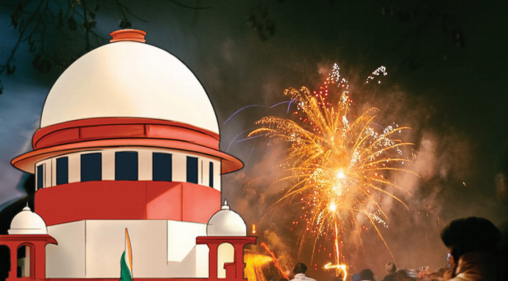
Diwali 2025, may be a little different. Supreme Court of India has just called for pan-India policy on firecrackers ban, while assuring that it would hear the livelihood concerns also on the next hearing on September 22. The apex court has also issued directions to the authorities to maintain the status quo on ban and also asked the Centre, in consultation with the National Environmental Engineering Research Institute (NEERI), to submit status report. While call of the Supreme Court is welcome, there is a clear need of balancing the ban on crackers and the livelihood concerns.
The bench headed by Chief Justice of India (CJI) B R Gavai, while hearing on September 12, 2025, a batch of petitions filed by firecracker manufacturers, who objected to the year-long ban applicable to the sale and manufacture of firecrackers in Delhi-NCR, suggested a nationwide ban on firecrackers and not just the NCR. “If firecrackers are to be banned, they should be banned throughout the country,” CJI said.
CJI Gavai said, “If cities in NCR are entitled to clean air, why not people of other cities? Whatever policy has to be there, it has to be on a pan-India basis. We can’t have a policy just for Delhi because they’re elite citizens of the country. I was there in Amritsar in winter last year, and there the pollution was worse.”
Issuing notice on the applications, the bench, also comprising Justice K Vinod Chandran, said, “If citizens in NCR are entitled to pollution-free air, why not so for people in other cities.”Then, there was the issue of the livelihood of several families which is dependent on this industry, the petitioners have said.
It was mentioned in the court that on the last order of the Supreme Court on April 3, the top court has refused to alter its ban, and even the green cracker formulations prepared by them have not been considered by the Centre along with the expert body NEERI.
The petitioner firecracker traders, the Association of Firework Traders, and Indic Collective and Haryana Firework Manufacturers, had pointed out that due to the order passed by the top court, their licenses are revoked even though it is valid till 2027-28.
Senior advocate Aparajita Singh assisting the court as amicus curiae informed the court that even when emergency measures, including a ban on construction activities, were proposed in Delhi, the court ensured compensation was released to the workers affected by the loss of work.
The court agreed on this point and said, “When we impose the ban on workers, they are left without work. It is the poor who suffer.” Thereafter the court agreed to examine the matter on the next date. Additional Solicitor General (ASG) Aishwarya Bhati, appearing for the Centre, has also said that any formulation on green crackers is done in consultation with experts, and they would provide the latest research conducted by NEERI.
It should be noted that during the last Diwali 2024, several states of the country had banned crackers, which included not only Delhi-NCR, but also Bihar, Maharashtra, Karnataka, Punjab, Haryana, Kerala, Tamil Nadu, and West-Bengal. Bans were imposed in several cities with different specifications of firecrackers.
Nevertheless, balancing livelihood and ban will not be easy task. Firecrackers contribute significantly to air and noise pollution, especially around Diwali and other festivals. It is in this context the Supreme Court and various state governments have imposed restrictions, sometimes blanket bans, sometimes partial bans allowing only green crackers. The problem is that the bans are often temporary, sometimes inconsistent, and enforcement mixed leading to confusion among businesses and consumers.
Ban also impacts workers and manufacturers. India’s firecracker hub Sivakasi in Tamil Nadu employ around 4 lakh workers directly or indirectly. Workers are largely daily-wagers and have limited alternative employment opportunities. Frequent bans create uncertainties, reduced production, jobs losses and wage cuts.
Millions of retailers and small businesses also depend across the country depend on Diwali sales. Sudden bans or restrictions lead to stockpile losses, as crackers can’t be easily resold due to moisture and expiry. They operate on thin margins and for them losses prove devastating.
Ancillary industries like printing, packaging, transport and raw material suppliers are also affected. Moreover, when bans are enforced without alternatives, illegal sale of firecrackers rise.
Therefore, the Supreme Court will have to find out some possible solution to the problem, perhaps a middle path of balancing between the ban and livelihood, since both are important issues.
Possible solutions may be allowing green crackers wisely – as developed by CSIR-NEERI which causes reduced pollution. But they are still controversial, and some states have doubts about their safety and effectiveness. Phased out transition may be another step, under which there should be gradual restrictions with re-skilling programme for workers losing their livelihood. Clarity on pan-India comprehensive policy is required along with provisions of compensation and social security to workers. (IPA Service)