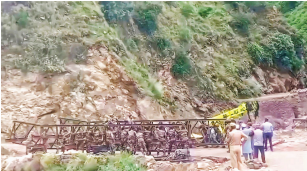
Jammu Tawi, Sep 2: Braving incessant rains and rough terrain, the Army on Tuesday constructed a Bailey bridge over the Jangalwar stream along National Highway-244, restoring crucial connectivity to Doda and Kishtwar districts of Jammu and Kashmir.
This is the second Bailey bridge built by the Army within a week to overcome the large-scale damage caused by record rainfall and floods in the region. According to the defence PRO in Jammu, engineer troops of the Northern Command, in coordination with White Knight Corps and the civil administration, completed the construction in record time. The bridge will be opened for traffic after safety validations.
The White Knight Corps said on X that devastating floods had submerged vast areas, washing away homes, bridges and fields. NH-244, considered the lifeline for Doda and Kishtwar, was washed away near Thatri, leaving many villages cut off. Engineer troops mobilised bridging stores to raise the new structure, while White Knight Corps troops provided area protection and J&K Police managed traffic to facilitate smooth operations.
On August 29, Army engineers had erected a 110-foot Bailey bridge in a 12-hour operation to reconnect the flood-hit Tawi bridge in Jammu city. Meanwhile, in Ramban district, the Army has been roped in to erect a temporary Bailey bridge at Batti, where a bridge was washed away by flash floods in the Chenab, cutting off Gool sub-division, parts of Ramban tehsil and several national projects. Army engineers have already surveyed the site for early restoration.
The recent extreme weather has left behind a trail of destruction. Since August 14, over 130 people, mostly pilgrims, have died and more than 120 were injured in cloudbursts, landslides and flash floods across Kishtwar, Kathua, Reasi and Ramban districts. At least 33 persons remain missing.
The record rainfall of August 26-27 triggered flash floods in low-lying areas of Jammu and adjoining plains, damaging public and private property on a massive scale. The Army’s swift bridging operations have emerged as a critical lifeline, ensuring mobility and relief in the disaster-hit districts.