
—Kishan Sanmukhdas Bhawanani, Advocate, Gondia
In many countries, the tendency to influence public opinion in the name of spirituality during elections, power negotiations, public policies, and social agendas has rapidly increased.
The greatest paradox of the modern world is that while science, technology, and material progress have taken human life to unprecedented heights, the inner world of humanity remains gripped by instability, uncertainty, and division. At such a time, worship, prayer, service, and spirituality should have emerged as the foundations of balance, compassion, and peace. Ironically, however, political interference is increasing in these very spiritual spheres.
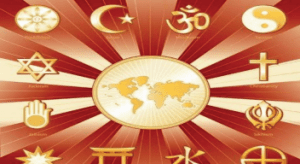
The politicization of spirituality has become a matter of global concern today, as it affects not only individual freedom but also undermines social unity, religious harmony, and democratic order. Therefore, it is essential to stop the trend of presenting worship and prayer services as entertainment, propaganda, or political instruments, and to restore spirituality’s lost sanctity.
I firmly believe that almost all religious and spiritual traditions—Hinduism, Buddhism, Christianity, Islam, Judaism, Taoism, Shintoism—consider worship a profoundly internal process. In Hindu philosophy, worship is a means of purifying the mind, intellect, and consciousness. In Buddhism, the emphasis is not on ritual worship but on mindfulness and meditation to calm mental impurities. In Islam, prayer is an exercise in humility, not a spectacle. In Christianity, prayer is a spiritual dialogue where inner purity holds more significance than external display.
Across cultures, worship has never been a program or a festival, but an inner journey—to know oneself, refine oneself, and connect with the Divine or cosmic consciousness.
Throughout human civilization, worship, meditation, prayer, and spiritual practices have served as pillars of inner balance, discipline, and moral development. But today, under the influence of the digital age, commercialization, consumerism, and an entertainment-driven culture, worship is increasingly viewed as a celebratory or ostentatious activity. The warning—“Worship, prayer, and service are not entertainment”—is not merely a call to religious awareness; it is a moral guide for the 21st century.
Unless society understands the boundaries between spirituality and the market, faith and entertainment, practice and display, humanity’s mental health, cultural purity, and spiritual discipline will be endangered.
If we remember that worship, prayer, and service are embodiments of purity, it becomes clear that they were never meant as entertainment in any culture. From ancient civilizations to modern religious traditions, the purpose of worship has been to elevate humans above ego, desire, and illusion. Worship requires solitude, discipline, and inner purity, whereas entertainment depends on external stimulation.
When religious rituals turn into musical festivals, crowd-pulling spectacles, or competitive displays, the essence of worship begins to fade. The goal of worship is introspection and spiritual upliftment, not popularity or mass mobilization. Reducing worship to entertainment creates two major social problems:
Commercialization of religious emotion, shifting focus from devotion to decoration and glamour.
Communal identity-based competition, leading to division and rivalry.
True worship brings peace; entertainment-driven worship creates tension and fragmentation.
The 21st century’s digital transformation has blurred the line between worship and entertainment. Livestreams from temples, mosques, churches, and gurdwaras; devotional reels and vlogs; viral bhajans; choreographed religious dances; and monetized devotional content have commercialized spirituality. Today, spiritual standing is often measured by likes, shares, and followers rather than depth of devotion. Houses of worship are increasingly becoming stages for light shows, sound systems, and digital theatrics.
This trend is not limited to India—it is visible in the U.S., Japan, Korea, Africa, Europe, and Latin America, where religious programs are presented with glitz and glamour.
Globalization, digital ecosystems, and rising political polarization have made religious identity a convenient tool for political gain. Political influence over spiritual spaces is now a worldwide concern. When politics enters the domain of faith, it weaponizes emotions and dilutes the universality of spirituality. The purpose of spirituality is to connect humanity to higher values—not to any political ideology.
In a world where artificial intelligence, robotics, and technology are distancing humans from their inner selves, true spirituality is more needed than ever. But when spirituality becomes a political tool, it loses its purpose—human welfare and inner peace.
The intrusion of politics into spirituality endangers democracy. In many countries, political parties use spiritual leaders and institutions to influence public opinion. This compromises their independence, distracts society from scientific and socio-economic issues, and turns religion into a divisive force. The true aim of spirituality is harmony; politics converts it into identity blocs.
From the Middle East to Africa to Asia, several conflicts have roots in the interplay of faith and politics. Misusing spiritual sentiments for political purposes poses a grave threat to humanity.
The spirituality thrives on voluntariness, compassion, and inner growth, whereas politics revolves around strategy, gain, and competition. Mixing the two damages the very soul of religion. Political use of worship fosters superiority in one community and inferiority in another, spreading discrimination and conflict. Turning spirituality into a political battlefield is a danger no civilized society can afford.
Preserving the autonomy of spiritual spaces is essential not just for a diverse country like India but for the entire world. Across America, Europe, Japan, the Middle East, and Africa, history has shown that religious freedom remains safe only when the state and spiritual institutions respect their boundaries.
If we analyze the above realities, we realize that protecting spirituality has become one of the world’s greatest social needs. In times of economic instability, mental stress, digital chaos, and social polarization, spirituality is the only medium that can provide inner strength and peace. But once spirituality becomes a tool of politics, it loses its healing power.
Thus, preserving the purity of worship, preventing the politicization of faith, and keeping politics away from places of worship are essential steps toward global human welfare. Every nation must accept that spirituality is an individual freedom—and no freedom should be overshadowed by political motives.
Protecting spirituality means protecting the inner world of human beings. If the inner world is safe, the outer world will naturally become peaceful.
(Compiled/Written by Advocate Kishan Sanmukhdas Bhawanani — Tax Expert, Columnist, Thinker & Poet and can be reached at 9226229318)