By Pushp Saraf
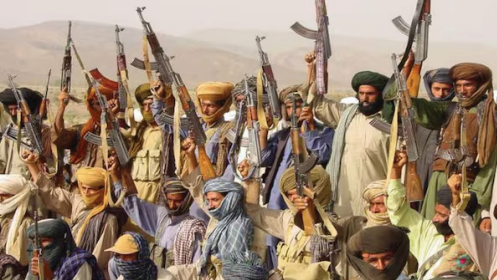
There are increasingly stark and undeniable signs that Pakistan’s grip on Balochistan—its largest, yet most sparsely populated and underdeveloped province—is slipping. Armed Baloch insurgents, demanding a separate, sovereign state, now operate with alarming impunity. Key highways linking Balochistan to the rest of the country have effectively become ambush zones. Commuters are routinely pulled off buses, subjected to ethnic profiling, and, if identified as outsiders, often executed on the spot. The frequency and sheer brutality of these attacks are deeply unsettling.
On March 27, amid widespread violence that claimed at least 14 lives across the province, unidentified gunmen pulled seven Punjabi passengers off a Karachi-bound bus and shot them dead in Gwadar’s Kalmat area. The attack mirrored a March 22 incident in which four Punjabi labourers were killed in Kalat, and four policemen were gunned down in Nushki (also spelled Noshki). Just a month earlier, clashes between militants and security forces had left 18 soldiers and 23 insurgents dead.
Balochistan may now be the only region in Pakistan where even Chinese workers—representing Islamabad’s so-called ‘iron brothers’—think twice before setting foot. Unprecedented train hijacking, a recent and unprecedented act of violence has further underscored the deepening volatility in Balochistan. On March 11, the Jaffar Express—carrying 440 passengers en route to Peshawar—was hijacked while traversing the treacherous Bolan Pass near Sibi, approximately 160 kilometers from Quetta, the provincial capital. In a shocking escalation, militants from the Balochistan Liberation Army (BLA) singled out passengers based on ethnicity, executing 21 on the spot and killing five more who later succumbed to their injuries. The 36-hour standoff ended with all 33 militants dead, highlighting their unwavering, do-or-die mindset.
In the aftermath, mass protests erupted, led by the Baloch Yakjehti Committee (BYC), a prominent rights group helmed by activist Mahrang Baloch. The demonstrators demanded the return of bodies from the Jaffar Express operation. According to the official version, the protest on March 21 turned violent as BYC members and allegedly armed accomplices engaged in stone-pelting, indiscriminate gunfire, and attacks on law enforcement. The unrest claimed three lives—allegedly due to firing by “armed elements accompanying the BYC leadership.” Seventeen BYC activists, including Mahrang Baloch, were arrested and charged with serious offenses such as attacking a civil hospital, forcibly removing bodies from a morgue, inciting violence, and other grave allegations. The arrests in Quetta, made under the Anti-Terrorism Act and the Pakistan Penal Code, drew widespread condemnation from the Human Rights Commission of Pakistan (HRCP), Pakistan Tehreek-e-lnsaf (PTI), and various civil society groups. BYC activists in Karachi denounced the arrests as “illegal detentions” and staged protests on March 24. As a result, prominent activist Sammi Deen Baloch and four others were detained for 30 days under the Maintenance of Public Order (MPO). Top leader Sardar Akhtar Mengal of the Balochistan National Party (Mengal), a former Chief Minister and parliamentarian, organised a protest rally on March 29 against the arrest of Mahrang and other Baloch leaders. Although the rally was not authorised by the local administration, it proceeded and survived a suicide attack en route, with no casualties reported. Mengal had earlier resigned from the National Assembly on September 3, 2024, citing state apathy towards Balochistan. The Government signalled a conditional willingness to engage with estranged Baloch groups, including the BYC—provided they were sincere in their intent. Minister of State for Law and Justice Barrister Aqeel Malik reiterated that while dialogue remained on the table, the state would not hesitate to act firmly against separatist movements. “Issues cannot be resolved through violent protests,” he warned.
Relentless insurgency The BLA, which re-emerged as a unified front for Baloch nationalist factions on January 11, 2022, has since spearheaded a relentless insurgency against the Pakistani state. Designated a terrorist organisation by both Pakistan and the United States, the BLA has intensified its campaign in recent years, targeting military installations, critical infrastructure and Chinese nationals linked to the China-Pakistan Economic Corridor (CPEC). Despite high-profile setbacks—including the surrender of its founder Gulzar Imam on May 23, 2023, and his successor Sarfraz Banguizai (alias Mureed Baloch) on December 23, 2023—the group’s operational momentum remains largely undeterred. Its ability to coordinate large-scale attacks continues to challenge the state’s narrative of control and signals the enduring strength of Baloch separatist sentiment.
According to the Pak Institute for Peace Studies (PIPS), an Islamabad-based think tank, the BLA emerged as the principal driver of militant violence throughout 2024. In August alone last year the group launched a wave of deadly attacks that claimed at least 50 lives, including 14 security personnel. Security forces responded by killing 21 militants. Just three months later, in November, a suicide bombing tore through Quetta Railway Station, killing 26 people and injuring 62 more. A PIPS report published in January 2025 revealed that the number of terrorist attacks in 2024 had surged to levels not seen since 2014—or earlier. While militants no longer held territorial control as they once did, the report described the deteriorating security situation in Balochistan and neighbouring Khyber Pakhtunkhwa (KP) province as “alarming.” The report further stated that over 95 percent of all terrorist attacks in Pakistan in 2024 were concentrated in KP and Balochistan. Violence linked to banned Baloch insurgent groups, particularly the BLA and the Balochistan Liberation Front (BLF), spiked dramatically—rising by 119 percent and accounting for 171 incidents in Balochistan alone.
Expanding militant spectrum in a report released in March this year, the Pakistan Institute for Conflict and Security Studies (PICSS), an Islamabad-based think tank, identified Balochistan as the most volatile province in February. The province witnessed 32 militant attacks resulting in 56 fatalities—including 35 civilians, 10 security personnel, and 11 militants—while 44 others were injured, among them 32 members of the security forces and 12 civilians. Two individuals were also abducted during the month. Responsibility for the majority of these attacks was claimed by various Baloch insurgent factions, notably the Bashir Zeb and Azad factions of the Balochistan Liberation Army (BLA), the BLF and the United Baloch Army (UBA). In retaliation, security forces killed 11 militants during operations. The Bashir Zeb faction—led by Bashir Zeb Baloch—has emerged as the dominant wing of the BLA. It is known for attracting educated youth and female activists, and was reportedly behind the recent railway hijacking incident. The Azad faction, named after the pseudonym “Azad,” is led by Hyrbyair Marri, who is believed to be living primarily in Europe.
Analysts have observed a recent resurgence in this faction’s strength, reflected in its growing manpower, weaponry, and financial resources—raising questions about the sources of its support and the implications for the broader Baloch insurgency. The BLF also has an active presence in Afghanistan and has claimed responsibility for attacks targeting not only security personnel and government officials but also civilians and journalists. The UBA emerged from a familial split between Mehran Marri and his brother Hyrbyair Marri, adding another layer of complexity to the fragmented Baloch militant landscape. Observers remain watchful as these groups evolve, expand their capabilities, and potentially shift the trajectory of the insurgency in Balochistan.
Ethnic cleansing:
A chilling pattern On February 18, seven men from Punjab were brutally shot dead after being off-loaded from a passenger bus in Barkhan district. Just four days earlier, on February 14, eleven coal miners from Khyber Pakhtunkhwa lost their lives when a roadside bomb struck their vehicle in Harnai district. These attacks highlighted a grim reality: militants have the impunity to stop multiple vehicles on major highways, check passengers’ identity cards, and kill those identified as non-locals. This terrifying pattern of ethnic targeting was not limited to February. Throughout 2024, similar atrocities unfolded.
In August, 23 travellers were pulled off buses and executed in Musakhail. In May, seven Punjabi barbers were gunned down near Gwadar. In April, civilians in Noshki and Kech districts were attacked specifically for their provincial identity accounting for the loss of nine and two Punjabis, respectively. In 2025, violence continues into March, as mentioned in the beginning also. On March 5, a remote-controlled bomb targeted the vehicle of pro-government tribal leader Abdul Samad Samalani in Naal, a town in Khuzdar district. While Samalani survived, five of his associates were burned alive and ten others seriously injured when the vehicle caught fire. Just two days earlier, on March 3, a woman suicide bomber attacked a Frontier Corps (FC) convoy in Kalat district, killing one soldier and injuring four others.
National Action Plan (NAP):
Still an unfulfilled promise in a strongly worded editorial titled “NAP Revival”, Dawn cautioned against relying solely on military solutions to address rising militancy. The editorial stressed that “Unless action in the field is complemented with social, economic and political efforts in the militancy-hit parts of Balochistan and KP, led by the civilian administration, this bloody cycle of violence will continue.” Referring to the Jaffar Express hijacking and the broader surge in terror activity, the editorial warned that conventional responses are no longer sufficient: “It is clear that in the midst of a fresh wave of terrorism, particularly after the Jaffar Express hijacking, the state cannot respond to the crisis using conventional approaches. Both the Baloch separatist insurgency and the TTP campaign of terror are posing existential threats to the nation, and if not handled with alacrity and foresight these violent anti-state movements can do much damage to the country’s integrity.”
Despite repeated claims about reviving the National Action Plan (NAP)—a 14-point counterterrorism strategy first unveiled after the 2014 APS Peshawar massacre—implementation remains largely rhetorical. Though the plan was revised in 2021 to include both kinetic and non-kinetic components, the editorial observed that successive governments have failed to meaningfully execute its non-military aspects: “Where the Baloch insurgency and the TTP campaign are concerned, the kinetic aspects of NAP are essential, as a state of insecurity is untenable, and all armed groups that threaten peace must be neutralised. Yet successive governments, including the current set-up, have not done enough to implement NAP’S non-kinetic measures. These include supporting the reconciliation process in Balochistan, as well as overseeing reforms in KP’s merged areas, which are hardest hit by the TTP insurgency”. A legacy of neglect even before the shocking train hijacking, Dawn had issued a sobering warning in an earlier editorial. It argued that the roots of Balochistan’s unrest lie in decades of systemic neglect that have left its people disillusioned and marginalised. Despite being rich in natural resources, the province has seen little of the development that has uplifted other parts of Pakistan. Basic infrastructure is lacking, educational opportunities remain scarce, and economic prospects for young Baloch are bleak. This enduring deprivation has created fertile ground for extremist groups to exploit. Yet, the political response has remained disappointingly superficial. While political parties are quick to issue statements condemning violence, their commitment to addressing Balochistan’s fundamental grievances is virtually absent. The province, the editorial noted, seems to matter only during election cycles—when lofty promises are made and then swiftly forgotten.
It questioned what lasting solutions has the ruling PPP-PML(N) coalition offered Balochistan? And what real progress have Baloch nationalist parties brought to the table? The editorial made a compelling call to Pakistan’s political leadership: they must prove, through concrete action—not rhetoric—that Balochistan has not been abandoned. While enhanced security is essential, the province needs far more: a complete rethinking of the federation’s relationship with it. This includes genuine political dialogue, significant investment in human development, and deliberate efforts to integrate Baloch youth into the national fabric.
Without addressing these root causes, the editorial warned, the country risks witnessing this tragic cycle repeat itself—with more innocent lives lost to a violence that could have been prevented. An analyst’s view Echoing concerns raised by the Dawn, veteran journalist Zahid Hussain painted an equally grim picture in a recent article: “What’s happening in Balochistan is largely the result of our flawed policy over the decades.” He argued that repeated reliance on kinetic solutions to what is fundamentally a political problem has only deepened the crisis, driving more people towards militancy. The current provincial administration—widely seen as a product of political engineering and propped up by the security establishment—is on the brink of collapse. Hussain described the situation as approaching a “civil war-like” state, with insurgents increasingly dominating the narrative. A low-intensity conflict that simmered for over two decades is now escalating into a full-blown insurgency, fuelled by the growing alienation of the local population from the state. As the writ of the provincial government weakens, separatist groups have grown more emboldened, launching frequent and increasingly brazen attacks. One of the most alarming developments, he noted, is the rising number of attacks targeting Chinese nationals working on China-Pakistan Economic Corridor (CPEC) projects—seen by militants as symbols of exploitation rather than development. At the same time, ordinary Pakistani citizens, particularly Punjabis, have also become targets. In several horrifying incidents, passengers have been forcibly offloaded from buses on major highways and executed in cold blood.
“These attacks,” Hussain wrote, “have given a horrific turn to the separatist militancy,” underscoring the urgent need for a complete reassessment of the state’s approach to Balochistan.
Dawn made a concrete recommendation: “Nationalists who believe in working within constitutional parameters must be allowed to spearhead the political process in the province, while lawmakers from across the country must stand in solidarity with Balochistan and its people, pledging that they will be given the security, development and rights that all Pakistanis should have. Several ‘Balochistan packages’ have been launched previously. This time, the state and politicians must move beyond clichés, and pursue a lasting solution.”
A broader crisis: KP also in flames
To make matters worse for Pakistan, its adjoining province of Khyber Pakhtunkhwa (KP) is also engulfed in escalating violence. In the days following the Balochistan train hijacking, KP witnessed a surge in militant activity, with over half a dozen attacks occurring on March 14 and 15 alone. In Mohmand district, two policemen and seven militants were killed during a security forces operation. Separately, two militants were gunned down in Dera Ismail Khan, while police posts in Lakki Marwat and Bannu districts came under repeated attacks. The violence has claimed the lives of notable religious and political figures, adding to the sense of instability. On February 28, Maulana Hamidul Haq Haqqani, chief of the Jamiat Ulema-e-Islam (S), was killed in a suicide bombing that tore through his Darul Uloom Haqqania seminary in Nowshera during Friday prayers. Five others also perished in the blast. Hamidul Haq was the son of Maulana Samiul Haq—often referred to as the “Spiritual Father of the Taliban”— who himself was mysteriously assassinated in 2018. The long-term implications of Maulana Hamidul Haq’s killing remain to be seen, given his lineage and political weight. On March 14, Abdullah Nadeem, the South Waziristan district chief of Jamiat Ulema-e-lslam (F), was injured along with three others in a bomb explosion inside the Maulana Abdul Aziz Mosque. Maulana Fazlur Rehman, leader of JUI-F, condemned the attack as a tragic violation of the sanctity of a place of worship. A day later, on March 15, Mufti Shakir—founder of the banned militant group Lashkar-e-Islam—was killed in an explosion outside his seminary in the Urmar area on the outskirts of Peshawar. Three others were injured. The Centre for Research and Security Studies (CRSS), an Islamabad-based think tank, reported that 2024 has been the deadliest year in a decade. A total of 685 security personnel were killed in 444 terror attacks across the country. Alarmingly, KP and Balochistan together accounted for 94% of all fatalities—underscoring the deepening crisis in two of Pakistan’s four provinces. If the state fails to address both the political and security dimensions of these crises, the writ of the government may continue to erode—not just in Balochistan and KP, but in the very foundation of the federation itself.
(The Article is reproduced from the latest issue of the ‘Border Affairs’)