By RAJAT SHARMA
In India, power wears two faces — one smiles before the camera, the other signs behind closed doors. The first is the politician, armed with votes, slogans, and promises. The second is the IAS officer, armed with files, rules, and continuity. Together, they run the country — but rarely in harmony. And the question that haunts every corridor of power is: Who really runs India — the politicians or the bureaucrats? The answer is neither simple nor absolute. It lies at the intersection of power, accountability, and the realities of governance in the world’s largest democracy.
Politicians in India enjoy the highest form of democratic legitimacy. They are elected by millions of voters to represent the people’s aspirations and to lead the country’s policy direction. The Constitution vests ultimate authority in the political executive — the Prime Minister, the Council of Ministers, the Chief Ministers, and their respective cabinets. They frame policies, set the national agenda, and determine the priorities of governance. In theory, the role of the politician is clear — to formulate policies reflecting public will and to ensure the bureaucracy implements them. This is the essence of democracy: the elected leading the appointed. However, the practical landscape of Indian governance often blurs these boundaries. Many politicians, especially at the state and district levels, depend heavily on bureaucrats for administrative advice, file movement, and policy interpretation. The vastness and complexity of India’s administrative structure make it impossible for any politician to govern effectively without bureaucratic support. As a result, while politicians hold formal authority, bureaucrats often exercise informal control
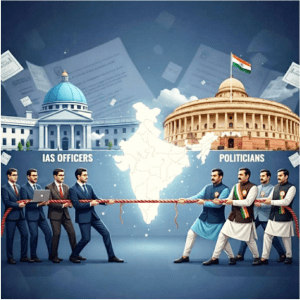
The IAS, established during the early years of the Republic as a successor to the colonial Indian Civil Service (ICS), remains the steel frame of Indian governance. IAS officers occupy key positions in ministries, departments, and districts — serving as secretaries, collectors, commissioners, and advisors. They are the institutional memory of the state — trained to uphold rules, ensure continuity, and provide administrative stability regardless of political changes. A government may change every five years, but an IAS officer continues to serve through decades, shaping and executing policies under successive political regimes. This permanence gives bureaucrats immense influence. They understand the systems, files, loopholes, and procedures better than most elected leaders ever could.
As a result, while politicians may “decide,” bureaucrats often “design.” They draft the policy notes, interpret legislative intent, and supervise implementation. In many cases, an inexperienced minister might depend completely on the bureaucrat’s briefing to understand his or her own department. However, this continuity also has a flipside — it sometimes fosters a sense of unaccountable authority. Unlike politicians, bureaucrats are not directly answerable to the public. Their decisions are protected by service rules, and their career progression often depends on seniority rather than public performance. This lack of democratic accountability sometimes creates friction with elected representatives, who feel bureaucrats act as power centers unto themselves
To understand today’s power structure; one must revisit its roots. The Indian bureaucracy was originally designed under British rule — not for democratic service, but for administrative control. The Indian Civil Service (ICS) served as the instrument through which the British governed a vast colony. Its purpose was to ensure order, collect revenue, and implement policies made by distant rulers, not to empower citizens. Post-Independence, India retained this administrative machinery but placed it under a democratic political structure. While the goals changed — from control to development — the bureaucratic culture of hierarchy, secrecy, and rigidity remained. This legacy often clashes with the dynamic, populist nature of Indian politics. Politicians seek quick results and popular measures; bureaucrats emphasize procedure and caution. The result is a friction that defines Indian governance even today — a constant negotiation between efficiency, accountability, and legality.
In reality, power in India’s governance is situational. At the central level, especially under strong political leadership, politicians clearly dominate. A powerful Prime Minister or Chief Minister can dictate bureaucratic behavior through appointments, transfers, and promotions. Officers are expected to align with the government’s vision, and those who don’t may find themselves marginalized. However, at the micro-level — districts, ministries, and specialized policy areas — bureaucrats often hold substantial power. District collectors, for instance, are mini-governments in themselves. They control law and order, revenue administration, disaster management, and welfare schemes. Their discretion often determines how a policy translates into ground reality. Similarly, senior IAS officers in central ministries influence how policies are worded, implemented, and evaluated. The bureaucratic draft of a bill or a regulation often shapes the actual outcomes more than the political speeches behind it. Thus, while politicians may set the destination, bureaucrats determine the route — and sometimes, even the pace of travel.
For the common citizen, politicians are the visible face of power — the ones seen inaugurating projects, announcing schemes, or appearing on television debates. Bureaucrats, on the other hand, work behind the scenes, rarely seeking public attention. However, whenever scandals erupt — whether it’s corruption, inefficiency, or administrative failure — both camps blame each other. Politicians accuse bureaucrats of being lazy and obstructive; bureaucrats claim they are scapegoat for political blunders..
So, who really runs India? It depends on who you ask — and when. At the Centre, under a strong majority government, politicians clearly dominate. The Prime Minister’s Office (PMO) today controls appointments, transfers, and policy directions more tightly than ever before. The bureaucracy is expected to implement, not interpret. But in states with weak coalitions or frequent political turnover, bureaucrats often become the de facto rulers. A powerful Chief Secretary or Principal Secretary can decide the fate of entire districts, sometimes overshadowing ministers themselves. In short, when politics is strong, bureaucracy is silent. When politics is weak, bureaucracy whispers.
In the end, neither IAS officers nor politicians truly run India. They only manage it. The real engine of India is the ordinary citizen — the farmer who votes, the teacher who serves, the worker who builds, and the taxpayer who funds. The bureaucrat may control the files. The politician may control the votes. But it is the people who control the legitimacy of both. India doesn’t belong to its rulers, elected or appointed. It belongs to its citizens — and they run India every time they demand better governance, cleaner politics, and accountable administration. Until that truth sinks into both sides of the power divide, the question — Who really runs India? — will remain unanswered.