
Ready to tackle any situation, contingency plan devised, says Jal Shakti Department
Jammu Tawi, Feb 19: In the first 50-days of the year 2025 Jammu and Kashmir has witnessed a rainfall deficit of 83 percent thus posing a risk of severe water scarcity in the coming months.
According to the official data, from January 1 to February 19, 2025, J&K has recorded a rainfall of just 29.8 mm against the normal precipitation of 175.8 mm. i.e. only the 17% precipitation.
Kargil in Ladakh has recorded zero percent precipitation in 2025 with the data revealing that the district has witnessed 100 per cent deficit as against the normal rainfall of 18.5 mm.
In Jammu and Kashmir, Kathua has witnessed the highest deficiency with 98 percent as a rainfall of only 3.6 mm was recorded against the normal of 152.4 mm.
Jammu and Udhampur stations have recorded a deficit rainfall of 95 per cent each in the last 50 days while 92 per cent deficiency was recorded in Samba district.
Ramban and Kulgam districts have recorded a deficiency of 90 per cent each, the data shows. It adds that Shopian and Reasi have witnessed the deficit rainfall of 88 per cent while Doda and Budgam districts have seen the deficiency of 87 per cent and 86 per cent respectively.
Srinagar, the summer capital of Jammu and Kashmir, has recorded the deficit rainfall of 85 per cent in the last 50 days while Anantnag, Bandipora and Pulwama have recorded the deficiency of above 80 per cent rainfall during the period.
The other stations including Baramulla, Ganderbal, Kishtwar, Kupwara, Poonch and Rajouri districts have recorded a deficit rainfall in between 72-78 per cent.
Meanwhile, Chief Minister Omar Abdullah on Wednesday said that J&K is staring at a water crisis this year, and he will be reviewing the measures the Jal Shakti (PHE) Department intends to take to address the situation.
A top official in the Jal Shakti Department (JSD) while talking to KNO said that the department is ready to tackle any such situation. “We have already formulated a contingency plan if such a situation arises,” he added.
The official also appealed to the people to use the water judiciously and not to waste it to ensure that all the people get adequate drinking water facilities. “Besides, if the dry spell persists, the department will ensure that the people don’t face difficulties,” he said—(KNO).
Govt, people must unite to overcome water crisis: Omar
Jammu and Kashmir is staring at a water crisis this year due to a massive deficit in rainfall, Chief Minister Omar Abdullah said on Wednesday, calling for a more proactive approach and collective efforts towards water management and conservation.
Kashmir has witnessed a dry winter this year with an 80 per cent deficit of rainfall overall this year, raising the possibility of drought in the valley this summer.
Abdullah said in a post on X, “J&K is staring at a water crisis this year. It’s not a recent phenomenon, actually it’s been building up for a few years now. While the government will have to adopt a more proactive approach for water management & conservation, it can’t just be a government centric approach. All of us residents of J&K will have to change the way we take water for granted.” The chief minister said he will review the measures being taken by the concerned department to deal with the crisis.
“I’ll be reviewing the measures the Jal Shakti (PHE) Dept intends to take to deal with the developing crisis & I’ll also be talking to the people of J&K over the next few months about what we can do collectively,” he added.
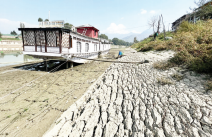
According to officials, several water bodies are flowing below the zero level mark at many places while some springs in south Kashmir have dried up completely due to the receding water table.
An official at the Irrigation and Flood Control Department said the water level in Jhelum and several other water bodies was more than a metre below the usual water level for this time of the year.
“If it does not rain or snow in the next fortnight, there is a possibility of a crisis with regards to water for drinking and irrigation purposes,” he added.
Social media is flooded with videos and images of dried-up water bodies with Achabal springs in south Kashmir having dried up completely.
The river bed of Jhelum is visible at many places, especially upstream in south Kashmir areas while the water level downstream in north Kashmir is alarmingly low. The situation is similar in other major streams of the valley.
As per the data, Jammu and Kashmir received only 29.8 mm of rainfall between January 1 and February 12, compared to the normal 140 mm.
Among the districts, Kathua district is worst affected with a 97 per cent shortage of rains. Jammu recorded a 94 per cent deficit, followed by Udhampur and Samba at 92 per cent. Srinagar witnessed an 82 per cent rainfall deficit.
Shopian, Reasi, Ramban, Kulgam, Doda, Budgam and Anantnag reported a shortfall between 80 per cent and 89 per cent. Pulwama, Kupwara, Bandipora and Baramulla experienced rainfall deficits between 70 per cent and 79 per cent, while Poonch, Rajouri, Kishtwar and Ganderbal recorded a 60 per cent to 69 per cent deficiency.
Earlier while talking to news agency, CM Abdullah raised concern over the rainfall deficit and emphasised the urgency of preparing for these shortages.
Asked if he was facing any heat from the central government, Abdullah, who is also the National Conference vice-president, said in a lighter vein that he was more concerned about the weather and water shortage.
“There’s too much heat, not from the Centre, not from the lieutenant governor, not from any officer but from the weather,” the CM said.
Abdullah added on a serious note, “This heat is actually worrying me. If it continues, we will have a shortage of water during the summer. It is going to be our biggest problem, bigger than any other problem.” He emphasised the urgency of preparing for these shortages and said he had called a meeting with the departments concerned to address the issue. Abdullah also said he was hoping for much-needed rain or snow in the coming days.
“I pray it rains or snows in the coming days. But at the moment, the day temperature feels like that of March or April. I am really fearful that this heat will have a direct impact on us,” he added.

