By Ravi Rohmetra
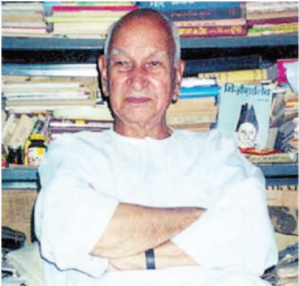
Duggar land (Jammu) has produced numerous great personalities who have left indelible marks in diverse fields. The Duggar region has a distinct cultural identity in the landscape of India. Lovers of the Dogri language laid the foundation of Dogri Sanstha in 1944 on the auspicious day of Basant Panchami. Duggar is the land of warriors, singers, actors, journalists, writers, poets, scholars and intellectuals whose sons and daughters have brought laurels to their motherland and raised her glory to Himalayan heights. Among them was Padma Shri Prof. Ram Nath Shastri, widely known as the “Pitamaha of Dogri.”
He was born on 15 April 1914 in the family of Vaid Gouri Shankar, an Ayurvedic doctor from the small village of Marhi in Reasi. He initially worked as a Sanskrit and Hindi teacher at Rajput School. Later, in 1943, he joined Prince of Wales College (now Gandhi Memorial Science College, Jammu) as a Professor of Sanskrit. He retired from the State Education Department in 1970 and subsequently joined Jammu University as a Senior Fellow in Dogri, where he served until 1975.
He also worked as Chief Editor of the Dictionary Project at the Jammu and Kashmir Academy of Art, Culture and Languages from 1977 to 1985.
Prof. Shastri was a doyen of the state and a respected figure in society who set an example for others to follow. He held an M.A. in Sanskrit and also possessed the Shastri and Prabhakar qualifications.
An exceptionally refined and versatile writer, he authored twelve books in Dogri, translated twenty-four books into Dogri, and edited or compiled about twenty more. His devotion to education and literature earned him widespread recognition.
He was the recipient of many prestigious awards, including the Padma Shri, the Sahitya Akademi Award, and the Jammu and Kashmir State Academy Award twice.
Prof. Shastri was soft-spoken, polite, and known for his polished manners and behaviour. Despite his stature, he led a very simple life and maintained modest habits. He married Sushila Khajuria in 1944, a devoted social worker and a founder member of Dogri Sanstha, who remained actively associated with it for nearly half a century.
He took keen interest in the preservation and promotion of art and culture. An optimistic person, he loved reading, writing and morning walks. His youthful appearance was often attributed to his disciplined and simple lifestyle.
A social worker of repute and a champion of nationalism, brotherhood and coexistence, he actively motivated the younger generation to shun bad habits and contribute to the promotion of social harmony and integrity.
Prof. Ram Nath Shastri was one of the pioneers of the Dogri cultural movement. His dedication and continuous service to the cause of Dogri inspired a whole generation of younger poets and writers. His personal contribution to Dogri literature is indeed immense.
He played a significant role in the publication of several Dogri books and personally edited many of them. A versatile literary figure, he distinguished himself as a poet, playwright, story writer, translator and critic.
His famous play “Bawa Jitto” was staged at many places and received wide acclaim. His translation of Rabindranath Tagore’s play “Sacrifice” was also staged successfully.
Shastri’s writings are rich in thought and possess strong intellectual appeal. His progressive outlook influenced the entire course of the Dogri literary movement.
Some of his published works include:
Ik Ha Raja (Edited)
Bhartri Hari’s Neeti Shatak (Translation)
Bhartri Hari’s Vairagya Shatak (Translation)
Tagore’s Gitanjali (Translation)
Late Padma Sachdev, the eminent Dogri writer, rightly observed that Prof. Ram Nath Shastri was the “Bhartendu of the Dogri language and literature,” truly a great pillar of Dogri.
He passed away on 8 March 2009, leaving the entire Dogri literary community deeply saddened. Though he is no longer among us, he continues to live through his writings and the immense work he did for the advancement of the Dogri language.
Prof. Ram Nath Shastri enriched Dogri literature with original works of high quality, translations of world classics, and a deep love for the mother tongue. The great son of the soil may have departed for his heavenly abode, but because of his selfless service to mankind, Duggar land and the Dogri language, his name will always remain alive in our hearts.
8 March 2009 remains a sad day when this distinguished writer, poet, translator, storyteller and critic passed away. However, he left behind a rich legacy of which every resident of Duggar Pradesh can be proud.
(The writer is a social worker and freelancer and can be reached at Mob: 9419652999.)