Ankit Patel
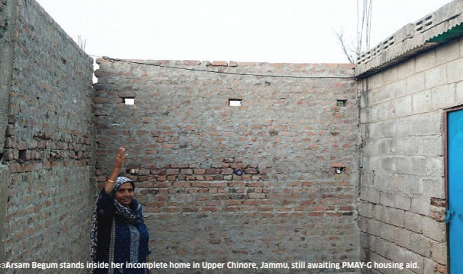
In the rugged landscape of Upper Chinore, Jammu, 59-year-old Arsam Begum’s life is a grueling, daily struggle against the elements. For the past 15 years, this Gujjar woman has lived in a makeshift, roofless structure that offers little more than a flimsy barrier between her and the harsh world outside. Her home is precariously perched near steep mountain slopes, leaving the family constantly vulnerable to the whims of nature. Her only son, who works as a driver in Kashmir, bears the immense weight of the family’s survival on his shoulders, yet his meager, unstable income offers no path to building a secure, permanent home.
The family’s daily existence is plagued by a complete absence of essential services. During Jammu’s biting winters, their thin-walled, exposed shelter offers almost no protection against the freezing temperatures, forcing them to endure bitter, sleepless nights in constant physical discomfort. Beyond the lack of warmth, they face a severe water crisis. With absolutely no piped water infrastructure in their vicinity, they are forced to rely entirely on the erratic and highly unpredictable schedule of government water tank deliveries. She has been waiting for the support promised under the Pradhan Mantri Awaas Yojana-Gramin (PMAY-G) for years, watching others receive aid while her application gathers dust. Arsam Begum is not just waiting for a house; she is waiting for a basic sense of dignity, the safety of a roof, and the fundamental right to reliable water and warmth that should be every citizen’s guarantee.
In Jammu & Kashmir, a region marked by tough terrain and harsh weather, rural housing is vital for economic stability and social equality. Launched in 2016, the Pradhan Mantri Awaas Yojana-Gramin (PMAY-G) replaced older housing schemes to systematically reduce rural homelessness. The policy provides direct financial aid to help marginalized families build safe, disaster-resistant homes with basic amenities. As the program enters its second phase (PMAY-G 2.0) through 2029, it is crucial to evaluate its performance and impact on the region’s people. Under PMAY-G, priority is given to homeless families or those living in ‘kucha’ dwellings (0-2 rooms), especially those facing severe vulnerabilities such as the absence of able-bodied adult males, low literacy, presence of disabled members, or dependence on casual labor. National guidelines mandate reservations of 60% for SC/ST families, 15% for minorities, and 3% for Persons with Disabilities. Beneficiaries are selected through a ‘Permanent Wait List’ (PWL) verified by the local Gram Sabha. Due to the challenging hilly terrain of Jammu & Kashmir, the standard unit assistance is enhanced from ₹1.20 lakh to ₹1.30 lakh, intended for the construction of a 25-square-meter disaster-resilient house that must include a dedicated, clean kitchen. As of February 2026, out of an allocated target of 3,36,498 houses, J&K has sanctioned 3,34,706 units and successfully completed the construction of 3,20,417 homes (approximately 95.7%), with 14,289 units currently under construction.
While official reports celebrate the saturation of housing targets, the reality in Upper Chinore, Jammu, tells a far grimmer story. 62-year-old Mohd. Ajim, a Bakerwal who has called this village home for 19 years, remains trapped in the cracks of systemic neglect. His house, partially destroyed by last year’s devastating floods, stands as a crumbling testament to the government’s failure to provide timely aid to vulnerable tribal communities.
Living with his wife, son, and daughter-in-law, Ajim struggles to survive as a daily wage laborer. With his limited earnings barely covering basic needs, rebuilding a kitchen or a functional toilet is an impossible dream. The loss of their sanitation facilities during the floods has hit the women of the family the hardest, forcing them to endure daily struggles for basic privacy and hygiene. For families like Ajim’s, the disconnect between digital administrative milestones and their lived reality of wreckage and indignity is growing wider every day.
Approximately 85% of PMAY-G houses in J&K have been constructed in the Jammu division, with the Kashmir division accounting for 15%, driven by distinct demographic and geographic factors. In Jammu, high concentrations in the Pir Panjal range (Rajouri, Poonch) are attributed to the traditional ‘kothas’ of the Gujjar-Bakerwal tribes, further accelerated by the 60% SC/ST quota. Similarly, the Chenab Valley (Ramban, Doda, Kishtwar) shows high demand due to extreme isolation and rural poverty. Conversely, Kashmir Valley’s traditional architecture featuring robust brick or timber structures designed to withstand heavy snowfall, results in fewer households meeting the strict PMAY-G criteria for ‘kucha’ dwellings. However, sensitive border districts in Kashmir like Kupwara, Baramulla, and Anantnag have seen significant interventions due to poverty and geopolitical instability, while Srinagar shows minimal rural coverage as its housing demand is primarily addressed under PMAY-Urban.
As of February 2026, approximately 4.99 lakh rural families in Jammu & Kashmir remain on the waitlist, comprising 14,289 families actively constructing homes, 3,168 landless families caught in bureaucratic reviews, and 4,82,253 newly verified beneficiaries under the Awaas+ 2024 survey awaiting target allocation. The housing aspirations of these families now depend entirely on the effective rollout and adequate financing of PMAY-G 2.0 between 2026 and 2029.
Financing for PMAY-G in J&K is exclusively dependent on central assistance, with ₹2,555.14 crore utilized over the past three years. The 2026-27 national budget for the scheme has seen a 69% increase, reaching ₹54,917 crore, although fresh fund releases are currently paused pending the formal verification of Awaas+ 2024 targets. To ensure leak-proof distribution, all funds are now channeled through the Single Nodal Agency (SNA) model. A significant achievement of the policy is gender mainstreaming and women’s empowerment; ownership of new homes is mandatorily registered in the name of the female head or jointly, ensuring that women own approximately 74% of PMAY-G homes nationally. Furthermore, convergence with other central schemes transforms these structures into complete, permanent homes.
The government’s failure to translate digital data into tangible relief is glaring. Bureaucratic inertia has effectively paralyzed the much-touted 5-marla land policy, with a staggering 85% rejection rate acting as a gatekeeper against the poor. Furthermore, while the administration celebrates its technical milestones, it has conveniently ignored the crushing reality of construction costs in mountainous terrain; without accessible, low-interest top-up loans, beneficiaries are left with half-finished shells of houses. As PMAY-G 2.0 (2024–2029) begins, the government must stop hiding behind optimistic statistics and address the systemic incompetence that leaves the most vulnerable like those in remote tribal belts without a roof over their heads. True success cannot be measured by algorithms alone, but by the families who are still, quite literally, left out in the cold.
(The writer is a student of IIMC Jammu and can be reached at [email protected])