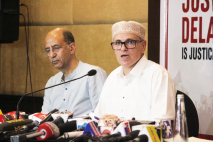
NEW DELHI, Dec 7: The Supreme Court has constituted a special bench to hear a batch of Public Interest Litigations (PILs) challenging the validity of certain provisions of the 1991 Places of Worship (Special Provisions) Act, which prohibits filing lawsuits to reclaim a place of worship or change its character from what existed on August 15, 1947.
A three-judge bench comprising Chief Justice Sanjiv Khanna and Justices Sanjay Kumar and K.V. Viswanathan is scheduled to hear the matter on December 12 at 3:30 pm.
The PILs, including one filed by Ashwini Upadhyay, seek the setting aside of Sections 2, 3, and 4 of the 1991 law. The petitioners argue that these provisions deprive individuals or religious groups of their right to seek judicial remedies to reclaim places of worship.
The case comes amidst several ongoing lawsuits in various courts, including those related to the Gyanvapi Mosque in Varanasi, Shahi Idgah Mosque in Mathura, and Shahi Jama Masjid in Sambhal. The petitioners in these cases claim that the mosques were constructed after demolishing ancient Hindu temples and seek permission to offer Hindu prayers at these sites. The Muslim parties in these cases have invoked the 1991 law, asserting that such lawsuits are not maintainable.
Six petitions, including one from former Rajya Sabha MP Subramanian Swamy, challenge the law’s provisions. Swamy advocates for the court to “read down” certain provisions to allow Hindus to assert claims over the Gyanvapi and Shahi Idgah mosques, while Upadhyay contends that the entire statute is unconstitutional and should be struck down, not merely read down.
The principle of “reading down” is typically used to save a law from being struck down on the grounds of unconstitutionality. However, Jamiat Ulama-i-Hind, in defense of the law, referred to the five-judge Constitution bench’s judgment in the Ram Janmabhoomi-Babri Masjid case, which cited the 1991 Act and argued that the law cannot be invalidated now.
On March 12, 2022, the Supreme Court had sought the Centre’s response to Upadhyay’s petition, which argued that the 1991 law created an arbitrary and irrational cut-off date of August 15, 1947, for the preservation of the character of places of worship, preventing any legal action to challenge the status of these sites.
The law prohibits the conversion of any place of worship and mandates that the religious character of places of worship be maintained as it was on August 15, 1947. The only exception to this rule is the Ram Janmabhoomi-Babri Masjid dispute in Ayodhya.