By Colonel Dev Anand Lohamaror, Security & International Affairs Expert
OPEC is a pivotal institution in modern global energy geopolitics, having significantly influenced oil prices, supply, and the international balance of power over the past six decades. It was established on 14 September 1960 in Baghdad by Iran, Iraq, Kuwait, Saudi Arabia, and Venezuela. These oil-rich nations came together to challenge the dominance of Western oil companies, commonly referred to as the “Seven Sisters,” and to assert control over their own natural resources.
The term “Seven Sisters” refers to seven major Western oil companies—Anglo-Iranian Oil Company, Royal Dutch Shell, Standard Oil of New Jersey, Standard Oil of New York, Standard Oil of California, Gulf Oil, and Texaco—which controlled global oil production, pricing, and export policies between the 1920s and 1960. Despite possessing vast oil reserves, producing countries received limited benefits, leading to growing dissatisfaction and ultimately the creation of OPEC to reclaim control over oil policies.
Over time, OPEC expanded with new members joining at different stages. Qatar joined in 1961 (and exited in 2019), Indonesia and Libya in 1962 (Indonesia later exited), and United Arab Emirates in 1967, strengthening Gulf influence. Subsequently, Algeria (1969), Nigeria (1971), Ecuador (1973, later exited), and Gabon (1975, exited and rejoined) became members. In the 21st century, Angola (2007, exited in 2024), Equatorial Guinea (2017), and Congo (2018) joined, making OPEC a significant global energy platform with fluctuating membership.
Although OPEC officially aims to ensure market stability and fair pricing, in practice it operates like a cartel, where member countries coordinate production levels. The logic is simple: unrestricted production would flood the market, driving prices down and harming producers. By controlling output, OPEC seeks to maintain price stability. However, this approach has drawn criticism. During the 1973 oil crisis, OPEC used oil supply as a geopolitical tool against Western nations, highlighting its strategic influence beyond economics.
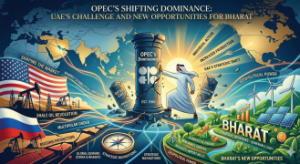
Since the 2000s, the global energy landscape has undergone major transformation. The shale oil revolution in the United States and rising oil production by Russia weakened OPEC’s traditional dominance. In response, OPEC+ was formed in 2016, bringing together OPEC members and non-OPEC producers like Russia to coordinate output and stabilize markets. In this evolving framework, United Arab Emirates—a member since 1967 and a key holder of “spare capacity”—has expressed dissatisfaction with production quotas, given its growing capabilities. This has led to strategic differences within the group, particularly with Saudi Arabia. While OPEC does not directly control sales, it influences markets through production limits. Even if the UAE adopts a more independent approach, OPEC’s existence will not collapse—as seen when Qatar exited in 2019 and Angola in 2023/24—but the global oil market will become more competitive and multipolar, benefiting major importers like Bharat.
The argument that OPEC manipulates global prices is not entirely unfounded, but it is also not the whole picture. While OPEC does influence prices by managing supply, it no longer holds exclusive control. The United States and Russia also significantly impact global oil dynamics. Thus, the reality is far more complex and multipolar than a simple narrative of control or coercion.
If the United Arab Emirates moves toward greater independence from OPEC, it could increase production, potentially easing prices in the short term. However, global demand—especially from China and Bharat—along with geopolitical tensions and supply chain disruptions, will continue to shape the market. For smaller OPEC members, production quotas can limit growth, but membership also provides stability and predictable revenue.
For Bharat, one of the world’s largest oil importers, these developments are crucial. A more competitive oil market could mean better pricing and reduced import bills in the short term. However, long-term volatility remains a concern, making diversification of supply sources, strategic reserves, and a shift toward renewable energy essential.
Ultimately, the question of whether a few countries should control global energy resources is both ethical and practical. While ideally energy should be accessible for global benefit, in reality, resources translate into power. OPEC represents this structured power dynamic. If countries like the UAE begin to move away from this framework, it signals a transition toward a more multipolar energy order—one that offers opportunities but also demands careful navigation between market freedom and stability….