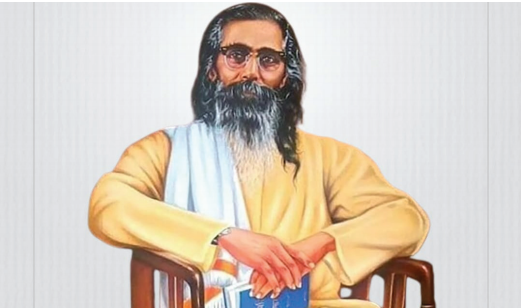
By Puran Chand Sharma
INTRODUCTION
Madhav Sadashivrao Golwalkar, reverentially called ‘GURU JI’ by his followers was one of the most influential ideological leaders of 20 th century India. As the second Sarsanghchalak of RSS, he shaped the organisation’s structure, philosophy and national reach for over three decades (1940—1973).
Taking charge after the demise of RSS founder, Keshav Baliram Hedgewar in 1940, Guru Golwalkar ji transformed the RSS from a regional volunteers’ body into a nationwide socio-cultural organization.
CHILDHOOD AND EARLY LIFE
Guru Golwalkar was born on 19.2.1906 at Ramtek near Nagpur (Maharashtra).
Family Background:
His father, Sadashivrao Golwalkar was a teacher, who influenced young families which influenced young Madhav’s intellectual discipline and his love as well as passion for learning. He was academically brilliant, introspective, and spiritually inclined from his tender age. He developed strong interest in Indian philosophy, culture and religion alongside formal education. His childhood combined scholarly excellence with a deep sense of cultural rootedness, traits that later shaped his ideological orientation.
EDUCATION AND ACADEMIC CAREER
Guru Golwalkar completed his early education in Nagpur. Later, he studied at Banaras Hindu University founded by Madan Mohan Malviya where he earned his M.Sc in Zoology. He excelled academically and briefly pursued research in Marine Biology at Madras.
Professor of Zoology
After completing his studies, Golwalkar joined Banaras Hindu University as a Professor of Zoology. He was prominently known for clarity of thought and disciplined teaching. Students affectionately called him ‘GURU JI’, a title that remained with him throughout his life. However, despite promising academic prospects, he felt drawn towards national and cultural service. His transition from academia to full time organizational work reflected a conscious choice of public life over a secure scholarly career.
ASSOCIATION WITH RSS
Golwalkar came into contact with Dr.Hedgewar in 1930s. He got deeply impressed by Hedgewar’s vision of National regeneration through character building. He became a full time Pracharak (Dedicated worker) and rose quickly within organizational ranks on account of his intellectual depth and discipline.
LEADERSHIP AFTER DR. HEDGEWAR (1940)
When Dr. Hedgewar left for heavenly abode in 1940, Golwalkar, just 34 years old, was appointed the Second Sarsanghchalak of RSS. There were numerous challenges and surmounting odds at that point of time which had to be encountered by GURU JI to expand and establish RSS among masses.
CHALLENGES
The RSS was still a regionally concentrated organization. Worldwide, there were uncertainties pertaining to World War II. The War was followed by severe national turmoil and partition of the country in 1947. Assassination of Mahatma Gandhi in 1948 had led to a Government ban on RSS.
Handling the 1948 Ban
RSS was banned by the Government of India following Gandhi’s assassination and Golwalkar was arrested, but he successfully steered the Organization through negotiations and restructuring. RSS adopted a written constitution and clarified and substantiated its cultural and non- political character. Consequently, the ban was lifted in 1948. This critical phase tested Guru ji’s resilience, commitment and strategic patience.
EXPANSION AND ORGANIZATIONAL CONSOLIDATION
Under Golwalkar, the RSS underwent massive expansion such as Structural Strengthening, formalized training camps (Shiksha Vargs), Strengthened discipline, uniform practices and hierarchical coordination. Daily Shakhas (Local Branches) were emphasized.
IDEOLOGICAL ARTICULATION
Guru Ji delivered numerous speeches which were later compiled as ‘Bunch of Thoughts’. He emphasized cultural nationalism, unity and social cohesion. He advocated national character-building as the foundations of Strong India.
NATIONWIDE GROWTH
Guru Ji expanded RSS beyond Maharashtra to North, South and Northeast India. He inspired creation of affiliated organisations in diverse fields like, education, labour, tribal welfare, students and social service. By the time of his death in 1973, RSS had become an organization with deep grassroots and intricate network across India.
PHILOSOPHICAL AND IDEOLOGICAL ORIENTATION
Golwalkar’s thoughts centered around Cultural unity of India, emphasis on Hindu civilizational identity, organised social discipline and the Nation above individual interests.
Guruji’s views have been both supported and critically debated in public discourse. Admirers see him as Nation-builder and critics question aspects of his ideological positions. Regardless, his influence on modern Indian socio-political thought remains significant.
LATER YEARS
The thought of Guru Golwalkar Ji continued guiding RSS during politically turbulent decades {1950-1970). These maintained organizational focus while staying away from direct electoral politics. Guru Ji passed away on 5 th of June, 1973. After his death, leadership passed on to Balasaheb Deoras, marking another phase in RSS evolution.
CONCLUSION
Madhav Sadashivrao Golwalkar’s life represents the journey of a scholar turned organizer who devoted himself to ideological and organizational nation-building; from a brilliant student of Zoology at BHU to the architect of RSS National expansion. His three decade leadership institutionalized the structure, discipline, and ideological framework of the organization after the foundational phase of Dr. Hedgewar.
Whether viewed through a lens of admiration or critique, Golwalkar has undeniably shaped the trajectory of one of India’s most influential socio-cultural organizations. Under Golwalkar’s 33 year tenure, RSS membership expanded quite significantly. Multiple affiliated organizations were formed in education, labour, tribal outreach and student movements. The RSS became one of the India’s largest organizations. His tenure provided continuity, discipline and ideological clarity that shaped the organization’s future trajectory.
From an academic standpoint, Golwalkar can be assessed in three dimensions:
- Organizational builder, as he consolidated and expanded RSS across the Nation.
- Ideologue of Cultural Nationalism, as he provided philosophical coherence to the organization.
- A Contested thinker, as his ideas continue to evoke debate about secularism, pluralism, and identity of India.
A nuanced reading avoids both uncritical praise and blanket dismissal. Understanding Golwalkar requires situating him in the historical context of a newly independent nation grappling with identity, unity and political consolidation.
(Author is President of Ved Mandir, Amphalla, Jammu)