By Ravi Rohmetra
Saigal was a perfect gentleman, full of compassion and generosity. He was often known to give away his money and even his clothes to the poor and needy. It is said that his salary was collected by his family directly from the New Theatres office for fear that he might part with it on his way home. Once, he is said to have given away his diamond ring to a widow in distress in Pune.
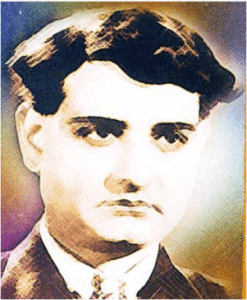
Kundan Lal Saigal was a singer and actor in the early days of Indian cinema. He is generally acknowledged as the first Bollywood superstar. Indeed, he was the first male superstar of Indian cinema who set the tone for musical melodramatic acting in the 1930s and 1940s. Saigal was born on April 11, 1904, at Nawanshahr in R.S. Pura, Jammu. His father, Amar Chand Saigal, was a Naib Tehsildar in the state revenue department. His mother, Kesar Kaur, was a deeply religious lady and very fond of music. She used to take young Kundan to various religious functions where bhajans, kirtans and shabads were sung in traditional styles. Kundan often accompanied his father to the interior parts of the state, where he imbibed the folk music of Punjab and Kashmir directly from shepherds and wandering minstrels.
As a child, he occasionally played Sita in the Ramlila at Diwan Mandir, Jammu. At the age of twelve, he got the opportunity to sing a Meera bhajan in the court of Maharaja Pratap Singh. The Maharaja was so impressed by the voice of little Kundan that he remarked that one day this child would shine in the world of music. When Saigal was thirteen, he lost his golden voice. He was upset and did not speak to anyone for several months. Seeing his condition, his mother became worried and approached a Sufi peer named Salman Yussuf to help him regain his lost voice.
He spent much time at the shrine of the Sufi saint Salman Yussuf, where he sang and practised along with other musicians and devotees. The singing tradition he assimilated had little classical rigour but emphasised the poetic blending of syllables into musical forms like the thumri and ghazal. His renditions of Mirza Ghalib’s poetry and his identification with its tragic iconography formed the famous Saigal persona.
As a young man, he had several occupations. After dropping out of school, he worked for a while as a railway timekeeper. Later, he worked as a typewriter salesman for the Remington Typewriter Company. This occupation gave him the opportunity to travel widely across India.
Throughout his travels, he continued singing on an amateur basis. He sang at gatherings with friends and met many people. On one such occasion, he met Meharchand Jain, who became one of Saigal’s early friends and supporters. During his travels, he also met B. N. Sircar, the founder of New Theatres. It is said that Sircar persuaded Saigal to go to Calcutta.
Saigal’s life in Calcutta was steeped in music. Although he briefly worked as a hotel manager, his real interest lay in the music scene. He was a frequent participant in mehfils. He also recorded a number of discs of songs written and arranged by Harishchandra Bali, which were released through the Indian Gramophone Company. His reputation as a singer steadily grew.
The film business at that time was undergoing a major transformation. The talking picture had just been introduced, and film companies were clamouring for actors who could sing. These were the days before playback singing came into vogue. Actors and actresses sang their own songs, and musical ability was considered an important prerequisite for a successful film career. Saigal’s immensely popular music recordings proved to be his stepping stone into films. While in Calcutta, Saigal was introduced to R. C. Boral, who signed him to a contract with New Theatres.
He was paid Rs 200 a month to work in their films. His first acting roles were in the Urdu films Subah Ke Sitare and Zinda Laash, released in 1932. Though these were not major hits, they demonstrated that Saigal possessed the qualities required for success in the film industry.
During this period, Saigal continued to record discs. The Hindustan Records Company of Calcutta brought out several discs, among which Jhulana Jhulao attracted considerable public attention. He went on to sing and act in a number of films. However, the film that made him famous was Chandidas (1934). After that, he received many offers, but the film that earned him a permanent place in film history was Devdas (1935). Following the phenomenal success of Devdas, there was no doubt that Saigal had become a formidable force in the film industry.
Saigal was fortunate to work with an institution like New Theatres, renowned for quality filmmaking. He featured in many of the studio’s masterpieces—Didi (Bengali) / President (Hindi) (1937), Saathi (Bengali) / Street Singer (Hindi) (1938), and Zindagi (1940).
In Street Singer, Saigal’s rendition of Babul Mora was performed live in front of the camera. Although playback singing had begun to gain acceptance, he convinced director Phani Majumdar that he could deliver a better performance live. Thus, Saigal literally “walked the streets” on the studio set, singing Babul Mora, with the entire orchestra following him just out of the camera’s frame. The result was sheer magic.
Seeing Saigal’s immense popularity, Sagar Movietone launched Surendra as an answer to him. Though Surendra went on to have a distinguished career of his own, Saigal remained incomparable. It was also during this period that Saigal’s personal life took shape. In 1935, he married Asha Rani. They had three children—a son, Madan Mohan (no connection with the music director of the same name), and two daughters, Nina (born 1937) and Bina. During his stay in Calcutta, Saigal also became proficient in Bengali.
(Ravi Rohmetra is freelance and a social worker and can be reached at (M): 9419652999; [email protected])