West Bengal is getting attention from Tokyo for its positioning as gateway to Asia
By Subrata Majumder
India is a vast country. It has long border stretching over the eastern region, which can act gateway to South East Asia. West Bengal has the longest international border, connecting the eastern region. West Bengal is better placed compared to Assam in acting as the gateway to South East Asia.
With the tectonic political shift, ending 34 years of rule the Left Front and 15 years rule by TMC, led by Mamata Banerjee, West Bengal witnesses a “new freshness” and moving towards a brighter future.
West Bengal is emerging a new and premier destination for foreign and domestic investment after the state election in May, 2026. Particularly for Japan, it is significant from the perspective of new vision for India as it is known as “eastern gateway of India”. Factors, attributing to its distinct characteristic and gateway to South East Asia, are strategic geographical location, critical role in Act East policy, logistic strength anchored by major port and surface trade, availability of skilled human capital and low operational cost due to cheap labour sources.
West Bengal has special advantages to edge other states. One, it is bestowed with ample natural resources under the soil of Sonar Bangla (fertile land and mineral resources ) and second its geographical location in the east, which anchors for border trade with four nations and gateway to South East Asia. Polarizing on these two strong parameters, which no other state embraces, West Bengal can usher a strong turf for border trade.
It can act pivot to India-ASEAN connectivity – the paradigm shift of Modi’s dynamism to rein in South East Asia under Act East policy.
Why did Japan initially choose Assam for India Summit? Is it the geopolitical significance or late Japanese Prime Minister Shinzo Abe’s failure to hold the Assam meet to establish a new gateway for economic penetration in South East Asia and counter China’s influence? The Annual India-Japan Summit, scheduled in Guwahati, Assam, by the late Japanese Prime Minister Shinzo Abe in December 2019, was cancelled due to widespread local protests and violence against CAA ( Citizen Amendment Act
During that period West Bengal was not vital destination for holding India summit. Because the state was engulfed by political insecurity and banished by global investors.
During long period of Shinzo Abe’s Prime Ministership, politicians and economists in both countries observed that the old approach of India-Japan relation is languishing. Global political turbulence led India-Japan strategic relation rallying behind the changes of geo-economic and geopolitical situations.
Currently, India is no more a destination for Japan only for natural resource procurement. It sparked as an important destination for investment and gateway to South East Asia. The geopolitical situation and global trade and investment relation of South East Asia turn vulnerable and susceptible to growing Chinese influence in the region.
RCEP (Regional Comprehensive Economic Partnership) and BRI (Belt and Road Initiative) are the cases in point. Both accelerate Chinese presence in South East Asia region. RCEP, comprising of 15 nations – ASEAN 10 +5, including Japan, but without USA – is a new challenge to global trade. It is driven by China. It accounts for nearly one-third of intra-RCEP trade. India is not a member of RCEP.
Given China’s predominance in the trade block, fears mounted over Chinese predatory role in the geo-economic situation in South East Asia. China used this platform to increase its global geopolitical influence and the global trade power. China used similar aggressive moves in grabbing global power through BRI, where several smaller nations were dragged into unbearable debt burdens in the name of infrastructure development.
Eventually, the last visit of Japanese Prime Minister Fumio Kishida, in March 2022, demonstrated a new vision for India-Japan relation. India’s Act East policy was re-energized, aligning with Japan’s FOIP (Free and Open Indo-Pacific) strategy. The main aim of FOIP is to counter security threats and promote economic cooperation in Indo-Pacific area.
Eventually, India-Japan Act East Forum was established. The main aim of this forum is to give a joint institutional approach and establish the core platform for collaboration in economic growth in the region through infrastructure development and industrial linkage in India’s Northeast.
FOIP committed support through Japanese ODA (Official Development Assistance) for development of infrastructure in India’s Northeast, paving the way for vital economic gateway to Southeast Asia.
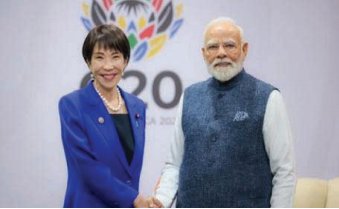
Prime Minster Sanao Takaichi never visited India. Nonetheless, she is well versed with India, by virtue of her close contact with India through diplomatic channel to increase self reliance and economic revival through bilateral relation.
Prime Minister Sanae Takaichi’s assertion to build India as a new power house to counter China could be one of the focus points for the summit in New Delhi on July 1 to 3.
To this end, India emerges a new economic ally for Japan. It opens new opportunity to combat Trump’s threat of high tariff and China’s growing influences in South East Asia.
For instance, Japanese investment in India surged by 386 percent in the post Abe period, from US$ 1,570 million in 2020 to US$7635 million in 2025. These unfold India as the second single biggest nation for receiving Japanese investment, outsmarting China and ASEAN.
West Bengal can provide a strong foundation for global value chain (GVC) manufacturing for South East Asia. In the wake of China loosing cost competitiveness, which resulted in foreign investors looking for alternatives, West Bengal can provide a propitious platform for GVC manufacturing operations between India and ASEAN. (IPA Service)