Aditya Pandey
In Jammu and Kashmir, people often talk about politics, development and security. But beyond these changes, there is a major problem of drug abuse, which is rapidly growing in the state, prevailing among the younger generation. According to a report of the Parliamentary Standing Committee on Social Justice and Empowerment, around 13.5 lakh people are consuming drugs, which is nearly 10% of the population. Another concerning trend is that around 1.68 lakh children aged between 10 and 17 are directly involved in the substance use. These numbers clearly show that drug abuse in the state is not a minor issue. It is a widespread social and public health concern.
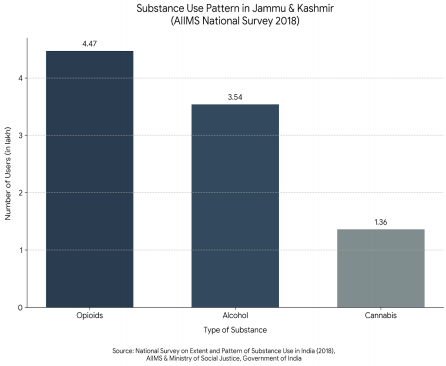
In 2018, the All India Institute of Medical Sciences (AIIMS) conducted a National Survey on the Extent and Pattern of Substance Use in India. It is estimated that around 4.47 lakh people in J&K rely on opioids, which include harmful substances like heroin. It also included that lakhs of people are directly affected by alcohol and cannabis use. What stands out from this data is the dominant use of opioids. Health experts and institutional reports suggest that there has been a shift from traditional substances to more dangerous drugs like heroin, which are more addictive and harmful. (Fig 1: Substance Use Pattern in Jammu & Kashmir – AIIMS 2018 Data)
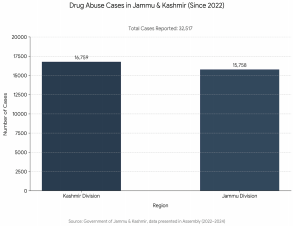
In recent years, government data shows that the problem has continued to grow. According to official stats, Addiction Treatment Facilities have recorded 32,517 cases of drug abuse in J&K since 2022. According to official figures released by the Ministry of Home Affairs and the National Crime Records Bureau (NCRB), J&K has witnessed a steady increase in narcotics-related cases and seizures in recent years. In addition, over 1,100 drug seizures were recorded alone in 2022, which highlighted the scale of drug trafficking and availability of drugs in the region. (Fig 2: Rising Drug Abuse Cases in J&K – Post-2022 Trend)
Meanwhile, institutional studies and health reports indicate that the nature of the drug is changing. There is an increase in injectable drugs, particularly heroin. Surveys conducted in the Kashmir Valley suggest that a significant number of users rely on intravenous drugs, which increases the risk of infections and long-term health complications. Doctors and researchers have also observed that many individuals begin using drugs at a very young age, often between adolescence and adulthood. Hence, this crisis can be considered a generational challenge, not just a health issue.
Recognising this problem, the Government of India has taken serious steps to address drug abuse in Jammu & Kashmir. One of the key initiatives is the Nasha Mukt Bharat Abhiyan (NMBA), which has been implemented across all districts of the Union Territory. According to a Press Information Bureau (PIB) release, the campaign has reached more than 91.5 lakh people in J&K, including more than 6 lakh youth, through awareness and outreach programs. The government also established treatment and rehabilitation centres, Addiction Treatment Facilities (ATFs) and Integrated Rehabilitation Centres for Addicts (IRCAs). These centres provide services such as counselling, detoxification, and long-term rehabilitation. Adding to this, local initiatives have also been introduced to involve communities in tackling the problem. Awareness campaigns in schools, colleges and even religious spaces are being used to spread information about the use of drugs.
Despite these efforts, the scale of the challenge remains significant. The data shows that drug abuse in J&K is not limited to only one district or one group. It is spread across regions, affecting both the divisions of Jammu and Kashmir, and impacts people from different social and economic backgrounds. The lack of information makes this crisis “invisible”. The numbers are available in government reports, surveys and official statements. However, it is not reported properly and does not receive the same level of public attention as compared to other issues. This issue can be tackled by a balanced and sustained response. There is a need for continued awareness, early intervention, better access to drug treatment and community support.
J&K today is going through a changing phase. Along with development and stability, it is equally important to address these social challenges. Drug abuse is one such challenge that requires attention, not just from the government, but from society too. This data clearly identifies the story. Lakhs of people are affected, thousands are seeking for help, and the problem is evolving day by day. The real question which rises is whether this invisible crisis will continue to grow quietly or will be addressed with urgency.
The writer is a student of M.A. in New Media Communications at the Indian Institute of Mass Communication (IIMC), Jammu.