Northlines Newsdesk
Tensions in the Middle East escalated dramatically after Israel launched a large-scale airstrike campaign targeting over 100 strategic sites across Iran. The strikes, which reportedly hit nuclear facilities, missile bases, and command centres, resulted in the deaths of senior Iranian military officials and nuclear scientists. Tehran condemned the action as a “declaration of war.”
The Israeli operation, dubbed Rising Lion, was described by Prime Minister Benjamin Netanyahu as a mission to dismantle Iran’s nuclear capabilities and military infrastructure. Speaking in a televised address, Netanyahu declared that Israel had struck “the heart of Iran’s nuclear and missile programmes,” specifically mentioning the Natanz enrichment plant and key scientists involved in weapons development.
The International Atomic Energy Agency (IAEA) confirmed that the Natanz facility had been hit but noted no rise in radiation levels. The UN nuclear watchdog has called for an emergency board meeting in light of the escalating crisis.
Iran’s Fars news agency reported at least 78 fatalities and more than 300 injuries resulting from the strikes. In response, Iran’s Supreme Leader Ayatollah Ali Khamenei vowed severe retaliation. The Islamic Revolutionary Guard Corps (IRGC) launched a swarm of drones—reportedly over 100—towards Israeli territory, according to Israeli military sources.
Netanyahu warned that the conflict could last for an extended period and urged Israeli citizens to prepare for possible prolonged sheltering. The Israeli Defense Forces (IDF) said that 200 fighter jets were involved in what it described as a “pre-emptive and precise” assault targeting military and nuclear infrastructure. According to the IDF, most of the IRGC’s air force senior leadership was eliminated during the offensive.
Iranian media reported the deaths of top military leaders, including IRGC commander Gen. Hossein Salami, Chief of Staff Gen. Mohammad Bagheri, and Gen. Gholamali Rashid of the joint forces. Additionally, six nuclear scientists, including former Atomic Energy chief Fereydoun Abbasi, were killed.
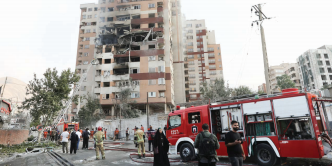
Residents in Tehran described a night of chaos and fear. Golnar, a woman living in Saadat Abad, recounted being jolted awake by a series of loud explosions that shook her building. “We didn’t know if it was war or a natural disaster,” she said. Another resident, Ahmad Moadi, expressed frustration, saying, “How long will we live in fear? We must respond decisively.”
The regional fallout was immediate. Iraq confirmed that Iranian drones had traversed its airspace, while Jordan stated it had intercepted multiple projectiles to prevent them from landing within its territory. Israel closed several diplomatic missions, and major airlines began rerouting flights across the region due to the heightened risk.
Former U.S. President Donald Trump praised the Israeli action as “excellent” and claimed the strikes followed a deadline he had set for Iran to come to the negotiating table. Although the Biden administration officially labeled the attack as an Israeli unilateral move, Trump suggested deeper coordination between the two allies. He hinted that Iran still had a “second chance” to return to diplomacy.
U.S. Secretary of State Marco Rubio reiterated that the U.S. had not participated directly in the strikes but acknowledged Washington had prior knowledge. Trump’s conflicting comments raised questions about the true extent of U.S. involvement and signaled internal divisions over strategy.
Global reactions have ranged from condemnation to calls for calm. Saudi Arabia criticized Israel’s military action, and the United Kingdom urged both sides to de-escalate immediately. Iran’s Foreign Ministry accused Washington of complicity and warned that the U.S. would be held responsible for the consequences of Israel’s “recklessness.”
The crisis unfolds just days before a new round of nuclear negotiations was scheduled to begin in Oman. The talks, already strained after the U.S. exit from the 2015 nuclear agreement in 2018, now appear uncertain amid the mounting violence. Analysts fear the confrontation may spiral into a broader conflict with severe implications for global security and energy markets.
The IAEA has recently ruled Iran in breach of its obligations under the nuclear non-proliferation treaty, citing a stockpile of 400kg of highly enriched uranium and limited cooperation with inspectors. While Western intelligence agencies have previously believed Iran had not decided to build nuclear weapons, Israeli officials now claim Iran was dangerously close to crossing that threshold.
With no clear end in sight, the world watches anxiously as two of the region’s most powerful rivals stand on the brink of full-scale war.
India calls for restraint
India on Friday expressed deep concern over escalating tensions between Iran and Israel, urging both sides to de-escalate and prioritise dialogue, as Israel launched widespread strikes and Iran responded with drones.
The Ministry of External Affairs (MEA) stated it is “deeply concerned at the recent developments between Iran and Israel,” adding, “We are closely monitoring the evolving situation, including reports related to attacks on nuclear sites.”
India called on both nations to “avoid any escalatory steps” and that “existing channels of dialogue and diplomacy should be utilised to work towards a de-escalation of the situation and resolving underlying issues.”
The MEA said that India shares close and friendly relations with both Iran and Israel and “stands ready to extend all possible support.”
The government also said Indian embassies in both countries are in touch with the Indian community, and urged Indian nationals in the region to exercise caution, stay safe, and follow local security advisories.
The remarks came hours after Israel launched preemptive strikes across Iran, targeting nuclear and ballistic missile facilities and killing high-ranking military officials. Israeli military spokesperson Brig. Gen. Effie Defrin said Iran responded by launching around 100 drones, which Israel is working to intercept.
Omar terms Israel’s attack unjustified
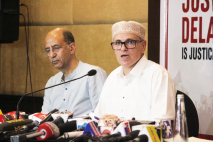
Srinagar, Jun 13: Terming Israel’s attack on Iran as “unjustified” Jammu and Kashmir Chief Minister Omar Abdullah on Friday said that escalation between the two countries will have direct impact on people in the sub-continent.
Talking to the reporters here, Omar, as per the news agency, said that “the attack will have a direct impact on our fuel prices, stock market, flights to ply to the west and more than that it will have an impact on sentiments of the people.”
According to Omar, Israel did not give any reason for this strike. “Israel has waged war on a country by calling it a pre-emptive attack. Israel did the same thing that Russia did in Ukraine. It will be unfortunate if the world remains silent on the issue,” he said.
“The attack on Iran is not justified like the way Russia’s attack on Ukraine was wrong,” he said.
Earlier, Israel said early on Friday that it struck Iran while Iranian media said explosions were heard in Tehran. Israel has also declared a state of emergency in anticipation of a missile and drone strike by Tehran.
Meanwhile, Omar termed the plane crash in Ahmedabad as unfortunate, hoping that the reasons behind the incident will be brought to the public and such incidents will not occur again. He also expressed sympathies with the families of victims.
Pertinently, 241 people were killed while only one person survived after Air India’s flight to London crashed in Ahmedabad.