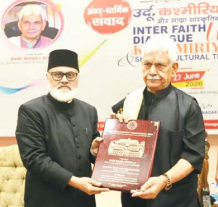
Calls Kashmiriyat a reflection of India’s enduring unity in diversity
Srinagar, Jun 27: Jammu and Kashmir Lieutenant Governor Manoj Sinha on Saturday said India’s civilisational identity is founded on inclusivity, mutual respect and coexistence, asserting that the country has never imposed any religion on others or asked anyone to abandon their faith.
Addressing an Interfaith Dialogue at the Sher-i-Kashmir International Conference Centre (SKICC) here, Sinha said the gathering represented India’s timeless traditions of wisdom, dialogue, tolerance and peaceful coexistence.
“India has always welcomed people of different beliefs with the message: come with your faith and live with us,” he said, adding that the country’s civilisation has nurtured diverse philosophies, cultures and religions for centuries while treating diversity as a source of strength rather than conflict.
Explaining the concept of Dharma, the Lieutenant Governor said it transcends sectarian boundaries and embodies righteousness, duty and values that sustain society. Referring to the Rig Veda and Atharva Veda, he said ancient Indian scriptures envisaged humanity as one family living together in harmony despite differences in belief and modes of worship.
“I call this Bharatiyata,” Sinha said, adding that even Sufi saint Khwaja Moinuddin Chishti had described this spirit as the essence of Hindustan.
Describing Jammu and Kashmir as the crown of India’s civilisational heritage, Sinha said Kashmiriyat embodies the ideals of Bharatiyata and is rooted in compassion, coexistence, tolerance and mutual respect.
“People often use the word Kashmiriyat, which springs from the philosophy of Bharatiyata and symbolises equal respect for all religions, cultures and traditions,” he said.
The Lieutenant Governor said India’s long-standing tradition of providing refuge to persecuted communities without compelling them to renounce their faith reflects its inclusive ethos.
Quoting a Kashmiri couplet and invoking Mahatma Gandhi, Sinha stressed that humanity’s shared spiritual values must prevail over divisions and that ideals acquire meaning only when translated into action.
He also announced that a high-level meeting would be held later in the day to review arrangements for the forthcoming Shri Amarnath Yatra.
Kashmir must uphold legacy of coexistence: Dr Karan
Srinagar, Jun 27: Former Sadr-e-Riyasat Dr Karan Singh on Saturday urged the people of Jammu and Kashmir to preserve the Valley’s centuries-old tradition of communal harmony, interfaith understanding and cultural pluralism, recalling Mahatma Gandhi’s description of Kashmir as a “ray of hope” during the turmoil of Partition.
Speaking at the Interfaith Dialogue at SKICC, Dr Singh said Kashmir earned that distinction because of its enduring culture of coexistence and mutual respect among communities.
Calling Kashmir the “crown of India”, he said the region’s composite ethos should be strengthened by safeguarding its shared cultural and spiritual heritage for future generations.
Dr Singh congratulated the organisers for bringing together discussions on interfaith dialogue, Urdu, Kashmiriyat and communal harmony under one platform, describing these themes as integral to Kashmir’s civilisational identity.
Tracing the evolution of the interfaith movement, he referred to the 1893 Parliament of the World’s Religions in Chicago, where Swami Vivekananda projected India’s message of universal acceptance, and said the movement has since evolved into a global forum for promoting understanding among faiths.
“Interfaith dialogue is not about proving the superiority of one religion over another. Its purpose is to understand each other and strengthen harmony,” he said.
Quoting the Rig Vedic verse Ekam Sat Vipra Bahudha Vadanti, Dr Singh said truth is one though expressed in different ways, and that different faiths ultimately lead to the same Divine destination.
He also proposed the establishment of a permanent Interfaith Dialogue Centre in Jammu and Kashmir to institutionalise dialogue among religious communities and reinforce the Valley’s tradition of peaceful coexistence.