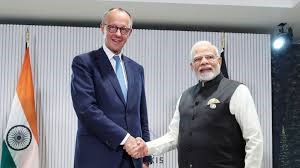
Gandhinagar, Jan 12: Prime Minister Narendra Modi said that the Indo-Pacific is a “high priority” for both India and Germany, and both countries have agreed to launch a “consultation mechanism” to enhance cooperation in the region and work on a “secure” and “resilient supply chains”.
Addressing a joint press meet with German Chancellor Friedrich Merz, PM Modi said, “The Indo-Pacific is a high priority for both countries. We are going to launch a consultation mechanism to enhance cooperation in this region. Today, we discussed in detail several global and regional issues, including Ukraine and Gaza.”
Upholding that dialogue is the way to bring and establish peace in the region, PM Modi said, “India stands for the peaceful resolution of all problems and disputes and supports all efforts being made in this direction. We are unanimous that terrorism is the ultimate evil of humanity. India and Germany will come together and continue to fight it resolutely. India and Germany agree that reform of global institutions is vital to address global challenges.”
On bilateral cooperation, PM Modi highlighted, “I express my gratitude to Chancellor Merz for the announcement of visa-free transit for Indian citizens. This will further strengthen the ties between the people of both countries. I am happy that the German Maritime Museum is collaborating with the National Maritime Heritage Complex being built in Lothal, Gujarat. This is a historic step that connects the maritime history of both countries. Gujarat Ayurveda University has had close cooperation with Germany in traditional medicine. The MoU being signed today on this important subject will further strengthen our cooperation.”
He also emphasised India and Germany’s cooperation on global issues. “India and Germany have always walked shoulder to shoulder. The impact of our friendship is global. Our trilateral development partnership with joint projects in countries like Ghana, Cameroon, and Malawi is a successful model for the world. We will continue our joint efforts for the development of countries in the Global South,” he said.
While reiterating that institutional reforms in the global bodies in the present era are of utmost importance, PM Modi said, “India and Germany agree that reforming global institutions to address global challenges is extremely important. Our joint effort through the G4 for reform in the UN Security Council is proof of this thinking.”
On education and people-to-people ties, he added, “Today’s Comprehensive Roadmap on Higher Education will give a new direction to our partnership in the field of education. I invite German universities to open their campuses in India. There are historic and deep people-to-people ties between India and Germany. The works of Rabindranath Tagore gave a new perspective to the intellectual world of Germany. The ideology of Swami Vivekananda inspired the whole of Europe, including Germany. And Madam Cama, by hoisting the flag of India’s independence for the first time in Germany, gave global recognition to our aspiration for freedom.”
On defence, security, and technology cooperation, PM Modi stated, “The growing cooperation in defence and security is a symbol of our mutual trust and shared thinking. I sincerely thank Chancellor Merz for simplifying the processes related to defence trade. We will also work on a roadmap to enhance cooperation between our defence industries, which will open new opportunities for co-development and co-production. The technology cooperation between India and Germany has strengthened year by year, and today its impact is clearly visible on the ground. In the field of Renewable Energy, the priorities of India and Germany are the same.”
PM Modi said the visit of Chancellor Merz is taking place at a special time. Last year, we completed 25 years of our strategic partnership, and this year both countries are also celebrating 75 years of our diplomatic relations. These milestones are not just achievements of time; they are symbols of our shared aspirations, mutual trust, and continuously strengthening cooperation.” (UNI)