
By Er. Rajesh Pathak
Launching not an attack on the enemy fleeing the battle with his back turned; granting pardon to the enemy fallen into one’s hands; raising not arms against an unarmed adversary; backtracking not from the promise once given, come what may; unconcerned with victory or defeat on the battlefield, sacrificing life in the battlefield being held as a matter of valour and glory — such was the exclusivist outlook towards human virtues which Indian kings could not part with, failing to discern the new kind of barbaric and cunning enemies of a jihadist mindset beyond the border. This led the country to succumb and suffer the ignominy of slavery and the secession of its territories one by one into the hands of invading opponents.
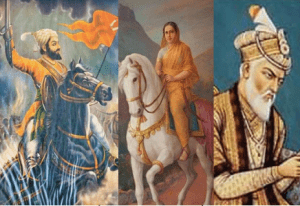
However, it was ultimately in the late medieval period that, for the first time, one ruler in the true sense discerned the deceptive tactics of invaders, defeated them at their own game, and successfully laid the foundation of the downfall of the Mughals — he was the great Maratha Hindu king Shivaji. It was a time when Hindu kings and vassals, by and large, had the sole priority of somehow saving their respective territories by appeasing the foreign invaders. Initiating an attack on them was something they couldn’t even think of. But as Shivaji laid the foundation of Maratha power, he opened the war front against the Mughals by launching fierce attacks, tearing into their military capabilities and empire as a whole. Utterly inferior as he had been before Muslim rulers in both strength and resources, the strategy he adopted earned glory in the annals of history as ‘Guerilla warfare’. Using dexterously the maze-like terrains of the Sahyadri mountains, forming a force of its brave tribal inhabitants, the Mavlays, led by Tanhaji Malsure, he dealt one setback after another to the enemies. Gradually he gained the upper hand; and as his strength increased, he began to attack the Mughals openly. And with the shattering defeats dealt upon Mughal forces led by Aurangzeb in the open battle of Salher in 1672, Maratha warriors even forced the opponents to adopt a defensive stance!
Away from the capital for one and a half years, Shivaji then successfully fulfilled the famous ‘Karnataka mission’. With his able administration and planned strategy, he won one battle after another, and founded a separate sovereign Maratha state extending more than 700 miles down to the southern part of the country, the famous Jinji fort near Chennai being its tip.
Emulating the ways shown by Shivaji, the Marathas later grew into so formidable a force that Aurangzeb, frustrated, even went so far as to propose a truce with them. But by then it was too late; his proposal met with outright rejection by Maratha power. And from this shock of contempt, which he could never have expected, he could gain redemption only when death embraced him.
And, particularly after 1740, it was when the Mughals weakened during the reign of Mohammad Shah that the real power of the country had shrunk into the hands of the Marathas. During 1755–1756, under Raghunath Rao and Malhar Rao Holkar, they dealt decisive defeat to the Rohillas and Afghans and succeeded in liberating Punjab after 800 years from foreign control. And, replacing Muslim rulers, at one point in time the Hindu Maratha dynasts had rooted their rule firmly, extending from Attock (Peshawar) in the north down to Tanjavur (Tamil Nadu) in the south; and from entire Gujarat in the west to the Hugli River (Bengal) in the east. Rising above caste, creed, and regional pride, the Hindu community should keep in mind that their existence today is the result of the complete decimation of Mughal power under Aurangzeb by their brave ancestors in the past.
The historian ML Shrivastava writes that in this great war, in order to subdue Maratha warriors, Aurangzeb had fuelled the whole of the resources of his vast empire from Bharuch to Bengal and from Kabul to the threshold of south India. This was a fight between a small “lamp” and a “storm”. But by the dint of their courage and prowess on the battlefield, the Hindu Marathas successfully turned the result in their favour.