A Hindu devotee-funded medical college caught between faith, regulation and a broken admission framework
Rattan Singh Gill
The first MBBS batch at shrine-funded institute sparks protests, exposes systemic faultlines, and revives debate on Hindu minority rights in J&K
What should have been a routine academic exercise—the admission of the first MBBS batch at the Shri Mata Vaishno Devi Institute of Medical Excellence (SMVDIME)—has snowballed into one of the most emotionally charged controversies in recent years.
With the formation of the Shri Mata Vaishno Devi Sangharsh Samiti (SMVSS), a consortium of organisations demanding the scrapping of the admission list, anxiety has intensified across Jammu, within SMVDIME, and among the maiden MBBS batch. The controversy has triggered strong reactions from devotees, civil society, and political groups, exposing long-ignored governance flaws within the Shrine Board and inconsistencies in J&K’s professional admission framework.
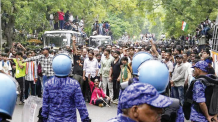
Established entirely from Hindu devotees’ offerings at the revered Shri Mata Vaishno Devi Shrine, SMVDIME was envisioned as a flagship institution to impart medical education and strengthen healthcare delivery. However, the admission outcome of the first published list on 25.10.2025—42 out of 50 seats allotted to Muslim candidates and only eight to Hindus—sparked widespread unrest. The Northlines was the first to publish the detailed report on 6 November 2025, which went viral. Interestingly, during the peak of public outrage, the number of Hindu candidates further declined after resignations, adjustments and mop-up counselling as per BOPEE’s final selection list of 18 November. This has shaken public confidence and ignited an unending series of protests.
A late entrant in counselling: A structural trigger for the imbalance
J&K BOPEE issued the first Provisional Merit List (PML) on 1 August 2025 for admission counselling scheduled throughout August. SMVDIME, however, entered the counselling process only in late September, after the National Medical Commission granted approval for 50 MBBS seats on 15.09.2025. By then, most meritorious candidates had already exercised their preferences and secured seats in the 11 Government Medical Colleges and the single private medical college (ASCOMS) during the first two rounds.
As a late entrant, SMVDIME figured only in the third and mop-up rounds, when the active choice pool had narrowed significantly. Worse, students from Jammu province were unaware that seats would become available in SMVDIME because the institute’s name and its sanctioned intake were missing from BOPEE’s official E-Brochure.
These procedural lapses raise serious concerns about transparency, timely disclosure, and systemic oversight. Many Jammu-based candidates—especially female aspirants who would have preferred a nearby shrine-linked institution—were effectively deprived of the opportunity to exercise informed choice during the crucial first two rounds.
Faultlines at inception: A Hindu shrine-funded project conceived without protective architecture
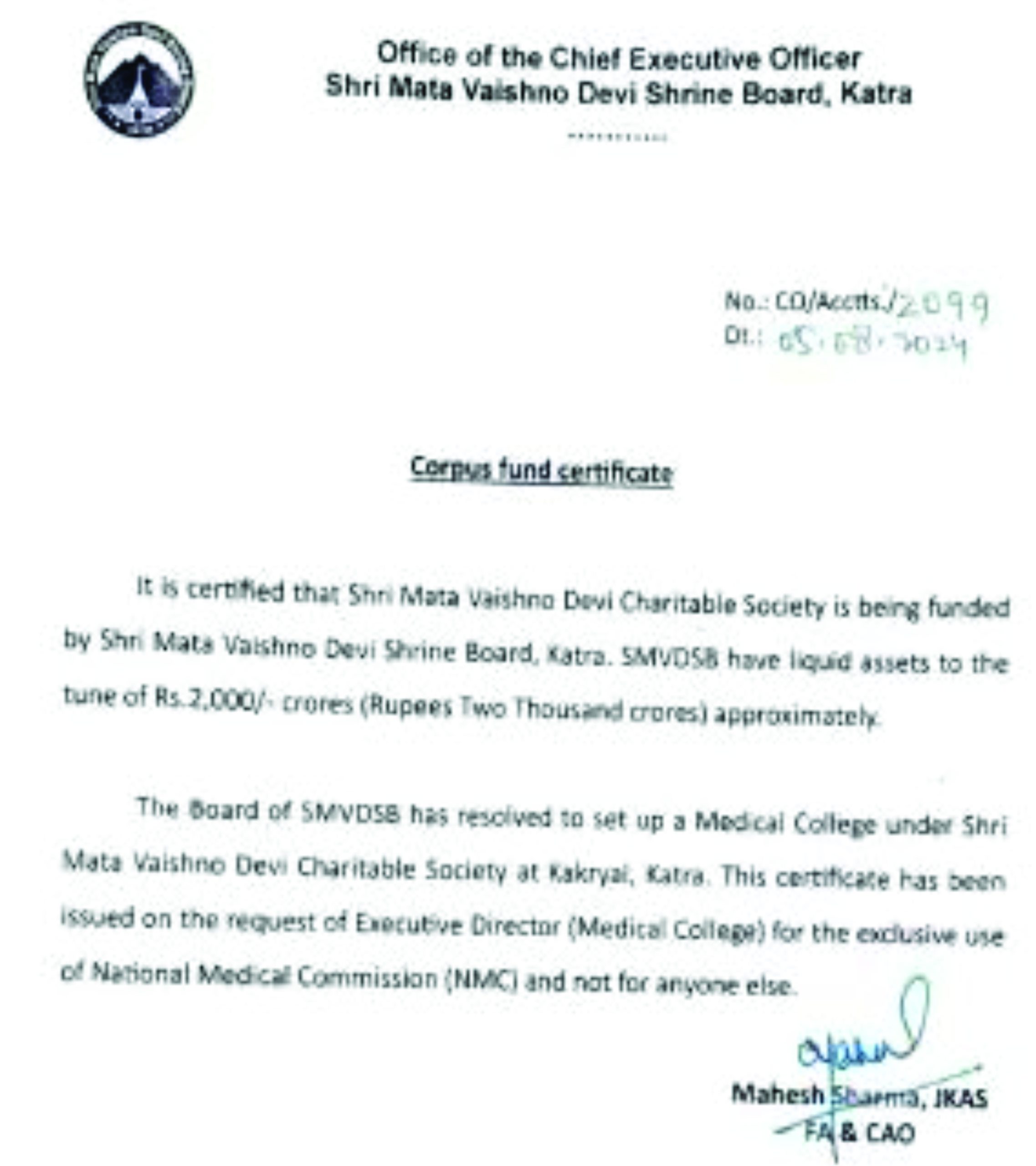
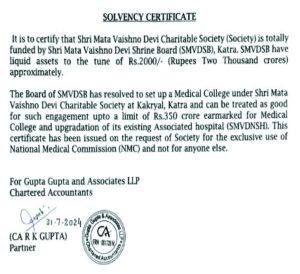
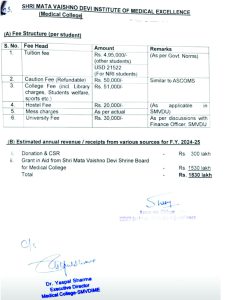
In its 73rd Board Meeting, the SMVDSB approved additional grant-in-aid to the Shri Mata Vaishno Devi Charitable Society to operate peripheral institutions such as the SMVDIME Medical College, Hospital, Gurukul, Sports Complex and College of Nursing. Corpus fund certificates, solvency certificates and NMC submissions confirm that over ₹600 crore came exclusively from Hindu devotees.
While the intent was noble—to enhance healthcare, foster medical excellence and create educational avenues—the planners failed to consider a crucial fact:
A shrine-funded institution must operate within a legal and regulatory framework that protects the aspirations, cultural ecosystem and sentiments of the community funding it.
Instead, SMVDIME was absorbed into a general admission pipeline governed by BOPEE norms, devoid of any institutional preference or minority safeguards.
Political overreaction and Kashmir-Centric narratives inflame the crisis
Resentment in Jammu is emotional—not communal
Many Hindu organisations argue that the imbalance contradicts the foundational ethos of a shrine-funded institution.
NC leadership escalates tensions
Rather than acknowledging systemic lapses, several NC leaders—including Omar Abdullah—responded with provocative rhetoric:
- “Remove secularism from the Constitution if you want Hindu-only seats.”
(Ironically, Omar must look back at history to understand why the Kashmir-dominated Constituent Assembly did not include the word ‘Secular’ in the J&K Constitution, and why — and by whom — a 2007 Bill seeking to incorporate the term ‘Secular’, was opposed and blocked in the then J&K Assembly.)
- “Give back the land.”
(The Shrine Board’s land belongs to the local shrine, not the government.) - “If your children don’t make merit, why blame Kashmiri students?”
(A remark perceived as contemptuous, projecting Kashmiri superiority over Jammu’s youth.)
These statements trivialised devotees’ concerns and deepened regional divides.
The Wire’s misleading narrative
The Wire suggested that since SMVDU received grant-in-aid from the “Muslim-majority government” of J&K, and because SMVDU manages the newly opened SMVDIME, Hindu groups were wrong to claim that the institute was built and run solely on Hindu donations.
This is inaccurate. The ₹121.30 crore grant-in-aid since 2016-17 was given to SMVDU, not SMVDIME, which is the epicentre of the controversy. SMVDIME, though academically affiliated with SMVDU, is a distinct entity administered by SMVDSB. Conflating the two misled the public and fuelled false narratives aimed at delegitimising Hindu grievances.
Religious Obligations vs. Secular Mandate
A grey zone of institutional purpose
The SMVDSB’s statutory mandate under Section 18(6) of the Shrine Board Act focuses on pilgrim welfare, shrine management, religious-cultural activities and broad “general education.”
Whether highly specialised professional courses like MBBS fall within this mandate remains a debatable issue.
Devotees argue that offerings cannot be used for such specialised expansion without community safeguards. Many feel:
“Why should Hindu offerings fund an institution where Hindu students become a rare minority?”
The sentiment is emotional but not communal—it reflects expectations rooted in faith-led contributions.
Admission framework collides with societal expectations
With SMVDIME funded entirely by Hindu devotees, the public assumed that Hindu students would not be structurally disadvantaged. Yet BOPEE’s open-merit counselling model automatically skewed selections toward regions with higher NEET participation—primarily Kashmir.
Experts point out that while NEET norms were followed and BOPEE acted within regulations, the system itself failed to protect the cultural character of a shrine-funded institution.
No procedural violation—but a structural injustice
- NEET rules were followed
- BOPEE acted as per regulations
- The imbalance is a policy failure, not manipulation
Yet the consequences are severe:
- Public uproar across Jammu and beyond
- Emotional hurt among devotees
- Institutional embarrassment for the Shrine Board
- Oversight failures exposed
A shrine-funded private institution was unintentionally treated like a general-category UT institution—unlike minority-run institutions (AMU, BGSBU, ASCOMS) that operate under clearly defined minority frameworks.
Key anomalies in the 2025–26 Admission cycle
- SMVDIME missing from BOPEE’s E-Brochure
Students were deprived of informed choice. - NMC approval came only in mid-September
Two major rounds of counselling were already completed. - Appearing only in Round-3 skewed demographics
The remaining candidate pool was Kashmir-dominant. - Mop-up round further reduced Hindu representation
Resignations and re-allotments exacerbated the imbalance.
Why SMVDIME should seek Hindu Minority status
The crisis stems from a mismatch between the institution’s purpose and its regulatory structure.
Legal basis for Hindu minority status in J&K:
- Article 30 applies fully to J&K UT
- Minority status is state/UT-specific
- Hindus are a minority in J&K
- UTs with legislatures enjoy state-equivalent Article 30 rights
SMVDIME meets all criteria:
- Established by a Hindu statutory religious body
- Funded by Hindu devotees’ offerings
- Administered by a Hindu charitable society
- Created to serve a shrine-linked welfare ecosystem
It is a textbook case for immediate minority-institution recognition.
NCMEI Act, 2004 provides remedy
If UT authorities delay, SMVDIME can directly approach NCMEI under Section 11. Its decisions are binding.
Precedents already exist in Jammu
- ASCOMS (Hindu minority quota)
- Mahant Bachittar Singh Engineering College (Sikh minority quota)
The fact that SMVDSB did not pursue a similar framework is a glaring oversight.
The Way forward
This crisis is not about challenging merit. It is about realigning:
- Devotee sentiment
- Institutional character
- Legal rights
- Governance frameworks
Urgent actions required:
- Amend Section 18 of the SMVDSB Act, especially sub-section 6, to broaden the mandate.
- Declare SMVDIME a Hindu Minority Institutionunder Article 30.
- Adopt a special admission model: 50% Hindu minority quota + 50% open merit.
- Fix BOPEE’s procedural lapsesfor future cycles.
- Establish transparent, culturally aligned institutional guidelineswith disciplinary safeguards.
- Protect the dignity and expectations of devotees without compromising meritocracy.