Sunil Dutt
Jammu Tawi, July 16: Across the Government Medical College (GMC) Jammu and its affiliated hospitals, women doctors employed on contractual or academic arrangement terms—including Assistant Professors, Lecturers, and Casualty Medical Officers—are being denied paid maternity leave after childbirth. This denial comes even as the government extends such benefits to comparable or even junior staff elsewhere within its health services.
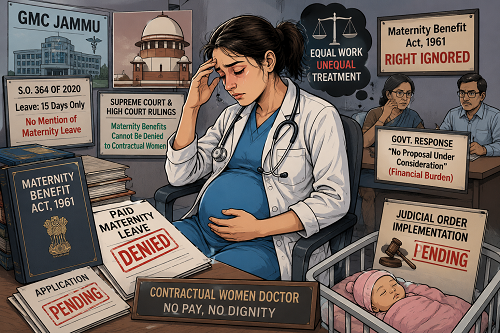
The issue stems from Service Order (S.O.) 364 of 2020, which governs contractual medical appointments in the Union Territory. While the order limits leave to just 15 days, it makes no mention of maternity leave. Administratively, this silence has been interpreted as a refusal to grant maternity benefits under the Maternity Benefit Act, 1961. Consequently, many new mothers—some recovering from cesarean sections or high-risk pregnancies—are left without any salary for months following childbirth.
The inconsistency is stark. A National Health Mission order dated August 5, 2023, grants 26 weeks of paid maternity leave, including honorarium, to contractual medical officers and healthcare staff. Further, a Health and Medical Education Department order (No. 451-JK(HME) of 2024, dated July 8, 2024) extended full maternity leave and pay protection to postgraduate students, senior residents, tutors, and DNB candidates—categories considered equivalent in rank to the very doctors now being denied these benefits.
The government’s stance was made clear earlier this year. On February 17, 2026, responding to a question in the Jammu and Kashmir Legislative Assembly from BJP MLA Shagun Parihar, Health and Medical Education Minister Sakina Itoo stated that no proposal to extend maternity leave benefits with honorarium to contractual women employees was under consideration, citing the financial burden such a move would place on the administration.
However, judicial rulings have consistently upheld the rights of contractual women workers to maternity benefits. The Supreme Court, in landmark cases such as Municipal Corporation of Delhi v. Female Workers (Muster Roll) (2000) 3 SCC 224 and Dr. Kavita Yadav v. Secretary, Ministry of Health & Family Welfare (2024) 1 SCC 421, clarified that maternity benefits cannot be denied merely due to contractual or muster-roll status. This principle was reinforced in Deepika Singh v. Central Administrative Tribunal. Locally, the Jammu & Kashmir and Ladakh High Court has applied the same reasoning in cases like Jammu and Kashmir Bank Ltd. v. Tanu Gupta and Dr. Sonakshi Gupta v. Union Territory of J&K & Ors.
Despite these clear legal precedents, administrative compliance remains an issue. In a notable case, the Central Administrative Tribunal’s Jammu Bench, in a December 12, 2025 ruling on Dr. Tanu Jamwal v. Union Territory of J&K, described the GMC administration’s conduct as “cavalier” and imposed punitive costs of ₹25,000 for willful non-compliance with earlier directions. Yet, nearly seven months later, the order remains unimplemented.
A troubling pattern emerges: applications for maternity leave are left pending indefinitely, files are intercepted before reaching decision-makers, and fresh rejections are issued citing S.O. 364—even after judicial rulings have made clear the entitlement of these women doctors. The problem, it appears, lies not in the law, which has been decisively settled, but in the administration’s unwillingness to implement it—while the government maintains its policy position in legislative forums.
This ongoing crisis highlights a disturbing gap between judicial mandates and administrative action, leaving many contractual women doctors to face pregnancy and motherhood without the dignity and financial security they deserve.