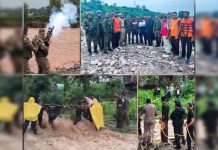
‘Op Sindoor’, capability upgrades emerge as landmark moves
Jammu Tawi, Dec 30: As 2025 draws to a close, the Indian Army has outlined ten pivotal milestones, led by Operation Sindoor, a calibrated military response to the April Pahalgam terror attack that reinforced deterrence and reshaped security dynamics in Jammu and Kashmir.
The year was marked by decisive action against cross-border terrorism, major capability enhancements, and a strong push for indigenisation and innovation, positioning the Army as a future-ready force.
Operation Sindoor
Launched in May 2025, Operation Sindoor stands among the most significant counter-terror operations in recent decades. Executed with precision and restraint, it targeted terror infrastructure across the border in response to the April 22 Pahalgam attack, which killed 26 tourists in the Baisaran meadows of Anantnag district. The attack aimed to disrupt tourism and challenge security gains post-Article 370, drawing widespread international condemnation and prompting India’s calibrated response.
Planning and execution
Initiated on the night of May 7–8, Operation Sindoor was a joint endeavour focused on precision strikes while avoiding escalation. Planning was undertaken by the Army’s Military Operations Branch and monitored in real time by the Directorate General of Military Operations, with oversight from the Chief of Defence Staff and the Service Chiefs.
Nine terror camps linked to Jaish-e-Mohammed, Lashkar-e-Taiba and Hizbul Mujahideen were destroyed—seven by the Army and two by the Indian Air Force. Along the Line of Control (LoC), over a dozen launch pads were dismantled, disrupting infiltration routes and logistics networks.
India maintained that no Pakistani military or civilian targets were hit. Pakistan responded with drone and missile attempts between May 7 and 10, most of which were neutralised by integrated air defence systems, including the S-400 and indigenous Akashteer. On May 10, Pakistan’s DGMO sought a ceasefire, leading to an understanding to halt military action. The operation significantly degraded terror logistics and led to reduced infiltration attempts through the year.
Security gains
Operation Sindoor strengthened counter-insurgency efforts, enabling greater focus on development and normalcy. Follow-up actions, including Operation Mahadev, neutralised key perpetrators linked to the Pahalgam attack, contributing to a decline in violence across Jammu and Kashmir.
Capability enhancements
The Army prioritised technology upgrades in 2025. A BrahMos unit conducted a successful combat missile launch on December 1, validating high-speed manoeuvrability and precision, while work on extended-range variants progressed. Two additional Pinaka rocket regiments became operational in June, and on December 29, the Pinaka Long Range Guided Rocket achieved a range of about 120 km.
Army Aviation was strengthened with the full induction of six AH-64E Apache attack helicopters, enhancing all-weather precision strike capability. New organisational concepts also moved to field deployment, with demonstrations of Bhairav Battalions and Ashni Platoons integrating drones, loiter munitions and ISR systems. Plans are underway to raise 25 Bhairav Battalions and additional specialised units.
Indigenisation and innovation
Building on the “Years of Tech Absorption” initiative, the Army achieved 91 per cent indigenisation of ammunition. Major inductions included nearly 3,000 unmanned aerial systems, swarm drones and high-altitude logistics platforms. Defence Acquisition Council approvals prioritised night-fighting systems, long-endurance RPAs and counter-drone technologies.
Strategic outreach
The Chanakya Defence Dialogue and the Inno-Yoddha initiative further strengthened strategic discourse and grassroots innovation.
As 2025 ends, the Indian Army emerges more assertive, technologically advanced and strategically aligned, ready to meet emerging security challenges.