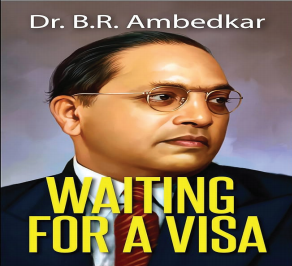
By Shaleen Mahajan
In an era when equality, constitutional morality, and human rights dominate public discussion, Waiting for a Visa remains urgently relevant. Written by B. R. Ambedkar, this brief yet powerful work is not merely an autobiography; it is a documented exposure of caste as a lived system of exclusion. Unlike conventional life narratives that celebrate achievement, this text presents selected episodes of humiliation and resistance.
In Waiting for a Visa, B. R. Ambedkar gives a short yet deeply meaningful glimpse into his life. He brings attention to the moral, social, and cultural realities that shaped his journey. Through simple but powerful episodes, we see not only his public struggles but also his inner strength and sensitivity. He also recalls the experiences of others who suffered under caste discrimination, showing that his story was part of a larger collective pain. Known across the nation as the Father of the Indian Constitution and one of India’s greatest thinkers, Ambedkar sets aside that towering image in this book. Here, he writes not as a lawmaker or national leader, but as a man who personally faced and endured systematic injustice.
At the heart of Waiting for a Visa lies a painful yet powerful exposure of untouchability as a lived social reality. The central conflict of the narrative unfolds like a quiet but relentless struggle. On one side stand compassion, dignity, and the basic human longing to be treated with respect; on the other stand humiliation, cruel language, blind superstition, and the rigid harshness of caste hierarchy.
He recounts his repeated struggles for the most basic necessities like education, water, food, shelter, and safety. These are not privileges but essential conditions of human survival. Each denial is deeply personal, yet his response is marked not by bitterness but by resilience. His perseverance in securing these rights is profoundly inspiring. Guided by values such as patience, courage, self-respect, and moral discipline, he confronts deeply entrenched prejudice. His resistance is calm and principled; it is a form of moral protest grounded in dignity rather than anger.
The episode of the journey to Koregaon in his childhood exemplifies this realism. After his mother’s death, Ambedkar and his siblings were raised by their physically disabled yet compassionate aunt while their father worked away from home. Despite her limitations, her kindness shaped his moral consciousness. The children survived on simple meals they cooked themselves. When invited to Koregaon, they were denied transportation at Masur railway station because cart-men refused to carry “untouchable” children. A humiliating compromise followed: they had to pay double fare and drive the cart themselves while the cart-man walked beside it to avoid “pollution.” During the journey, they feared for their safety, suspecting harm. Later, they were denied water at a toll-collector’s hut and spent the night hungry and thirsty. These details reveal how untouchability produced not only humiliation but also insecurity and fear.
In school, discrimination was institutionalized. Ambedkar had to sit separately on a gunny sack that he carried himself. He could drink water only if the peon poured it from a height, an experience captured in his famous phrase, “No peon, no water.” Barbers refused to cut his hair; the washermen refused to wash his clothes. Such routine humiliations reflect systematic degradation affecting every sphere of life.
The second chapter marks his return to India after completing his higher education abroad. His years in Europe and America had briefly allowed him to live without the constant shadow of caste. For a while, his identity did not define his worth. But the moment he reached Baroda, the harsh truth returned, he could not even find a place to stay.
In desperation to avoid humiliation, he took shelter in a Parsi inn under a false name, hoping that followers of Zoroastrianism might not believe in untouchability. For eleven days, he lived quietly, carrying both fear and hope within him. When his real identity was discovered, a group of men surrounded him with sticks, accusing him of polluting the inn and demanding that he leave immediately. The attack was not physical, but the shame and rejection cut deeply.
He later described the inn as a dungeon, not because of its walls, but because of the loneliness and fear it held for him. Even in that painful isolation, he did not allow himself to fall apart. Instead, he sought refuge in books and quietly strengthening his mind through reading. The very experience that was meant to humiliate and break him ultimately deepened his determination.
Even professional status did not erase stigma. As a probationer in the Accountant General’s Office under the Maharaja of Baroda, he still lived on the margins. Colleagues showed quiet sympathy, yet most kept their distance, afraid of social consequences. The prejudice he faced was not confined to one religion or community; it was woven into everyday life.Ultimately, he realized that untouchability denied not only equality but even the basic right to shelter.The later chapters broaden the narrative to include collective experiences. The Chalisgaon incident of 1929 reveals how caste hierarchy overrode professional merit. While serving on a committee investigating oppression against Dalits, Ambedkar was invited to Maharwada. A Hindu cart driver refused to drive him because of caste identity. A substitute driver’s inexperience led to an accident that injured Ambedkar. This episode exposed a harsh truth: birth-based hierarchy could render a barrister inferior to a cart driver in social perception.
Similarly, the Daulatabad Fort incident of 1934 shows how the denial of water became a denial of basic humanity. Members of his group were accused of polluting a public tank and were met with harsh words and humiliation. An armed guard was stationed to watch over them, as if their very presence were a threat. In that moment, something as simple and life-giving as water was turned into a tool of exclusion. Untouchability, Ambedkar makes clear, was not limited to any one religious community; it operated as a deeply rooted social mindset that stripped people of dignity and belonging.
The story of the Dalit teacher whose wife died after a doctor refused to treat her is not just an incident of discrimination; it is the story of a husband watching helplessly as prejudice outweighed humanity. In that moment, caste overpowered compassion, and professional duty collapsed before social bias. What should have been a place of healing became a site of silent cruelty.
Similarly, the Dalit youth appointed as a village Patwari did not merely face administrative challenges; he endured daily humiliation. Despite earning a government post through merit, he was denied water to drink, a house to live in, and the basic assurance of safety. He was treated as an outsider in the very village he was meant to serve. Threats, social boycott, and constant hostility slowly isolated him, until resignation seemed like the only way to survive.
Together, these experiences reveal more than individual injustice. They expose a system where social customs, collective enforcement, and the fear of violence sustain structural oppression, turning ordinary lives into prolonged struggles for dignity.
The title itself is profoundly symbolic. A visa grants permission to enter and belong. Through Waiting for a Visa, Ambedkar suggests that Dalits, though native to the land, awaited acceptance within their own country. They possessed legal citizenship but lacked social recognition.
Waiting for a Visa has earned international recognition, including from Columbia University, showing its global significance. The story addresses universal issues like dignity, exclusion, and moral responsibility. It documents systemic injustice and argues against social inequality. Ambedkar shows that untouchability was more than custom. It was a denial of basic humanity. By turning his personal suffering into collective testimony, he makes his autobiography a call for justice, not sympathy.
(The writer is a Final Year Student of LL.B.Guru, Nanak Dev University, Amritsar)