Satya Prakash
A stalwart of South Indian politics, Kuppusamy Annamalai, who has parted ways with the Bharatiya Janata Party (BJP) due to ideological differences and disagreements over political strategy is renowned for his rapid-fire decision-making and aggressive working style. Annamalai has severed ties with the BJP following the rise of actor ‘Thalapathy’ Vijay’s political force in Tamil Nadu and the failure of the Modi-Shah electoral strategy in the state. This decision is expected to have a visible impact not only on Tamil Nadu’s politics in the times to come but will also influence national politics.
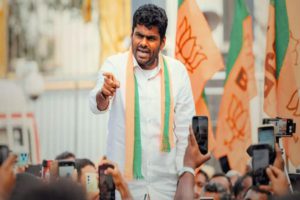
A former officer of the All India Police Service, Annamalai served as the Tamil Nadu BJP State President from July 2021 to April 2025. He had joined the BJP in 2020. He submitted his five-page resignation letter to the BJP’s national leadership, specifically to Nitin Nabin and Amit Shah. Fundamentally, Annamalai aims to dismantle the dominance of the AIADMK and DMK in Tamil Nadu. His strategy is anchored in the principles of Sanatan Dharma, nationalism, and Tamil identity.
He believes that the BJP in Tamil Nadu should not form alliances with the AIADMK or any other political party, but should instead build its own independent foundation. To this end, he undertook numerous foot marches prior to the Tamil Nadu elections and spoke out boldly on social issues, thereby gaining popularity among the general public and the youth. Thanks to his ‘En Mann, En Makkal’ (My Land, My People) campaign trail and his aggressive style, Annamalai has cultivated a strong, independent support base among the youth and on social media. he could decide to launch a new political party and present a fresh alternative to the prevailing Dravidian politics of the state.
The political landscape in Tamil Nadu has shifted significantly following the recent assembly elections. Actor ‘Thalapathy’ Vijay’s party, the Tamizhaga Vetri Kazhagam, has emerged as a formidable force. By submitting his resignation to the BJP’s central leadership, Annamalai has signaled his clear intent to chart a new political course for himself. Behind this move of his, serious differences with the central leadership regarding the strategy for an alliance with the AIADMK in Tamil Nadu as well as long-term priorities for the state’s development are cited as the primary reasons. Annamalai seeks to prioritize Tamil Nadu’s regional identity.
Given the current circumstances, two main paths appear to lie before Annamalai. Based on posters put up by his supporters in Coimbatore and other parts of Tamil Nadu, it is speculated that he might launch a new socio-political platform named ‘Makkal Shakti Iyakkam’ (People’s Power Movement) or announce the formation of his own new regional political party. Through his ‘En Mann, En Makkal’ (My Land, My People) Padayatra (foot march), he significantly bolstered the BJP’s visibility and organizational reach within Tamil Nadu, a traditional bastion of Dravidian politics. His core strategy involves establishing a brand of politics rooted in an independent Tamil identity, free from any electoral pacts with either the AIADMK or the DMK in the state.
However, Union Home Minister Amit Shah is also actively engaged in efforts to persuade Annamalai to stay. He held an intensive discussion with Annamalai at his residence for approximately 30 minutes. The BJP leadership is attempting to retain him by offering a significant national role within the organization, a central responsibility, or a seat in the Rajya Sabha. Senior leaders of the Rashtriya Swayamsevak Sangh have also met with him. The BJP leadership is keen to avoid losing a popular face like himThe differences between Annamalai and the BJP’s central leadership primarily stemmed from disagreements over electoral strategy.
Annamalai held the view that the BJP should shed its reliance on regional parties such as the AIADMK as “crutches” in Tamil Nadu; instead, he argued, the party should contest elections independently and focus on building a robust, long-term organizational structure with a strategic outlook spanning at least a decade. The central leadership’s strategy, however, took a divergent path. The BJP opted to renew its alliance with the AIADMK for the 2026 state assembly elections, aiming to consolidate votes against the incumbent DMK government. Following the formation of an alliance, and under pressure from the AIADMK, Annamalai was removed from the post of State President, and the responsibility was handed over to Nainar Nagendran. The BJP subsequently suffered a crushing defeat in the Assembly elections, securing only one out of the total 234 seats. In the wake of this outcome, Annamalai’s desire to pursue an independent political path intensified significantly. He has conveyed to the leadership his wish to “part ways amicably” with the BJP.
Annamalai does not have a direct personal conflict with the BJP’s top leadership—specifically Prime Minister Narendra Modi and Home Minister Amit Shah; rather, the rift stems from serious policy differences regarding ideological priorities and electoral strategy. These very differences served as the primary catalyst for Annamalai tendering his resignation in June 2026. He had sought to build an independent and enduring grassroots base for the BJP within the state, anchored in a distinct ‘Tamil identity.’ However, prioritizing pragmatic politics, Amit Shah and the central leadership decided to forge another electoral alliance with the AIADMK. Their primary objective was to prevent the fragmentation of anti-DMK votes and to secure immediate electoral gains.
Under the terms of the alliance with the AIADMK, the BJP’s central leadership removed Annamalai from the post of Tamil Nadu BJP State President to ensure smooth electoral coordination. Annamalai was sidelined from the decision-making process and denied key roles during the assembly elections. He himself declined to contest the elections; furthermore, when PM Modi visited Coimbatore in March 2026, Annamalai did not even turn up to welcome him an incident that brought this rift into the public domain for the first time.
Annamalai recently publicly criticized the Central Government’s three-language policy, which is being hastily implemented for Class 9 students. He argued that imposing a new language within such a short timeframe would place undue mental pressure on students in Tamil Nadu. This statement, made in opposition to a central policy, reflects his growing ideological differences with the leadership in Delhi. The Modi-Shah leadership is well aware that, amidst the rise of actor Vijay’s political party, the departure of a popular young face like Annamalai could inflict severe damage upon the BJP’s future prospects in Tamil Nadu.
(The writer is senior journalist from Delhi)