Nikita Kandpal
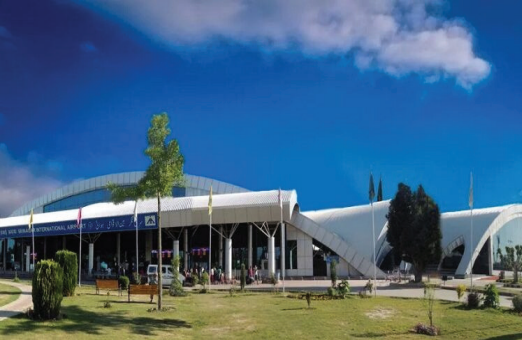
In a major boost for aviation infrastructure in the Jammu and Kashmir region, the Government of India has approved a ₹1,677 crore expansion project for the civil Enclave at Srinagar International Airport. The goal behind this project is to increase passenger handling capacity and improve the aviation infrastructure of Srinagar Airport. However, this development has given rise to a regional disparity between the Kashmir and Jammu Divisions, as there is a wide gap in the capacities of the airports.
According to an official press release issued by the Press Information Bureau (PIB), the new expanded terminal at Srinagar Airport, upon completion, will be able to handle up to 10 million passengers annually. (Source: PIB Release on Cabinet approval for expansion of Srinagar Airport Civil Enclave, February 2024). The key point is that neither Srinagar nor Jammu airport are fully independent civilian airport; they both operate as civil enclaves within Indian Air Force (IAF) airbases. The runaway ownership is under the Indian Air Force, while civilian flight operations are managed by the Airport Authority of India (AAI).
The passenger traffic data released by the Airport Authority of India (AAI) for the financial year April 2024 to March 2025 shows that during this time period, Srinagar Airport handled 4,472,449 passengers. In comparison, Jammu Airport handled 1,614,167 passengers; This indicates that Srinagar Airport handled approximately 2.7 times more passengers than Jammu Airport during the last financial year. (Source: AAI Traffic News – FY 2024–25, Airports Authority of India). (Fig. 1: Passenger Traffic Handled by Srinagar and Jammu Airports in FY 2024–25).
Further, the Aircraft movement data highlights an operational gap between the two airports. In FY 2024–25, Srinagar Airport recorded 28,494 aircraft movements, and Jammu Airport recorded 13,520 aircraft movements. Aircraft Movements refer to the total number of take-offs and landings handled by an airport over a given period of time. This depicts Srinagar Airport handled more than double the number of flight operations compared to Jammu Airport, which directly impacts flight frequency, availability of flight tickets and connectivity for regional passengers. (Source: AAI Aircraft Movement Statistics, FY 2024–25).
Another major infrastructural difference between the two airports is their operational classification. In 2005, Srinagar Airport was declared an international airport, and since then, it has handled international flight operations subject to airline scheduling and regulatory approvals. However, Jammu airport continues to function as a domestic airport, which limits the possibility of direct international tourism and cargo movement from the Jammu region.
The proposed expansion project for Srinagar airport includes the construction of a new terminal, which will take the yearly passenger handling capacity up to 10 million. Also, it is expected to handle 2,900 passengers during peak hours and provide up to 15 aircraft parking bays upon completion.
When the anticipated future capacity of Srinagar Airport is compared with that of Jammu Airport, the infrastructural gap becomes noticeable. Currently, Jammu Airport manage around 1.61 million passengers annually, while Srinagar Airport’s planned future capacity is of 10 million passengers annually, which is more than six times of the passenger traffic handled by Jammu Airport presently. (Source: AAI Passenger Traffic Data, FY 2024–25). (Fig. 2: Current Passenger Traffic at Jammu Airport vs Planned Capacity of Srinagar Airport).
According to the Airport Authority of India, domestic airport statistics indicate Jammu Airport has a limited capacity range. In November 2025, Jammu airport recorded 130,553 passengers, and in December 2025, 109,640 passengers. The long-term monthly average passenger traffic has been around 129,447 passengers per month, indicating a stable yet restricted operational capacity. (Source: AAI Monthly Domestic Traffic Reports, November–December 2025)
The Srinagar Airport expansion is expected to strengthen connectivity in the Kashmir Region, but the Jammu airport still has limited infrastructure. Even though Jammu is home to major religious and cultural tourist locations such as Vaishno Devi, Raghunath Temple, Bahu fort, Mansar Lake, Shivkhori Cave and Patnitop. Considering Jammu’s growing tourism potential and strategic importance, there is a big question whether a similar infrastructure expansion at Jammu Airport could lead to more balanced regional aviation development across the union territory.
The writer is a student of M.A. in New Media Communications at the Indian Institute of Mass Communication (IIMC), Jammu.