Innovations in Microbial Interventions for Productivity, Nutrient Cycling, and Stress Management
Prof (Dr.) Parshant Bakshi
Horticulture has emerged as one of the most dynamic and growth-oriented sectors of Indian agriculture. It contributes substantially to nutritional security, diversification of farm incomes, employment generation, and export earnings. However, the long-term sustainability of horticultural production systems is increasingly threatened by declining soil health, nutrient imbalance, excessive reliance on chemical inputs, and heightened vulnerability to climate-induced stresses. Plant Growth–Promoting Rhizobacteria (PGPR) have emerged as an eco-friendly, scientifically validated technology capable of restoring soil microbial balance and improving overall horticultural productivity to overcome these challenges. PGPR-based interventions align closely with the principles of sustainable and climate-smart agriculture. PGPR serve as natural bio-fertilizers, bio-stimulants, and bio-control agents, making them an integral component of climate-smart and sustainable horticulture. Recognizing this potential, the Division of Fruit Science at Sher-e-Kashmir University of Agricultural Sciences and Technology of Jammu (SKUAST-J) has been actively integrating PGPR research with field-level horticultural practices and farmer outreach programmes. This work spans a range of crops including strawberry, litchi, dragon fruit, citrus, and cape gooseberry, demonstrating the practical relevance of microbial technologies under diverse agro-climatic conditions.
Understanding PGPR and Their Functional Role
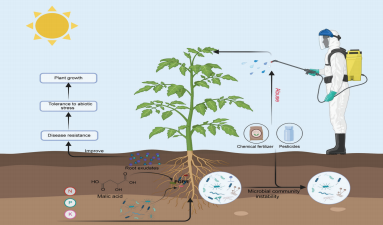
Plant Growth–Promoting Rhizobacteria are a diverse group of beneficial microorganisms that colonise the rhizosphere—the narrow zone of soil influenced by plant roots. Their significance lies in their ability to enhance plant growth through a combination of direct and indirect mechanisms that improve nutrient availability, root development, disease suppression, and stress tolerance.
Nutrient Mobilisation and Cycling
One of the most critical contributions of PGPR is their role in improving nutrient dynamics in soil. Certain bacterial species such as Azotobacter and Azospirillum possess the ability to fix atmospheric nitrogen and convert it into plant-available forms, thereby supplementing nitrogen nutrition in horticultural crops. This biological nitrogen fixation reduces dependence on synthetic nitrogen fertilisers, which are both costly and environmentally damaging.
Phosphorus, another key nutrient, often exists in soils in insoluble forms that are inaccessible to plants. Phosphate-solubilising PGPR release organic acids such as gluconic, citric, and lactic acids, which mobilise fixed phosphorus and enhance its availability in the root zone. In addition, PGPR facilitate the mobilisation of micronutrients such as iron, zinc, and potassium through mechanisms like siderophore production and chelation, addressing widespread micronutrient deficiencies observed in intensive horticultural systems.
Regulation of Plant Growth and Root Architecture
PGPR are known to synthesise a range of phytohormones that directly influence plant growth and development. Auxins promote root elongation and lateral root formation, leading to greater soil exploration and nutrient uptake. Gibberellins stimulate stem elongation and overall vegetative growth, while cytokinins enhance cell division and delay leaf senescence. Collectively, these hormonal effects result in stronger root systems, improved nutrient-use efficiency, and better crop vigour—attributes that are particularly important in perennial fruit crops.
Biocontrol of Soil-Borne Pathogens
Another major advantage of PGPR lies in their capacity to suppress soil-borne diseases. Certain strains produce antibiotics such as phenazines, volatile compounds like hydrogen cyanide, and lytic enzymes including chitinases and glucanases that degrade the cell walls of pathogenic fungi and bacteria. Siderophore production further deprives pathogens of iron, limiting their proliferation. Through these mechanisms, PGPR reduce the incidence of root rot, wilt, and damping-off diseases, thereby lowering the need for chemical pesticides and contributing to safer food production.
Enhancement of Abiotic Stress Tolerance
In the face of climate variability, PGPR play a crucial role in enhancing plant resilience to abiotic stresses such as drought, salinity, nutrient deficiency, and temperature extremes. The production of ACC deaminase helps lower stress-induced ethylene levels in plants, while osmolytes and exopolysaccharides protect root cells and improve soil aggregation. These attributes make PGPR particularly valuable for horticulture in stress-prone environments.
PGPR in Horticultural Crops: Research Evidence
Extensive field and laboratory studies demonstrate PGPR effectiveness in various horticultural crops:
a. Chili (Capsicum spp.)
Inoculation with specific PGPR strains allowed a 25% nitrogen fertilizer reduction with no loss in yield.
Improved fruit size, colour, and capsaicin content.
b. Bell Pepper (Capsicum annuum)
PGPR consortia involving Paenibacillus, Bacillus, and Klebsiella enhanced overall plant vigour.
Yield increased significantly with incremental PGPR application units.
c. Vegetable Crops (Tomato, Cucumber, Brinjal)
Enhanced nutrient-use efficiency.
Higher fruit firmness, TSS, lycopene content in tomato.
Reduction in wilt and root rot diseases.
d. Fruit Crops (Guava, Mango, Strawberry, Citrus)
PGPR-treated plants showed improved nutrient content, antioxidant levels, and shelf life.
Significant reduction in post-harvest losses due to better skin resistance and firmness.
e. Polyhouse and High-Density Orchards
PGPR enhance root development in intensive systems, improving water-use efficiency and reducing fertigation load.
India’s Soil Health Scenario: Challenges & Opportunities
37% of India’s land faces degradation (ICAR).
Excessive chemical fertiliser use has reduced soil organic matter.
Declining microbial diversity leads to poor nutrient cycling.
Imbalanced fertilizer application causing micronutrient deficiencies.
Government Initiatives Supporting Soil Health
Soil Health Card Scheme
25 crore+ cards distributed
8,272 soil testing labs operational
Soil maps created for 40 aspirational districts
Natural Farming Programs promoting microbial-based farming
Per Drop More Crop encourages fertigation and precision agriculture
PMKSY, HADP, MIDH, and other missions integrate soil conservation and efficiency.
These initiatives create a favourable ecosystem for promoting PGPR adoption nationwide.
How PGPR Helps to Achieve PM Modi’s Vision for Sustainable Agriculture
a. Soil Health Improvement
PGPR restore microbial balance, enhance nutrient cycling, and improve soil structure.
They reduce soil compaction and increase organic carbon through microbial turnover.
b. Reduction in Chemical Fertiliser Dependency
With SHC already achieving 8–10% reduction in fertilizer use, PGPR can amplify this shift.
PGPR act as natural substitutes for NPK and micronutrient supplements.
c. Quality Enhancement of Horticultural Produce
Improved nutritional value (Fe, Zn, Ca, antioxidants).
Better aroma, firmness, TSS, colour development in fruits.
Lower pesticide and fertilizer residues make produce export-friendly.
d. Increased Farmer Income
Decreased input costs: biofertilizers are cheaper than chemical fertilizers.
Improved yield quantity and quality increases market value.
Better soil health reduces long-term crop failure risks.
e. Climate-Resilient Agriculture
PGPR help plants tolerate drought, salinity, and heat stress.
Crucial for horticulture under climate change scenarios.
Practical Implementation Strategies
a. Localised PGPR Strain Selection
Region- and crop-specific inoculants perform more reliably than generic strains.
b. Integration with SHC Data
Nutrient-deficient soils can be matched with targeted PGPR types (e.g., P-solubilizers for P-deficient soils).
c. Farmer Training & Awareness
Demonstrations and field schools to show benefits under real conditions.
Training on application timing (seedling, transplanting, fertigation, foliar).
d. Industry Regulation
Standardization of microbial load (cfu/ml)
Shelf-life monitoring
Certification for commercial products
e. Monitoring and Feedback
Seasonal soil health monitoring
Digital tracking through mobile-based apps
Feedback loop between farmers and research institutions
Future Prospects of PGPR in Horticulture
a. Next-Generation Bioformulations
Encapsulated, nano-enhanced, and slow-release microbial carriers.
b. AI and Remote Sensing-Based Soil Health Diagnostics
Precision recommendations for PGPR application.
c. PGPR for Hydroponics and Vertical Farming
Microbial biostimulants that improve nutrient uptake in soilless systems.
d. Integration with Organic and Natural Farming Systems
Enhancing viability and crop performance without synthetic inputs.
e. Climate-Smart Orchard Management
Using PGPR with mulching, drip fertigation, and high-density planting systems.
PGPR represent one of the most promising, sustainable, and scientifically validated solutions for restoring soil health and boosting horticulture productivity. By improving nutrient availability, enhancing plant resilience, reducing chemical dependency, and improving fruit and vegetable quality, PGPR can transform India’s horticulture sector.
Their wide-scale adoption aligns with the national mission of:
“Swasth Dharaa, Khet Haraa” — Healthy Soil, Green Fields
As India moves toward sustainable, export-oriented, and climate-resilient horticulture, PGPR-based practices can play a defining role in shaping future agricultural success.
The writer of this article is Prof. & Head, Division of Fruit Science, SKUAST-Jammu. For information contact email us at [email protected]