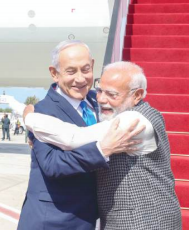
Jammu Tawi, Feb 24: Prime Minister Narendra Modi on Wednesday began his two-day visit to Israel, receiving a red-carpet welcome at Ben Gurion Airport in Jerusalem. Israeli Prime Minister Benjamin Netanyahu, accompanied by his wife Sara Netanyahu, personally received Modi upon his arrival, underscoring the importance both nations attach to their bilateral ties.
This marks Modi’s second visit to Israel in nine years. His first trip in July 2017 was historic, during which India and Israel elevated their relationship to a strategic partnership. The two leaders shared a warm hug at the airport before Modi was accorded a ceremonial welcome at the facility located about 20 kilometres southeast of Tel Aviv.
During his visit, Modi is scheduled to address Israel’s parliament and hold a tete-a-tete with Netanyahu. Wide-ranging delegation-level talks between the two sides are planned for Thursday, covering key areas of mutual interest and cooperation.
In his pre-departure statement, Narendra Modi expressed confidence that the visit would further consolidate the enduring bonds between India and Israel and help chart new goals for the strategic partnership. He described the relationship as robust and multifaceted, noting its remarkable growth and dynamism in recent years.
Modi said he looked forward to discussions aimed at strengthening cooperation across various domains, including science and technology, innovation, agriculture, water management, defence and security, trade and investment, and people-to-people ties. The two leaders are also expected to exchange views on regional and global developments of mutual interest.
The visit comes at a time of heightened tensions in the Middle East, including strained relations involving the United States and Iran, adding geopolitical significance to Modi’s trip.
Bilateral ties between India and Israel have seen a steady upswing in recent years, particularly in defence, scientific research, cybersecurity and innovation. Defence cooperation has emerged as a key pillar of the partnership, with Israel supplying a range of military platforms and weapon systems to India.
In November last year, during a visit by India’s Defence Secretary to Israel, an important defence cooperation agreement was signed. India is also exploring options to strengthen its indigenous air defence capabilities through the proposed “Sudarshan Chakra” shield. In this context, New Delhi is understood to be examining elements of Israel’s Iron Dome all-weather air defence system, known for its ability to intercept and destroy missiles and artillery shells.
Economic engagement between the two countries is also gaining momentum. During Commerce Minister Piyush Goyal’s visit to Israel in November, the terms of reference for launching negotiations on a Free Trade Agreement were signed. In September, the two sides concluded a Bilateral Investment Agreement to further expand economic cooperation.
People-to-people ties remain a vital component of the relationship, supported by a 41,000-strong Indian diaspora in Israel that continues to play a significant role in strengthening bilateral engagement.