By: Omkar Dattatray
The demand for Separate Statehood for Jammu is not an ephemeral political slogan born of momentary disaffection; rather, it is a deeply entrenched aspiration rooted in historical grievances, regional imbalances, and an enduring quest for equitable representation. The region of Jammu, geographically distinct, culturally pluralistic, and demographically diverse, has for decades articulated a sentiment that its political voice has been subsumed under the overarching narrative of the erstwhile state of Jammu and Kashmir. The reconfiguration of the former state into Union Territories in 2019 rekindled the debate, with many in Jammu contending that administrative restructuring alone has not fully redressed the asymmetries that have historically characterized regional governance. Jammu, situated at the crossroads of the Shivalik foothills and the Pir Panjal ranges, occupies a liminal space between the plains of northern India and the mountainous expanse of Kashmir. Unlike the Kashmir Valley, which is relatively homogeneous in linguistic and cultural composition, Jammu is a mosaic of Dogras, Gujjars, Paharis, Sikhs, and various other communities. This plurality has often been cited as a testament to its syncretic ethos, yet it has simultaneously engendered a perception that Jammu’s distinct identity has been eclipsed within the broader political discourse. Proponents of separate statehood argue that political centralization in the Valley historically resulted in a disproportionate allocation of resources, institutional establishments, and developmental priorities.
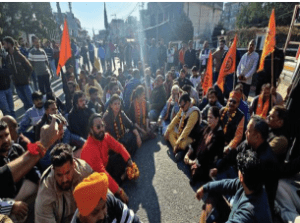
The historical substratum of this demand can be traced to the princely state of Jammu and Kashmir under the Dogra dynasty. The Dogra rulers, beginning with Maharaja Gulab Singh, administered a vast and heterogeneous territory that encompassed Jammu, Kashmir, Ladakh, and frontier tracts. While the Dogra era is often scrutinized through multiple historiographical lenses, it is undeniable that Jammu functioned as the political nucleus during substantial periods. The subsequent political transformations following independence and accession to India altered this equilibrium, gradually reorienting administrative gravity towards Srinagar. Many in Jammu perceived this shift as the genesis of a long-term marginalization. The abrogation of Article 370 and the bifurcation of the state in August 2019 into the Union Territories of Jammu and Kashmir and Ladakh were watershed moments. While Ladakh was granted separate Union Territory status, Jammu remained conjoined with Kashmir within a single administrative framework. Advocates of Jammu’s separate statehood argue that if Ladakh’s unique cultural and geographical distinctiveness warranted independent status, the same rationale could be extrapolated to Jammu. They contend that the persistent conflation of Jammu’s aspirations with those of the Valley obscures region-specific developmental exigencies. The, economic argument constitutes a pivotal plank of the statehood movement. Jammu possesses considerable potential in tourism, pilgrimage circuits, horticulture, and border trade. The revered shrine of Vaishno Devi attracts millions of pilgrims annually, generating substantial revenue. Proponents assert that an autonomous state apparatus could channel such revenues into infrastructural modernization, industrial corridors, and employment generation tailored specifically to Jammu’s topographical and socio-economic contours. They argue that decentralized governance fosters administrative alacrity and attenuates bureaucratic inertia. Furthermore, the question of political representation is frequently invoked. Demographic parity between Jammu and Kashmir divisions has often been debated, especially in the context of legislative constituencies and delimitation exercises. The recent delimitation process increased the number of assembly seats in Jammu, a development hailed by many as a corrective measure. Yet, advocates of full-fledged statehood maintain that incremental adjustments do not suffice; they envision a sovereign legislative and executive apparatus dedicated exclusively to Jammu’s governance.
However, the proposition of separate statehood is not devoid of complexities. Critics caution against potential administrative fragmentation, fiscal burdens, and the exacerbation of regional cleavages. They argue that the creation of additional states necessitates robust institutional frameworks and sustainable revenue streams. Moreover, there exists apprehension that further territorial bifurcation could engender centrifugal tendencies in other regions, thereby complicating federal dynamics. The Indian Union, already characterized by intricate federal arrangements, must calibrate such decisions with prudence. Security considerations also permeate the discourse. Jammu shares an international border and the Line of Control with Pakistan, rendering it strategically sensitive. Some analysts posit that unified governance under a single Union Territory enhances coordinated security management. Conversely, proponents counter that localized administration could engender more responsive border management, tailored to the region’s specific vulnerabilities and demographic realities. Culturally, the Dogra identity occupies a central locus in the statehood narrative. The Dogri language, recognized in the Eighth Schedule of the Indian Constitution, symbolizes Jammu’s linguistic heritage. Advocates argue that a separate state would institutionalize the preservation and promotion of Dogra art, literature, and traditions. They envisage cultural academies, research institutions, and heritage conservation initiatives operating under a state government singularly committed to Jammu’s patrimony. It is imperative to acknowledge that the demand for separate statehood is not monolithic. Within Jammu itself, opinions are variegated. Certain segments prioritize the restoration of full statehood to the entire Union Territory, encompassing both Jammu and Kashmir, rather than bifurcation. Others perceive economic integration with Kashmir as beneficial. Thus, the discourse oscillates between regional assertion and overarching unity. In assessing the viability of separate statehood, one must situate the debate within India’s broader federal evolution. The reorganization of states along linguistic and administrative lines has historically been undertaken to enhance governance efficacy and accommodate regional aspirations. From the creation of Himachal Pradesh to the formation of Uttarakhand and Telangana, the Indian polity has demonstrated adaptive federalism. The Jammu question, therefore, must be evaluated not merely as a regional agitation but as part of this continuum of federal recalibration. Ultimately, the aspiration for Separate Statehood for Jammu encapsulates a yearning for dignity, parity, and self-determination within the constitutional framework of India. It is animated by historical memory, economic calculation, cultural pride, and political pragmatism. Whether this aspiration culminates in constitutional realization will depend upon democratic deliberation, empirical assessment, and statesmanship that transcends parochialism. The discourse must eschew acrimony and instead cultivate constructive engagement, ensuring that any decision fortifies national integration while honoring regional distinctiveness. In this dialectic between unity and diversity lies the enduring challenge—and promise—of the Indian federation.
The author is a columnist, social, KP activist &Freelancer