The issue calls for a holistic development strategy for India’s Islands
By Raju Kumar
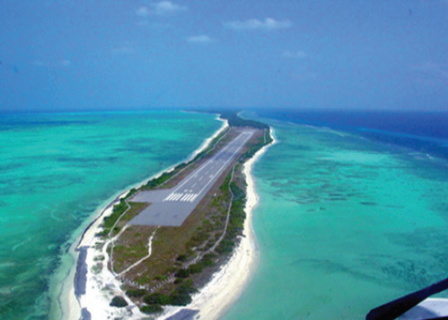
Agatti, one of Lakshadweep’s smallest inhabited islands, has recently found itself at the centre of a serious policy debate. Gazette notifications issued by the Lakshadweep Administration in January 2026 propose the acquisition of land for three separate purposes: 1,01,020 square metres for tourism and other public development, 1,908 square metres for a city centre project, and 1,52,760 square metres for the establishment of Forward/Field Base Support Units (FBSUs) for the Indian Air Force. Taken together, these proposals amount to 2,55,688 square metres. On an island whose total land area is approximately 2.70 square kilometres, this represents roughly eight to nine percent of its total land mass. For a small coral atoll with tightly packed settlements and limited cultivable land, that figure is far from insignificant.
The numbers themselves are drawn from official Gazette notifications issued under the Right to Fair Compensation and Transparency in Land Acquisition, Rehabilitation and Resettlement Act, 2013. The notification dated 5 January 2026 outlines land acquisition for tourism and city centre development, while the notification dated 17 January 2026 identifies the Indian Air Force as the project developer for a strategic support facility. The administration has described Agatti as a strategically important location requiring enhanced logistical and operational capability. From a national security perspective, this rationale carries weight. Lakshadweep occupies a sensitive maritime position in the Arabian Sea, and strengthening defence infrastructure can enhance surveillance, disaster response and long-term strategic readiness.
At the same time, Lakshadweep is not an ordinary development frontier. It is a highly sensitive ecological zone composed of fragile coral atolls, limited freshwater lenses and delicate coastal formations. Its land is finite and vulnerable to erosion, climate change and sea-level rise. It is also a security-sensitive region, given its proximity to vital sea lanes and international maritime routes. In such a context, it may not be prudent to promote tourism expansion in the same manner as mainland states or larger coastal destinations. Lakshadweep’s development model must necessarily differ from that of other parts of India. Large-scale tourism promotion, if pursued without strict ecological thresholds, risks undermining both environmental sustainability and long-term strategic stability.
The concerns voiced by residents, local representatives and members of the island community reflect this reality. Their apprehension centres not merely on the legality of acquisition but on its cumulative scale. In a territory as compact as Agatti, every hectare diverted alters the balance between habitation, livelihood and environmental buffer. Coconut plantations, residential settlements, the existing airstrip and essential utilities already account for much of the usable land. Any additional consolidation reduces flexibility for future housing, climate adaptation measures and community needs.
Island communities play an indispensable role in safeguarding fragile ecosystems. Their insistence on caution should not be interpreted as opposition to national interest. Rather, it represents a deeply rooted awareness of ecological limits. Coral islands cannot absorb the same intensity of construction or population pressure as mainland cities. Groundwater recharge is limited, waste disposal options are constrained and coastal stability depends on maintaining natural buffers. Development that ignores these structural realities may generate long-term costs that outweigh short-term economic gains.
Another dimension of unease relates to participation. The notifications indicate that consent of Gram Sabhas is not mandatory under the invoked provisions. While this may satisfy legal requirements, it does not automatically address concerns about inclusion and transparency. In small island societies, where landholding patterns and social networks are tightly interwoven, consultation is more than a procedural step; it is central to legitimacy. Strengthening participatory dialogue, even when not strictly required by statute, would reinforce confidence in the administration’s intentions.
None of this negates the importance of strengthening security infrastructure. A calibrated expansion of defence facilities may be justified in light of evolving maritime challenges. However, policy prioritisation becomes essential. Strategic necessities can be addressed through optimised land use, shared infrastructure models and phased development. Tourism-related acquisition, on the other hand, warrants closer scrutiny. Before expanding hospitality and commercial footprints, a comprehensive carrying-capacity assessment should determine how much additional activity the island’s ecology can sustain without degradation.
Development in Lakshadweep must be guided by the twin imperatives of ecological prudence and national security. These objectives are not contradictory; indeed, they reinforce one another. Preserving environmental stability strengthens strategic resilience. Undermining it weakens both.
Agatti’s debate offers an opportunity to articulate a distinct development philosophy for India’s island territories—one that recognises their uniqueness rather than treating them as miniature versions of mainland districts. Progress need not mean replication of mainland tourism models. It can instead mean measured infrastructure, limited-impact economic activity and prioritised strategic capability. By adopting a restrained, island-sensitive approach, the administration can meet national needs while safeguarding the ecological and social fabric that defines Lakshadweep. (IPA Service)