By Ravi Rohmetra
Pandit Deendayal Upadhyaya was born on September 25, 1916, in the village of Nagla Chandrabhan in Mathura district of Uttar Pradesh, now known as Deendayal Dham, near Farah town. His father, Bhagwati Prasad, was a well-known astrologer, and his mother, Rampyari, was deeply religious. He lost both his parents at a young age and was brought up by his maternal uncle and aunt, under whose care he excelled academically.
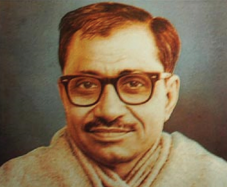
He studied at Sikar, where he topped the board examination and received a gold medal from Maharaja Kalyan Singh of Sikar, along with a monthly scholarship of Rs. 10 and Rs. 250 for books. He completed his Intermediate from Birla College, Pilani (now BITS Pilani), and earned his B.A. in first division from Sanatan Dharma College, Kanpur. He later joined St. John’s College, Agra, for an M.A. in English literature but could not appear in the final examination due to a cousin’s illness. Though selected in the Provincial Services Examination, he declined to join, choosing instead a path of public service. He later obtained a B.T. degree from Prayag.
During his student years at Kanpur in 1937, he came into contact with the Rashtriya Swayamsevak Sangh (RSS) through his classmate Balwant (Baluji) Mahashabde. He met RSS founder Dr. K. B. Hedgewar and was deeply influenced by his ideas. He underwent Sangh training at Nagpur and, after completing advanced training, became a lifelong pracharak (full-time worker). He worked in Lakhimpur district and later became joint prant pracharak (regional organiser) and then provincial organiser for Uttar Pradesh.
Upadhyaya was known for his simplicity, discipline, and intellectual depth. He was regarded as an ideal swayamsevak whose discourse reflected the core ideological stream of the Sangh. A man of high idealism and remarkable organisational ability, he distinguished himself as a thinker, economist, educationist, writer, journalist, speaker, and political organiser.
In the 1940s, he started the monthly journal Rashtra Dharma from Lucknow to promote nationalist thought. Though his name did not formally appear as editor, his imprint was visible in almost every issue through his thought-provoking writings. He later helped launch the weekly Panchjanya and the daily Swadesh. He also established Rashtra Dharma Prakashan. His literary contributions included a drama on Chandragupta Maurya, a biography of Adi Shankaracharya, and a Hindi translation of a Marathi biography of Dr. Hedgewar.
In 1951, when Dr. Syama Prasad Mookerjee founded the Bharatiya Jana Sangh, Upadhyaya was seconded to the party by the RSS and appointed General Secretary of its Uttar Pradesh unit, later rising to become the all-India General Secretary. His organisational acumen deeply impressed Dr. Mookerjee, who famously remarked, “If I had two Deendayals, I could transform the political face of India.” After Mookerjee’s death in 1953, Upadhyaya carried the main burden of building the Jana Sangh into a nationwide political movement, serving as General Secretary for about 15 years. He also contested a Lok Sabha election from Uttar Pradesh but was not elected.
Pandit Deendayal Upadhyaya emerged as a significant political philosopher and activist. He was a critic of both unrestrained capitalism and rigid communism, and propounded the doctrine of Integral Humanism, advocating a moral, culturally rooted, and human-centric approach to politics and economics. He strongly supported swadeshi, decentralisation, and small-scale industrialisation, and believed that blindly copying Western ideologies was unsuitable for India’s conditions.
In 1968, he was elevated to the position of President of the Bharatiya Jana Sangh. Soon after assuming this responsibility, he undertook organisational tours across the country. Tragically, his life was cut short on February 11, 1968, when he was found dead under mysterious circumstances near Mughalsarai railway station in Uttar Pradesh.
Remembered for his integrity, simplicity, and ideological clarity, Pandit Deendayal Upadhyaya continues to be regarded as one of the key political thinkers of modern India, whose ideas on Integral Humanism still influence public discourse and policy debates.
(Ravi Rohmetra is a Writer and a social worker and can be reached at
M.No.9419652999; e-mail:[email protected])