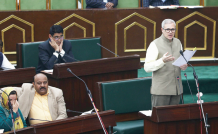
Jammu Tawi, Feb 9: Jammu and Kashmir is set for a major surge in hydro power generation, with the Union Territory expected to add nearly 47 percent extra capacity in the upcoming fiscal and cross 7,300 MW of installed capacity by 2030–31, Chief Minister Omar Abdullah informed the Legislative Assembly on Monday.
According to official figures shared in the House, J&K will add 1,685.7 MW of power generation capacity in 2026–27, taking a significant step forward from the existing installed capacity of 3,540.15 MW.
In a written reply to a question by National Conference legislator Khurshied Ahmad, Abdullah said J&K currently has 32 operational hydro power projects with an aggregate capacity of 3,540.15 MW. These include 13 UT sector projects with 1,197 MW, six central sector projects generating 2,250 MW, and 12 Independent Power Producer (IPP) projects with a combined capacity of 92.75 MW. Abdullah holds charge of the Power Development Department.
The government has planned a total capacity addition of 3,704.5 MW through eight proposed and six under-construction Hydroelectric Power Projects (HEPs) between 2026–27 and 2030–31. With these additions, the total installed capacity is projected to reach 7,314.85 MW by 2030–31.
Giving a year-wise break-up, the Chief Minister said 1,685.7 MW capacity will be added in 2026–27, 577.5 MW in 2027–28, 1,370 MW in 2029–30, and 141 MW in 2030–31.
During 2026–27, four HEPs are scheduled to be commissioned, including the 1,000 MW Pakaldul, 624 MW Kiru, 12 MW Karnah, and 49.70 MW (IPP JAKEDA) projects. In 2027–28, the 540 MW Kwar and 37.5 MW Parnai projects are expected to be completed.
For 2029–30, the commissioning list includes the 850 MW Ratle, 240 MW Uri-I Stage-II, 260 MW Dulhasti-II, and 20.50 MW (IPP JAKEDA) projects. In 2030–31, the 93 MW New Ganderbal and 48 MW Lower Kalnai projects are slated for completion.
Replying to another question regarding the delay in execution of the Ans (Nandoli) hydro power project in Gulabgarh constituency, Abdullah said the project, tendered in 2011–12 and allotted in November 2012, has been delayed due to non-performance by the IPP. A notice of default was issued in August 2025.
He said the IPP submitted the Detailed Project Report (DPR) in October 2025 and later a financial analysis indicating a 40-year levelized tariff of Rs 7.30 per unit, making the project techno-economically unviable under prevailing market tariffs. The IPP has sought exit from the project with a refund of the deposited premium, citing external and policy-related constraints. The matter is under consideration of the J&K State Power Development Corporation as per the implementation agreement and Hydro Electric Power Policy 2011.
The Chief Minister also informed the House that all villages in Jammu division are electrified either through on-grid or off-grid mode. However, some habitations, morhas, or newly established households remain unelectrified or partially electrified.
He said efforts are underway to cover such areas under the centrally sponsored DA-JGUA and UT Capex schemes. Some remote habitations in Billawar area — including Thingen, Kanodi and Hanok of Panchayat Madoon/Dehota — are either unelectrified or partially electrified. DPRs are being prepared after earlier proposals were dropped due to cost escalation, he added.