Beijing’s steady progress at cheaper costs has unnerved Trump and Silicon valley
By T N Ashok
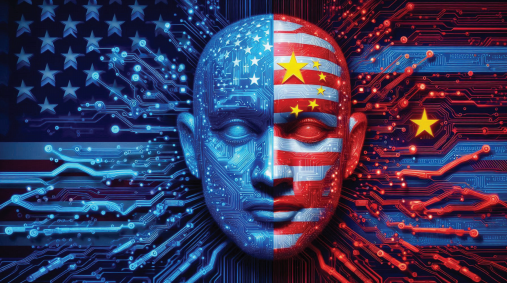
NEW YORK: A global competition is reshaping technology, geopolitics, and the world economy as Washington and Beijing race to dominate artificial intelligence—with no guarantee of success.
In the spring of 2024, executives at a prominent Chinese artificial intelligence company found themselves fielding an extraordinary barrage of phone calls. Ten different government agencies contacted them in a single month, each delivering the same urgent message: China needed homegrown AI models, and it needed them now.
The pressure campaign reflected a deeper anxiety gripping Beijing. While OpenAI and Google were racing ahead with generative AI breakthroughs, Chinese firms remained so far behind that many relied on Meta’s free, open-source models. American export restrictions on advanced chips threatened to widen the gap even further, raising fears in China’s leadership that the nation risked falling permanently behind in the century’s most consequential technology race.
Nine months later, a little-known Chinese startup called DeepSeek released a problem-solving model that rivalled OpenAI’s top offering at a fraction of the cost. The breakthrough electrified China’s tech sector and sent shockwaves through Silicon Valley, crystallizing what many observers now describe in Cold War terms: a winner-take-all contest between superpowers that will reshape industry, society, and global power dynamics.
“China finally has a model it can be proud of,” Premier Li Qiang reportedly told officials after DeepSeek’s release. The optimism unleashed a torrent of government support and jolted American competition into overdrive.
The escalating rivalry evokes comparisons to Cold War-era technological battles, particularly the lesser-known but consequential race to build defense computers that ultimately produced innovations rippling through the global economy. But AI’s potential makes even that contest seem modest.
If artificial intelligence surpasses human intelligence and acquires the ability to improve itself, experts say, it could confer decisive scientific, economic, and military advantages on whichever nation controls it. Short of that sci-fi scenario, AI’s capacity to process vast data and automate complex tasks promises to revolutionize everything from cancer diagnosis to missile defense.
The competition has already fuelled a worldwide surge in tech spending that has lifted stock markets in both nations and unlocked new sources of economic growth. American investors poured $104 billion into AI startups in the first half of 2025 alone. Major Chinese tech companies are projected to spend $361 billion on AI through 2027, according to Bernstein analysts.
Both sides are driven as much by fear as ambition. Washington warns that Chinese “authoritarian AI” threatens American tech supremacy. Beijing believes falling behind in AI will enable the United States to curtail China’s return as a global power. Both see market share across the developing world as up for grabs—and with it, influence over large swaths of the global population.
The intensity of the race is pushing leaders to sideline concerns about AI dangers, including disinformation and the theoretical risk of superintelligent systems misaligned with human values. “The AI future is not going to be won by hand-wringing about safety,” Vice President JD Vance declared in a February speech in Paris.
The United States maintains a clear lead in producing the most powerful AI models. It dominates advanced chip manufacturing and enjoys unmatched financial firepower from private investors. But China possesses a massive pool of capable engineers, lower costs, and a state-directed development model that often moves faster than American market-driven approaches.
Beijing’s response to the AI challenge has been characteristically comprehensive. Under Xi Jinping’s “AI Plus” blueprint, authorities are accelerating construction of massive computing clusters in regions like Inner Mongolia, where solar and wind farms provide cheap energy. The plan calls for connecting hundreds of data centres into a shared computing pool—described by some as a “national cloud”—by 2028. China is also channelling hundreds of billions of dollars into upgrading its power grid to support AI training and adoption.
The blueprint aims for AI penetration in 70 percent of China’s economy by 2027 and 90 percent by 2030—a vision Xi characterized as reshaping “the paradigm of human production and life.”
China has a history of initially trailing American tech leadership before catching up as know-how spreads. Social media followed this pattern: American platforms led early on before TikTok, created by Chinese engineers, ultimately dominated and redefined the industry. Chinese AI models now rank at or near the top in tasks from coding to video generation, according to crowdsourced rankings. The nation’s manufacturing sector is surging ahead in bringing AI into the physical world through autonomous vehicles, drones, and humanoid robots.
“Our lead is probably in the ‘months but not years’ realm,” said Chris McGuire, who helped design U.S. chip export controls while serving on the National Security Council.
Access to advanced semiconductors remains America’s trump card. Industry observers believe China may be a decade away from producing microchips matching America’s best products, primarily due to U.S. restrictions on chipmaking technology. The shortage of high-end computing power has already delayed Chinese companies like DeepSeek in developing next-generation models.
Beijing has responded by mobilizing tech champions to develop domestic semiconductor supply chains, pressing companies like ByteDance to suspend Nvidia purchases and collaborate with Chinese chipmakers. Huawei has emerged as the standard-bearer, working with thousands of firms to develop systems bundling up to one million chips to boost capabilities—an approach some industry insiders call “swarms beat the titan.”
Yet closing the gap requires China to overcome America’s more than half-century head start in semiconductor technology. “To say that China can snap their fingers and indigenize this because they’ve indigenized other things in the past ignores that this might be the single hardest thing in the world for them,” McGuire said.
Meanwhile, Nvidia and other American chipmakers continue pushing technological boundaries, supported by massive capital investments.
The ultimate victor remains unclear, experts say, partly because the race won’t necessarily be determined by spending alone. A critical uncertainty looms: whether simply boosting computing power with ever-better chips will continue yielding more powerful AI models—a growing concern in Silicon Valley as progress has recently slowed.
If performance plateaus despite enormous investments by OpenAI and others, China gains an opportunity to compete on more equal footing. “We don’t actually know which way the technology is going to go,” said Helen Toner, director of strategy at Georgetown’s Center for Security and Emerging Technology and a former OpenAI board member.
The competition’s costs extend beyond dollars. Escalating hacking and cyber espionage seem inevitable as AI provides hackers more powerful tools while increasing incentives to steal intellectual property. Growing distrust will make cooperation virtually impossible in areas like preventing extremist groups from weaponizing AI.
“The costs of the AI Cold War are already high and will go much higher,” said Paul Triolo, a technology policy analyst. “A U.S.-China AI arms race becomes a self-fulfilling prophecy, with neither side able to trust that the other would observe any restrictions on advanced AI capability development.”
With billions pouring into research and development, and fundamental questions about the technology’s trajectory unanswered, the new Cold War’s outcome remains as uncertain as its stakes are monumental. (IPA Service)