
By Omkar Dattatray
Delhi once again trembled under the shadow of terror after years of uneasy calm, as a devastating explosion rocked the national capital near the Red Fort Metro Station. A city that had long enjoyed a deceptive sense of security was jolted back into grim reality when a high-intensity blast ripped through a moving Hyundai i20, instantly killing ten people and injuring twenty-five others. The inferno engulfed nearby vehicles, shattered glass across a wide radius, and turned an ordinary evening in Delhi’s historic heart into a scene of carnage, smoke, and wailing sirens.
The car—obliterated in seconds—killed all three occupants inside and left behind a trail of destruction, damaging several parked vehicles, auto-rickshaws, and injuring unsuspecting pedestrians. Given the density of people in the vicinity, the casualties could have been far higher. Investigators later revealed that the vehicle had been parked in a nearby lot for over two hours before the explosion, pointing toward careful planning and deliberate timing. Yet the very nature of the blast has left experts baffled.
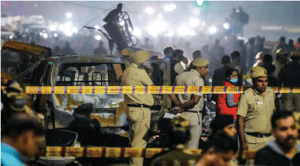
Forensic teams and bomb-disposal units were perplexed by what they did not find: no crater, no metallic shrapnel, no detonator wires, no circuitry—none of the usual remnants associated with a conventional explosive device. Instead, early evidence suggested an unconventional, possibly chemical or fuel-based ignition system. Forensic scientists speculated that volatile vapours under high pressure, or an improvised chemical reaction, might have triggered the explosion. The ferocity of the fireball—which was visible several hundred metres away—hinted at a timer-based or remote-control mechanism, yet the total absence of electronic components has left investigators with more questions than answers.
The vehicle’s registration number, HR 26CE 7674, led authorities to its original owner, Mohammad Salam of Gurugram. While Salam had purchased the car in 2013, it had changed hands at least four times since then, complicating the investigation. Preliminary reports suggested the involvement of a Pulwama resident identified as Dr. Umer, believed to be among the occupants of the car. The possibility of a suicide mission cannot be ruled out, although executing a fidayeen-style attack in a moving vehicle is both rare and difficult.
The mystery deepened further with another major breakthrough. Only hours before the Delhi blast, Haryana Police arrested a Kashmiri doctor from Faridabad on charges of plotting a major terror attack. From his residence, authorities recovered nearly 2,900 kilograms of explosives, twenty timers, remote-control devices, a rifle, and live ammunition. Seven alleged accomplices were also arrested. The timing of these arrests, together with the Red Fort explosion, strongly suggests a larger terror network operating under a single command—possibly directed by Pakistan-based handlers.
The National Investigation Agency (NIA) has taken over the probe, treating the incident as an act of terrorism. Early indications point toward the involvement of Lashkar-e-Taiba, the Pakistan-sponsored militant outfit long associated with attacks on Indian soil. Intelligence sources believe the attack was meticulously planned to coincide with rush-hour traffic in one of Delhi’s most crowded corridors, maximizing both its psychological and symbolic impact. The choice of the Red Fort area—an emblem of India’s sovereignty—underscores the intent to strike at the nation’s core.
This brutal and barbaric act has once again exposed worrying cracks in India’s internal security framework. The fact that such a high-profile attack could unfold in the capital, despite the presence of multiple security agencies, raises serious questions about preparedness, vigilance, and coordination. The attack reinforces a disturbing pattern: security agencies often appear reactive rather than proactive, springing into action only after tragedy has unfolded. The lack of stringent security measures in a sensitive zone like the Red Fort is a lapse that cannot be dismissed.
Union Home Minister Amit Shah convened an emergency meeting with senior officials from the NIA, Intelligence Bureau, and Delhi Police, assuring citizens that the perpetrators would be brought to justice. He stressed the need for heightened surveillance and ordered an immediate review of all security protocols across the capital. However, the strength of the government’s resolve will ultimately be judged by the effectiveness of its response, not its assurances.
The blast rekindles painful memories of past attacks that have scarred Delhi—the Parliament attack of 2001, the serial blasts of 2008, and now the carnage of 2025. The frequency and audacity of such strikes reveal that terrorism remains alive, adaptive, and disturbingly sophisticated. A new and unsettling trend has also emerged: the rise of “white-collar terrorism.” Increasingly, educated professionals—doctors, engineers, and technocrats—are becoming deeply embedded within terror networks, lending them both technical expertise and legitimacy. This makes them far harder to detect.
The arrests of medical practitioners like Dr. Umer and his associates highlight how terror outfits have begun infiltrating intellectual and professional circles. These individuals, outwardly respectable and socially secure, often operate below the radar, using their status to conceal radical affiliations. Their involvement marks a dangerous shift in the nature of terrorism, expanding it beyond fringe fighters to educated conspirators driven by ideology or manipulation.
For Delhi’s residents, the attack has reignited fear and frustration. The sense of safety painstakingly rebuilt over the years has been shattered. Families of victims are left in grief and disbelief, asking the same haunting questions: When will this bloodshed end? How many more innocent lives must be sacrificed before decisive action is taken? The recurring cycle of outrage, investigation, and complacency cannot continue.
India urgently needs a comprehensive overhaul of its counterterrorism apparatus. Intelligence gathering must evolve from reactive operations to predictive, data-driven analysis. Coordination between central and state agencies should be seamless, not hindered by bureaucracy. Counter-radicalization programmes need strengthening, especially to prevent educated youth from falling prey to extremist ideologies masquerading as grievances.
The attack on Delhi is not just a crime; it is an assault on India’s sovereignty and its people. It demands a firm and proportional response. The time for restraint has passed. Pakistan and its proxies must be made to understand that every act of terror will be met with decisive retaliation. Diplomatic niceties cannot take precedence over national security. If required, targeted strikes across the Line of Control to dismantle terror infrastructure should not be ruled out.
Ultimately, this tragedy is a grim reminder of the persistent threat that terrorism poses and the heavy price of complacency. Delhi has been shaken, not only by the force of the explosion, but by the realization that even in an age of advanced surveillance, the enemies of peace continue to strike at will. India must rise to this challenge with unwavering resolve, ensuring that the sacrifice of the innocent does not go in vain. Only through unity, vigilance, and a relentless pursuit of justice can the nation reclaim the peace stolen by the shadow of terror.
(The author is a columnist, social leader, KP activist, and freelancer)