By Mool Raj
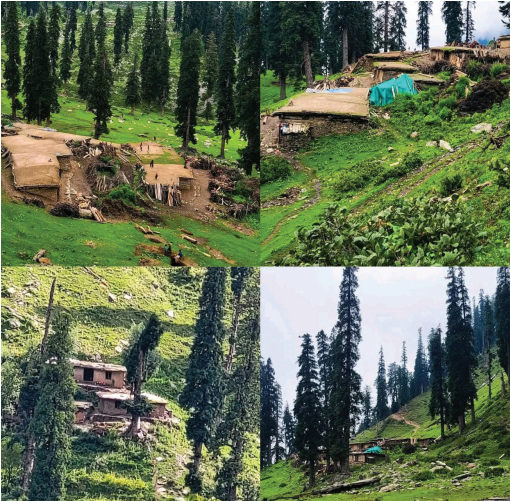
Just 25 kilometres from the Doda District headquarters lies Khabrala Dedani, a tiny village tucked in the remote hills of Marmat Tehsil. Surrounded by thick forests of deodar and perched on an isolated ridge, the settlement looks picturesque from afar. But behind this beauty lies a reality so stark that it feels unbelievable in today’s India — Khabrala has lived without electricity for 78 long years, ever since the country became independent in 1947.
In an era when India has successfully launched missions to the Moon and Mars, there is a village in Jammu & Kashmir where the flicker of an earthen lamp is still the brightest source of light.
A Shocking Discovery
When I first learnt of Khabrala’s condition, I felt disbelief and disbelief gave way to shame — shame that such a village exists in my own home district of Doda. It was almost impossible to imagine that in the age of smartphones, 4G connectivity, and digital classrooms, an entire village lives in the same darkness that prevailed more than seven decades ago.
For the residents of Khabrala, the darkness is not just physical — it is a symbol of years of neglect, broken promises, and abandonment.
Children Studying Under Candles and Wooden Torches
The village has boys and girls who dare to dream big — to become engineers, civil servants, or join government services. But their reality is heartbreaking. They burn candles, lanterns, and even wooden sticks wrapped with cloth to study at night.
One student told me quietly,
“We want to become engineers. But how can we compete with others when we must hold a candle in one hand and books in the other?”
Only a few relatively better-off families have installed small solar panels, and even these panels allow only a single bulb to glow for a few hours.
The dreams of the village may be bright, but the pathways to achieve them remain dim.
A Youth That Never Saw Light
Many young men of the village have never seen electricity in their entire lives. Not a single electric fan, tube light, or switchboard exists in their homes.
What was most painful was their resignation.
One youth told me with a hollow smile,
“We have never seen electricity. We do not expect to see it in this life either.”
This acceptance of deprivation reveals how deeply helplessness has seeped into their everyday lives.
Life Without Basic Facilities
A visit to Khabrala feels like stepping back in time. Apart from electricity, the village lacks almost every basic facility — no school, no functioning drinking water supply, no government dispensary. For 300 residents of this isolated hamlet, reaching a hospital or even a grocery shop requires steep treks through thick forests and unpaved paths.
In summers, with temperatures touching 30°C, they cannot even enjoy a glass of cold water. Perishable food cannot be stored. Milk spoils quickly. Meat cannot be preserved. The concept of a refrigerator exists only in stories — and ironically, some families who received refrigerators as dowry use them as cupboards to store clothing. The villagers call them “almirahs” instead of fridges.
It sounds humorous, but it reflects a harsher truth — when a village does not have electricity, the modern world becomes meaningless.
Mobile Phones That Require a Day’s Trip to Charge
Everyone today, even in remote areas, uses mobile phones. But in Khabrala, the very idea of using a phone is a challenge. The residents trek to nearby electrified villages to charge their mobile phones and battery lamps. Sometimes, arguments erupt because neighbouring villages cannot always accommodate dozens of phones and power needs.
Technology has reached them, but power to use it has not.
A Village Cut Off From Marriage Prospects
The absence of electricity has created unexpected social consequences. Parents refuse to marry their daughters into Khabrala, fearing their daughters will live a life of hardship. Only those from equally powerless villages agree to matrimonial ties.
Even in weddings where refrigerators were gifted to the groom’s family, they could not be used. Instead, they became clothes cupboards — a tragic reminder of everything the village lacks.
The young men of Khabrala feel this discrimination deeply. Many express that their village’s “dark” identity has become a burden on their lives.
Apathy of Successive Governments
The residents say that for decades, they have been running from pillar to post, pleading with government officials, MLAs, and even engineers of the Power Department. Transmission poles and even a transformer were installed under the Deen Dayal Upadhyaya Gram Jyoti Yojana — but the village was never electrified.
The poles stand like silent witnesses to governmental apathy.
Local residents said:
“Leaders come during elections and promise everything. After the votes, they disappear. We are left with hope that never becomes reality.”
Some of the children in the village have dropped out of school simply because studying under candlelight is impossible during harsh winters and frequent storms.
A Politically Orphaned Hamlet
The village describes itself as “politically orphan” — claimed by everyone during speeches but forgotten when it comes to development. Their repeated applications, calls, and visits to government offices have yielded nothing except verbal assurances.
Despite the national goals of “Digital India” and “24×7 Power For All,” Khabrala remains untouched by progress.
A Plea for Humanity, Not Favour
Even after 78 years of Independence, Khabrala is still waiting for its first light bulb to glow. The people of the village say that if not electricity, they would be grateful even for government-supplied solar panels so that at least their children could study properly.
Their request is modest, humble, and deeply human —
“Allow us to live like the rest of India. Give our children a fair chance.”
In the end, the villagers appeal to their elected representative, Hon’ble MLA Shakti Raj Parihar, urging him to intervene on humanitarian grounds and help bring light to a village buried in darkness for generations.
Conclusion: A Call to Conscience
In a world celebrating Artificial Intelligence, digital transformation, and interplanetary exploration, Khabrala stands as a stark contradiction — a reminder that progress is meaningful only when it reaches every corner of society.
The story of Khabrala is not just about electricity.
It is about dignity.
It is about equality.
It is about the right of every child to dream with the same brightness as others.
May this story not become just another report.
May it become a wake-up call — a spark that finally brings light to Khabrala.
(The writer is a freelance columnist)