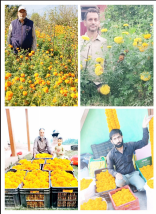
Dr. Parveen Kumar
With more than 90% of area under rainfed conditions and average land holding size below the UTs average along with a very low level of farm mechanization; productivity of different crops in district Ramban is low as compared to national average. The uncertainties of weather further add to the vagaries of the farmers. The low productivity results in low profitability and as such farming community is in despair. Agriculture here needs an immediate and urgent shift from conventional crops and practices to ones which have the potential to augment the income of farming communities and at the same time are sustainable and empower the producers.
From traditional cropping systems involving Maize and Wheat, farmers’ here in the district have now started moving towards diversification. They are diversifying their farms with crops which are more profitable. They are now including millets like Finger millet, Barnyard Millet, Little millet & Amaranthus and floriculture crops like marigold in their cropping patterns. KVK-Ramban as a district level extension institute to cater to the diverse farming needs of farming community including advisory and diagnostic services, trainings and skill development and technology dissemination has been actively working with the farming community including farm women and youth to promote technologies and practices which augment their income, are environmental friendly and result in their empowerment. Among such technologies and practice include vermicompost production, Natural Farming, Rain water harvesting, cultivation of Shree Anna/Millets, Marigold cultivation, Crop rotation, Mixed cropping systems like Maize with vegetables, pulses or flowers like Marigold, Wheat with Oilseeds and also promotion of horticultural crops. As a result of the efforts of KVK-Ramban, more and more farmers are adopting diversification of their farms. One promising diversification strategy is the floriculture which involves growing of different flowers for commercial purposes as an entrepreneurial activity and venture. Among different type of flowers, more and more farmers are now moving towards cultivation of marigold. Infact this beautiful valley is now witnessing a silent revolution in the form of Marigold cultivation. Farmers’ including farm women and youths including females are now cultivating Marigold in their fields in different villages of this district. One can see beautiful fields shining with Marigold flowers in Dhalwas, Champa, Gandhri, Kabbi, Kasal, Batli and many other villages. . .
Dr. Parveen Kumar, Scientist at Krishi Vigyan Kendra-Ramban told that as youths of the region explore employment opportunities in different sectors, cultivation of commercial crops like Marigold have the potential both for engaging youth in constructive activities as well as to create employment opportunities for themselves and others too. This also inculcates a spirit of entrepreneurship among them. To further their and this cause, KVK-Ramban organizes training programmes for youths on scientific cultivation of Marigold and provides them with high yielding Marigold seed. They are briefed about various operations and practices followed for getting a good crop including how to raise a healthy nursery, appropriate time of transplanting, Interculture and the role of pinching in getting a good crop. After receiving the necessary guidance, farmers raise nursery and then the seedlings are transplanted in lines with proper line to line and plant to plant distance along with the timely application of recommended doses of nutrients. Timely inter-culture operations like earthing up and pinching enable the growers a good harvest of crop. Seeds of African marigold (Pusa Narangi & Pusa Basanti) were also provided to them. The term Pusa Marigold variety refers to several marigold varieties developed by Indian Agricultural Research Institute with popular examples including Pusa Narangi (Red) and Pusa Basanti (Yellow). These are known for their large, double petaled flowers and are widely used for ornamental gardens, floral décor and other religious and social functions. The CSIR-IIIM has also been instrumental in promoting Marigold cultivation in this district.
Farmers cultivating Marigold are taking two harvests in a year. As far as marketing of Marigold is concerned, the farmers sell them in local market as well as are sent to adjoining districts of Udhampur and Jammu where they are required in large numbers owing to a large number of temples. Farm women cultivating marigold have also formed groups where certain members take care of the responsibility of sale of produce and thereafter distributing the proceeds of purchase according to the quantity of flowers harvested by each individual member. Mr. Rehmatullah Rounyal a farmer from Gandhri village who went for large scale cultivation of marigold only this year expressed satisfaction over the income generated from this enterprise. Presently he is growing it on 03 kanals of land. After every three or four days, he harvests 40-50 kilogram of flowers which he sends to Udhampur District for sale. He gets about rupees 40-50 per kilogram of flowers. Mr. Rounyal further told that during Diwali, Marigold was in high demand and this fetched him a greater price than the routine one. He has earned rupees 20,000-25,000 this season so far and is still going on. Like Mr. Rehmatullah there are many other farmers like Abdul Majeed Rounyal from Gandhri, Mir Din from Batli, Rohit from Dhalwas, and Mubina from Champa who are trying their fortunes in this enterprise. They are also doing value addition of Marigold by making garlands which are more remunerative than loose flowers sold in the market.
What is encouraging that more and more youths have come forward to do something new. They are fed up with the traditional crops like Maize and Wheat grown in this region which seldom give them good yield. They have found a new love in the form of Marigold.
The author writes on agricultural and social issues; can be reached at [email protected]