By Girdhari Lal Raina, Ex- MLC
Living in Harmony is Our Culture
The centenary of the Rashtriya Swayamsevak Sangh (RSS) is not merely an organisational milestone; it is a moment to reflect on a century of ideas, service, and contestations that have shaped India’s national journey. The lecture series, “100 Years’ Journey of RSS: New Horizons”, organised by RSS at Vigyan Bhawan, New Delhi (26–28 August 2025), captured this significance. The presence of diplomats, academics, scientists, doctors, sportspersons, entrepreneurs, and media professionals underscored that the RSS is no longer seen only as a cultural volunteer body, but as a participant in India’s larger conversation about identity, nationhood, and social transformation.
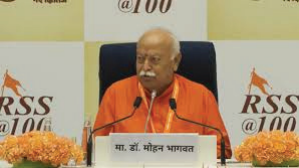
RSS Chief (Sarsanghchalak) Dr. Mohan Bhagwat, in the series of lectures and a remarkably candid two-and-a-half-hour interaction, traversed subjects as varied as Manusmriti, artificial intelligence, tariffs, caste, national language, education, Partition, immigration, retirement age for politicians, and communal harmony. The breadth itself was revealing — an organisation often painted in narrow ideological colours chose to engage with questions spanning the ancient, the modern, and the futuristic.
Several ideas stood out as philosophical anchors:
Facts over Perceptions: Dr. Mohan Bhagwat the RSS SarSangChalak urged critics and supporters alike to move beyond stereotypes and engage with what the Sangh actually does. “Discussions on the Sangh should be based on facts, not perceptions,” he noted — a plea for intellectual honesty in public debate.
Unity without Uniformity: He articulated that cultural rootedness need not mean sameness. India’s unity has always thrived on diversity, provided it is woven into a larger sense of belonging.
Change Begins at Home: Social transformation, he insisted, must start with the individual and the family. Reform without self-discipline is rhetoric without impact.
Trust Across Communities: On Islam’s place in India, Bhagwat was unequivocal: “From the day Islam came to India, it has been here and it will remain here. Those who think Islam will not remain are not guided by Hindu thought.” This distinction between invaders of history and Indian Muslims of today is a crucial reset in discourse.
This emphasis — inclusivity without appeasement, coexistence without dilution of identity — is the philosophical core of the RSS @100.
Kashmir in Context: A History of Engagement and Suspicion
For Jammu Kashmir, Kashmir in particular, this message of “new horizons” carries special resonance. The RSS has had a presence in the state since the late 1930s, well before Independence. During the worst years of terrorism, its workers and affiliates continued visiting the Valley, engaging with civil society, intellectuals, and political figures. These efforts rarely made headlines, but they are well known and signaled an intent to remain connected despite danger and hostility.
Yet, the relationship between Kashmir’s Muslim community and the RSS remains complicated. Three factors stand out:
- Perceptions Fuelled by Politics: For decades, vested interests equated the RSS with the Jana Sangh to sound them synonyms and labelled as anti-Muslim. Propaganda was very often repeated until it hardened into a firm belief. Many Kashmiris rejected the RSS not because they studied its work or had any personal experience, but just because they inherited suspicion as political common sense.
- The Article 370 Question: The RSS’s principled opposition to Article 370 and 35A deepened these divides. Yet, its reasoning was not religious but constitutional: these provisions institutionalised discrimination, hindered economic development, and trapped even Muslims of J&K in a cycle of separatism and dependency. But discussion on the merits of the issue was discouraged.
- The Post-2019 Reality: With the abrogation of these provisions, J&K stands fully integrated administratively and economically with the Union. The unfinished task is social integration — bridging divides of trust, perception, and lived experience. So the future engagement is mutually beneficial and in the interest of the region as well as its people.
This is where Dr. Bhagwat’s call for dialogue and openness acquires urgency. For Kashmir, the question is no longer whether Article 370 will return — it will not. The real question is whether its communities can transcend political manipulation and engage honestly with those who see J&K as an integral part of India’s civilisational journey.
A Philosophical Corrective
Bhagwat’s invocation of Mahatma Gandhi’s seven social sins — wealth without work, commerce without morality, politics without principle, religion without sacrifice, science without humanity, pleasure without conscience, and knowledge without character — offers a moral lens to view India including Kashmir. In times of materialistic Globalization & capitalism, politicised religiosity, and opportunistic politics, these words strike harder than ever.
Equally significant is the Sangh’s foundational idea, articulated by Dr. Hedgewar- its founder, a century ago, of an organised society that places the collective above the individual. This directly challenges Western modernity’s assumption of man as essentially selfish. In the RSS worldview, discipline, service, and sacrifice are not virtues for the few but obligations for all.
For Kashmir — where decades of terrorism, separatism, and externally funded networks have corroded trust and fuelled grievances — this framework of self-correction before social correction carries profound meaning. It calls on Kashmiris of all hues not to await miracles from Delhi or Srinagar, but to begin rebuilding trust, discipline, and coexistence within their own homes and mohallas.
Punching Through Myths
It is important to confront a few myths head-on:
RSS as “anti-Muslim”: Bhagwat’s explicit assertion that Islam is an inseparable part of India demolishes this caricature. The Sangh has always opposed separatism, not the faith. It makes a clear distinction between invaders and insiders who converted to a new way of worship.
RSS as “political tool”: While it has ideological affiliates, the RSS has consistently maintained that it is a cultural and social organisation. Its critics may disagree, but reducing it to an electoral machine is intellectually lazy. That is why Dr. Bhagwat invited the uninformed to come and study the organisation by experience not here say.
Unity vs Uniformity: The repeated emphasis on unity without uniformity challenges this misconception. Harmony in difference, not erasure of difference, is the vision. The message was clear that in spite of visible differences the Hindu view stresses unity and harmony.
Kashmir’s intelligentsia must, therefore, move beyond inherited slogans and confront the organisation on its ideas, not on caricatures.
Towards Informed Engagement
The road ahead is not smooth. Suspicion, especially when cultivated over generations, cannot be undone by one lecture series or one outreach. Yet, refusing engagement only deepens alienation. A more constructive path involves:
Open Dialogue: Interaction with the RSS need not mean acceptance. It simply means engaging with ideas openly rather than whispering suspicions in closed rooms. It also means to take interaction to the next level systematically and collectively.
Acknowledging Differences: Disagreement is natural, but it must be honest and expressed in a transparent manner. Demonisation based on biased opinions serves no one.
Shared Ground on Service: In spheres like education, health, environment, and disaster relief, the Sangh’s work can intersect with Kashmir’s needs. This is a basis for cooperation even amidst ideological differences.
Conclusion: The Next Horizon
The RSS at 100 is not seeking validation; it has already shaped India’s social and political currents irreversibly. What it does seek is honest dialogue, wider engagement, and the dismantling of myths that have clouded its image.
For Jammu & Kashmir, this is not about agreeing with the RSS on every issue. It is about recognising that the post-2019 era demands new frameworks of dialogue and coexistence. Political barriers are gone. Economic integration is advancing. What remains is the hardest task — social reconciliation.
Dr. Bhagwat’s appeal — that Hindu thought does not wish away Islam, but seeks trust across communities — is a call to transcend inherited fears. The challenge for Kashmir’s intellectuals, youth, and civil society is to respond not with slogans but with reasoned engagement.
The real test of the “new horizons” message lies here: whether a region scarred by conflict can now chart a path of confidence, trust, and constructive dialogue within the broader civilisational journey of Bharat.
(Girdhari Lal Raina is a former Member of the legislative council of erstwhile Jammu Kashmir and spokesperson of BJP JK-UT).