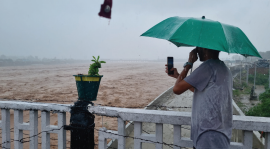
Rivers swell past danger mark; lightning kills one in Kokernag
MeT warns of heavy rains, cloudbursts and flash floods today
Jammu Tawi, Sep 2: In a week, the water bodies across Jammu have once again swelled, crossing the alarm mark at multiple places, prompting authorities to issue an advisory urging people to stay away from vulnerable spots. However, a teenage boy lost his life after being struck by lightning in Kokernag area of Anantnag district.
According to details, the Jammu region has witnessed extreme weather conditions since August 14, 2025, leading to the loss of over 100 lives, including 65 in the Kishtwar cloudburst incident and 35 in landslides along the Shri Mata Vaishno Devi (SMVD) route.
One more life was lost in a natural calamity in Anantnag district today. A 16-year-old boy lost his life after being struck by lightning in Kokernag.
Officials informed that Dilawar Ahmad Bhokad (16), son of Mohammad Sardar Bhokad, a resident of Soin Wangam, Kokernag, was hit by lightning at Nawkhan near Margan Top, resulting in his on-the-spot death.
Meanwhile, as moderate to heavy rainfall was witnessed in the Jammu region from late Monday evening, water bodies in Udhampur, Kathua, Samba, and other places saw an unprecedented rise, leading to flood threats in the Jammu region again. The water level in Kashmir’s water bodies was flowing well below the flood alert mark at the time the report was last filed.
The details indicate that the water level crossed the flood alert mark today, with the State Disaster Response Force (SDRF) issuing an urgent advisory, advising residents to stay away from the banks of the River Tawi and other swollen rivers in the Jammu region.
Heavy rainfall over the past 24 hours has triggered a critical flood situation across Jammu, with the River Tawi, Ujh, Basanter, Chenab, and Ravi rivers breaching alert and danger levels, prompting heightened vigilance from authorities.
Udhampur recorded the highest precipitation till this morning, with the figures revealing a total of 60.4 mm of rainfall at the station. Rajouri recorded a rainfall of 56.4 mm till this morning.
Batote station witnessed a rainfall of 55.1 mm since morning till evening, while 17.6 mm rainfall was recorded at the station till this morning.
Bhaderwah saw a rainfall of 42.6 mm since morning, while Katra recorded 32.7 mm till 5:30 PM. The data reveals that Jammu recorded a precipitation of 11.4 mm since morning and 17.8 mm till this morning.
In Srinagar, the summer capital of the region, the highest rainfall of 15.4 mm was recorded since this morning, followed by 13.2 mm in Kokernag.
During the fresh wet spell, Jammu city’s River Tawi experienced a rapid rise in water levels, approaching the danger mark.
The SDRF reported that the Tawi has crossed the flood alert level, raising concerns about potential inundation in low-lying areas.
The District Magistrate of Jammu has reiterated warnings for residents to avoid the riverbanks, saying there is an imminent risk of flooding. A recent post on X by the District Magistrate said, “Citizens of Jammu are requested to stay away from Tawi River banks. The water levels may reach the danger mark within a short period of time.”
The Tawi’s rising levels follow a similar trend observed in Udhampur, where the river had previously crossed the evacuation level of 24.975 ft on August 26, 2025, surpassing both danger and evacuation thresholds. Authorities warn that continued rainfall could push the Tawi in Jammu city past the danger mark in the coming hours, potentially leading to evacuations in vulnerable areas.
Kathua’s Ujh River at Panjtirthi has also crossed the flood alert level, with a recorded discharge of 59,750 cusecs, surpassing the alert threshold of 48,000 cusecs. While it remains below the danger level of 88,000 cusecs, officials are closely monitoring the situation due to the steady upward trend.
Similarly, the Ravi River in Kathua has breached its flood alert level, with the water level recorded at 524.97 meters above mean sea level (MSL), exceeding the alert level of 523 meters.
The danger level for the Ravi stands at 527.91 meters, and authorities have warned that further increases could lead to severe flooding in villages such as Bagthali, Massos Pur, Keerian Gandial, Barni, Dhanna, Dhanore, Karyali, and adjoining areas.
The SDRF, alongside local disaster management teams, have been placed on high alert across Jammu, Kathua, and Samba districts.
Meanwhile, the weatherman here has predicted heavy rainfall until tomorrow, saying that generally cloudy weather is expected with one or two spells of light to moderate rain and thunder at many places during the daytime, with the possibility of heavy to very heavy rain over Kathua, Jammu, Udhampur, and Reasi, along with moderate to heavy rainfall over Doda, Samba, Rajouri, Poonch, Ramban, Kishtwar, Anantnag, and Kulgam, mainly towards late tonight and early tomorrow, continuing till late afternoon.
Director Meteorological Department (MeT), Dr Mukhtar Ahmad, said that from September 4 to 7, a brief spell of rain and thunder is expected at a few places. From September 8 to 11, a spell of moderate rain is expected over a few districts of Jammu division during the night of September 8 and the 9th, with improvement thereafter until the 11th evening.
The fresh weather forecast has raised fears of flash floods and further inundation. Residents in flood-prone and low-lying areas are urged to remain indoors, avoid riverbanks, and keep emergency supplies ready.
In its advisory, the MeT has stated that there is a possibility of heavy to very heavy rain in a few districts, as well as the possibility of cloudbursts, flash floods, landslides, mudslides, and shooting stones at many vulnerable places.
It said that a rise in water levels in rivers is expected and urged people to stay away from water bodies, nallas, river embankments, and loose structures. Besides, the public has been advised to stay alert and updated.
Moreover, the Indian Army and other disaster response teams are actively engaged in rescue and evacuation operations, particularly in areas affected by overflowing rivers.
It is worth mentioning here that the government has closed all educational institutions and non-essential offices in Jammu to ensure public safety.
Railway services have also been disrupted, with 18 trains cancelled due to soil erosion and flash floods near the Chakki River, and traffic between Jammu Tawi and Katra has been suspended.
CS for urgent actions on flood relief
Jammu Tawi, Sep 2: In the aftermath of the visit of the Union Home Minister, Amit Shah to Jammu yesterday to personally assess the extent of damage caused by the recent flash floods, Chief Secretary, Atal Dulloo Tuesday chaired a high-level meeting with Administrative Secretaries and Divisional Administration to review the swift and time-bound implementation of the directives issued by the visiting Minister.
At the outset, the Chief Secretary underscored the urgent need for seamless inter-departmental coordination to bring immediate relief to the affected people and ensure early restoration of essential services, including power supply and potable water, in the shortest possible time frame.
Placing particular emphasis on connectivity, he directed that all efforts be undertaken on a war-footing to restore damaged road links at the earliest, as road connectivity forms the backbone for other relief, rehabilitation, and restoration measures.
He instructed the respective Divisional and District administrations to prepare a comprehensive action plan for the restoration of damaged infrastructure across the flood-affected areas, ensuring strict adherence to timelines.
Highlighting the importance of public health, the Chief Secretary directed that all water sources be tested for contamination prior to supply, so as to prevent any outbreak of water-borne diseases.
He further instructed the Health Department to organize health camps in all affected villages, with medical teams conducting vital health checks and ensuring the availability of essential medicines to the local population.
In addition, he called for a detailed safety audit of all public infrastructure in the flood-hit regions, particularly educational and health institutions, bridges, and government offices, to ensure structural stability and safeguarding of human lives.
Stressing that these measures hold the highest priority, the Chief Secretary made it clear that the directives emanate directly from the Union Home Minister and must, therefore, be implemented with the utmost urgency and seriousness.
The Chief Secretary further reiterated the government’s commitment to not only providing immediate relief and rehabilitation to affected families but working towards long-term resilience through better infrastructure planning, disaster preparedness, and preventive measures to mitigate the impact of such calamities in the future.