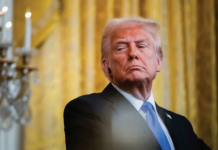
Republican Congressmen are talking of sue of denaturalisation provision
By Ashok Nilakantan Ayer
NEW YORK: Democratic Nominee for New York Mayor Zohran Mamdani is under fire from nervous Republican Party leaders as also Democratic establishment. Republicans want to weaponize the citizenship denaturalisation process to knock him out of the race slated for November this year.
Incumbent Eric Roberts, disgraced for corruption charges against him, has turned a Trump ally and Andrew Cumo, former mayor, despite his financial muscle and powerful backing from ex president Bill Clinton, have been eliminated from the party’s nomination. While Roberts is contesting as an independent, forces within Cuomo camp want him also to contest as an independent. But the GOP, while encouraging this move, does not want Zohran Mamdani, a muslim, to be in the race at all.
Just weeks after Ugandan-born Zohran Mamdani secured the Democratic nomination for New York City mayor, a wave of coordinated Republican outrage escalated from standard political mudslinging to something more sinister and darker: calls to strip him of U.S. citizenship.
The charge, led by Rep. Andy Ogles (R-Tenn.), rests on the thin premise of Mamdani’s past rap lyrics allegedly expressing support for Hamas—lyrics written years before his 2018 naturalization. Ogles didn’t stop at condemnation. He demanded action, urging Attorney General Pam Bondi to launch denaturalization proceedings, invoking national security concerns.
In today’s political climate, that isn’t just red meat—it’s a test case for Trump’s new and aggressive denaturalization strategy. And it’s got civil liberties advocates alarmed.
Historically, denaturalization—revoking someone’s U.S. citizenship—has been reserved for extreme cases: ex-Nazis, spies, war criminals, and terrorists. The legal bar is intentionally high, requiring the government to prove, in civil cases, that misrepresentations made during the naturalization process were deliberate and material. But what used to be a blunt, last-resort instrument is now being sharpened into a political scalpel.
The Trump administration’s latest directive, unveiled in a June memo from Assistant Attorney General Brett Shumate, puts denaturalization at the center of its immigration enforcement agenda. It lists a broad array of justifications, including fraud, terrorism ties, war crimes, Medicare scams—and more vaguely, any case “sufficiently important” to warrant prosecution. That catch-all clause is what’s causing panic.
“There’s a real risk this becomes a tool to harass political opponents,” warns Noor Zafar, a civil rights attorney at the ACLU. “Even if the government doesn’t win a case, the process itself becomes the punishment.”
Mamdani’s journey to the political spotlight is hardly unusual in America’s immigrant narrative. Son of acclaimed filmmaker Mira Nair, he moved to the U.S. as a child and became a citizen in 2018. His rise in Democratic politics, particularly as a leftist with pro-Palestinian leanings, has placed him in the crosshairs of conservative backlash. That backlash erupted when Rep. Ogles took to X (formerly Twitter), accusing Mamdani of having supported terrorists, citing his lyrical reference to the “Holy Land Five”—a group convicted in 2008 of funnelling funds to Hamas via a Muslim charity. Human rights groups and civil liberties lawyers have long criticized the case as a post-9/11 overreach tinged with Islamophobia. Nonetheless, Ogles weaponized it, demanding denaturalization.
“This is about protecting the homeland,” he declared on Newsmax, pushing unsubstantiated claims that Mamdani lied on his naturalization application by failing to disclose his political views. But legal experts say that’s a stretch.
Jeremy McKinney, past president of the American Immigration Lawyers Association, points out that the law doesn’t allow for denaturalization simply based on someone’s political affiliations—especially post-citizenship. “They need clear, unequivocal, and convincing evidence that citizenship would not have been granted had the truth been known,” he said. “Rap lyrics? That’s nowhere near that bar.”
Denaturalization isn’t new—but its politicization is. The tool was used in the 1940s and ’50s to hunt former Nazis who had entered the U.S. under false pretenses. After 9/11, the focus shifted toward rooting out terrorists. The Obama administration quietly launched Operation Janus, a massive audit of fingerprint data to identify naturalization fraud. Over 300,000 records were flagged.
Still, actual denaturalizations remained rare. Under Trump’s first term, only 102 cases were filed, the first of which targeted an Indian man, Baljinder Singh, who had used a fake identity to naturalize. By comparison, the Biden administration filed just 24 cases.
But Trump’s second term is different. Already five new cases are on the books—and officials say more are coming. One successful case involved a UK-born man convicted of child pornography. The others remain shrouded in secrecy.
The numbers are minuscule compared to the roughly 800,000 naturalizations processed each year. But that’s not the point. The message is.“The fear is disproportionate to the volume of cases,” says Elizabeth Taufa of the Immigrant Legal Resource Center. “It’s not about enforcement. It’s about intimidation.”
The Mamdani case isn’t happening in a vacuum. Trump’s immigration apparatus has already made headlines for detaining pro-Palestinian activists—including Mahmoud Khalil, a Palestinian campus protestor held over 100 days by ICE without formal charges. Turkish student Rümeysa Öztürk was jailed for two months after speaking out in support of Gaza.
In both cases, free speech blurred into cause for detention. Now, with the Mamdani saga, that logic seems to be scaling up. The idea of denaturalization as political retribution, once the domain of dystopian fiction, is now being seriously discussed on right-wing platforms. Even Elon Musk chimed in, musing about the possibility of deporting another naturalized American—again, without evidence of wrongdoing.
Advocacy groups are livid. The National Immigration Forum called the administration’s actions “a direct assault on American pluralism.” The ACLU warns of a return to McCarthy-era politics—except this time, the government isn’t just blacklisting dissenters; it’s threatening to erase their citizenship altogether.
Legally, revoking someone’s citizenship requires navigating a minefield of due process protections. Misrepresentations must be willful and material. Simply forgetting to list a speeding ticket or expressing controversial political views doesn’t cut it. But the Mamdani case presents a chilling possibility: that the Trump administration could stretch these legal standards for spectacle, not success.“They don’t need to win in court,” says McKinney. “Dragging someone through litigation is punishment enough. It deters others from speaking out.”
Moreover, denaturalization does not automatically trigger deportation. Mamdani, if stripped of citizenship, would likely revert to permanent resident status. But even that technicality doesn’t dilute the damage—public vilification, legal uncertainty, and political delegitimization.
Mamdani has refused to be silenced. In a recent interview on Meet the Press, he condemned the attacks against him as “a glimpse into what life is like for many Muslim New Yorkers”—a reality where belonging is always contingent, conditional, and vulnerable to the mood of the administration. His case has become a rallying cry for immigrant rights advocates and progressives who see a dangerous precedent unfolding: a federal government using arcane legal tools to crush dissent, reframe political speech as fraud, and transform citizenship from a right into a privilege.
The Trump administration, emboldened by a judiciary increasingly aligned with its ideological bent, is moving fast. Civil rights groups are scrambling to mount defenses, but the scope of the administration’s ambitions is still unclear. What is clear is this: Denaturalization, once a footnote in immigration law, is now a centerpiece of America’s authoritarian drift. And Zohran Mamdani—rapper, socialist, mayoral hopeful—is just the beginning. (IPA Service)